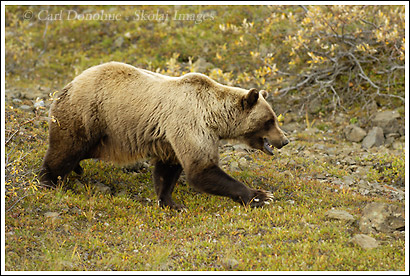
Grizzly Bears of the Denali Tundra
Few animals reign over a landscape like the grizzly bear does the Alaskan tundra. They are awesome in every sense of the word. Even for those of us who have spent decades in the backcountry, seeing a grizzly remains the definitive Alaskan experience.
While Katmai National Park offers high-density viewing, Denali National Park provides a different thrill: seeing bears roaming the vast, open interior. However, for the serious photographer, Denali can be a lesson in frustration.
The Photographer’s Dilemma in Denali
Denali is a unique challenge. Particularly for photographing grizzly bears. You are close to incredible opportunities, but the logistics often get in the way. Most sightings happen from the park shuttle buses, which aren’t built for photographers. You are often shooting through glass or from angles you can’t control.
This leads many professionals to skip Denali, yet the draw remains. There are very few places on earth where you can find grizzly bears moving across such a massive, unobstructed stage.
Ethics and Regulations in the Backcountry
When I am hiking or backpacking in the Wrangells or Denali, I rarely set out to photograph grizzlies. The risk-to-reward ratio is rarely in the photographer’s favor.
Denali regulations require a 300-yard distance from bears. Photographing them in Katmai is much easier, and often results in better images, because we can be so much closer. Even with a long telephoto lens, that is too far for a professional-grade shot. Most decent photos require being within 60 or 70 yards. That’s a distance that is both illegal and unsafe when you are on the ground. When a bear comes over the horizon, the goal is safety and respect, not the shutter button.
The “Quirky Wise Old Bear”: A Backcountry Encounter
A few years ago, while coming down off a high ridge in the Denali backcountry, a friend spotted a massive grizzly. Easily the largest I’ve seen outside of Katmai. The wind was howling, and the bear hadn’t yet caught our scent.
I stood up, signaled our presence, and watched the bear’s reaction. He didn’t flee. He gave us a look that felt almost comical, as if he knew exactly how ridiculous we looked huddling in the wind.
He quartered up the hill and passed us at about 50 yards. We moved on, only to realize we were both headed toward the same valley. My friends thought we were being stalked; in reality, we were just sharing the same route. We spent the next hour climbing and changing direction to give him the space he deserved.
The expressions that bear gave us were beautiful—a wise, old animal knowingly in charge. I didn’t take a single picture of him. Some moments are better lived than captured.