Category Archives: Wildlife

Wildlife Photos. Notes and thoughts related to wildlife photography.

Wolverine, Wrangell-St. Elias National Park, Alaska.

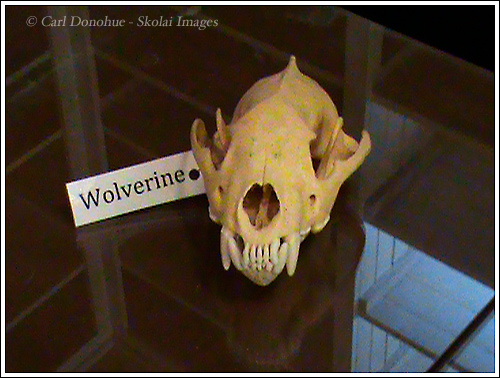
Wolverine Skull, NPS Visitors Center, Wrangell-St. Elias National Park, Alaska.

Hey Folks,

I think Ron Niebrugge owes me dinner – don’t you? I’ve been stalking this here Wolverine for a couple of years now, and every time I’ve spotted him, I had left my camera behind  this time I was ready, and after years of hard work, I finally photographed a wolverine.

National Park Visitor’s Center, Kennecott, Wrangell-St. Elias National Park, Alaska.

Cheers

Carl

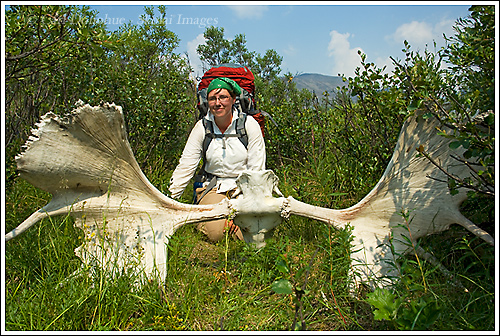
Moose Rack, Wrangell-St. Elias National Park, Alaska

A hiker, Natalie, sits with a moose rack and skull, Wrangell-St. Elias National Park, Alaska.

Hey Folks,

I ran across what is easily the biggest moose rack I’ve ever come across in the woods a few days ago. I was on the last leg of a hike in Wrangell-St. Elias National Park, from the Sanford River drainage over the Sanford Plateau, and down to the Dadina River. Natalie (pictured) and I were sauntering through the forest, along the Dadina River when I spotted this rack, not far from the game trail we were walking along. This was one BIG bull moose – I don’t know what happened to the grand old fella, but he’s bones now. He must’ve been a pretty awesome creature back in the day. There are a number of wolves in the area, and grizzly bears as well, and I’m sure he fed them well, along with the myriad other carnivores in the region – wolverine, fox, marten, gulls, ravens, eagles, etc. What a treat it must’ve been for them when he passed, and what a treat it would’ve been to see him walking through the forest beforehand. RIP, great bull.

Some of you might remember I did this hike last summer, and we found this awesome natural ice arch on the Sanford Glacier. Sad to say, the arch has had its day. We hiked up the moraine and crested the ridge right before the arch, only to see a huge gaping gap between the 2 side walls – no bridge at all. Ironically, a couple who were up there the week prior to our trip said the arch was still there, so we only missed it by a few days. It seems the arch collapsed under glacial movement, not melting, as the left side of the gap is noticeably higher than it used to be – in fact, the wall ascends away from the gap, where it used to descend. So I’m pretty sure pressure from the glacier caused the collapse of the arch, not melting – though melting may have been a contributing factor, as the summer has been hot, hot hot so far. Except, of course, for the day we hiked up to the now gone arch – it rained like a sonuvagun that day – so no pics of the fallen arch. I should’ve taken a picture, instead, of me, drenched to the bone, in my failed (and now history) Marmot Precip raingear. The jacket and pants had done their time and now are beyond redemption. Fortunately, it didn’t rain again for the rest of the trip until the final night, when I was tucked away in my very dry tent. I should’ve known better than to carry my old gear, but I thought it might still work reasonably well. Alas, it didn’t and I got a soaking. Toughened me up though.

Heading out tomorrow for a week at Skolai Pass. Woo hoo. I’ll try to schedule another post while I’m away, from this last trip, but it’s hard – summer’s the time for hiking, not blogging.

Cheers

Carl
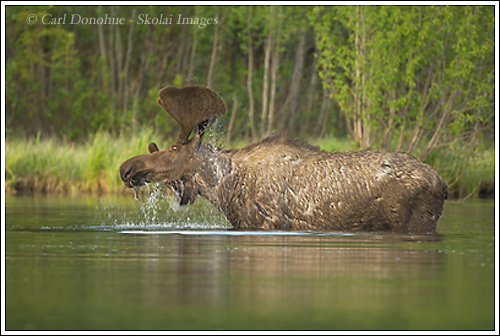
Bull Moose, Long Lake

Bull Moose (Alces alces) shaking water from antlers, in a lake, springtime, Wrangell-St. Elias National Park, Alaska.

Hey Folks,

Here’s a quick one while I’m hiking. I saw this bull moose a few times this spring, feeding on the aquatic plants that grow on the lake bed this time of year. Quite a rack for early June. He’ll be quite a sought after moose come this fall when the subsistence hunters look around Wrangell-St. Elias National Park for their winter meat. As much as I like for my friends to eat well, I hope nobody gets this guy.

Cheers

Carl

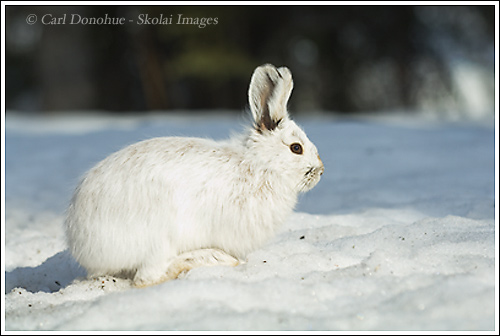
More Snowshoe hares

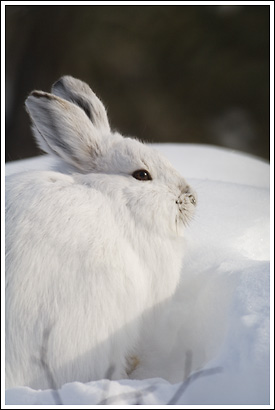
snowshoe hare (Lepus Americanus) on snow, winter, Wrangell-St. Elias National Park, Alaska.

Hey Folks,

Here’s a look at a Snowshoe hare (lepus americanus) just as it starts to pelage and change to its summer coat, and below, a look at another hare further along in the process. I like to try to photograph animals in the various stages of their phenology, and also to try some different kinds of compositions – the one below showing a little more of the forest this snowshoe hare lives in, and what they might do this time of year; sit in the morning sun and catch some rays after a long, cold winter. Continue reading

The Wolf Song

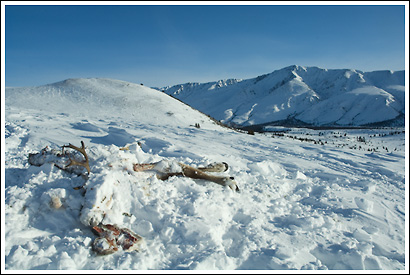
Wolf killed caribou carcass, winter, Wrangell St. Elias National Park, Alaska.

Hey Folks,

I was really, really hoping to get some wolf photos on this last trip. Just one would’ve been fine. Wolves aren’t as common in the southern reaches of the park, though they’re certainly around, so I was hoping to get lucky enough to maybe see, perchance to photograph, one on the north side of the park. The habitat on the south side isn’t (generally) as wolf friendly – more heavily forested, and lots of alpine mountain country, snow and ice.

Dall sheep and moose are the main prey for wolves in that part of the park, and though there are a lot of sheep, the numbers are smaller than the herds of caribou that wander through the north part of the park in the fall and late winter/early spring. Continue reading

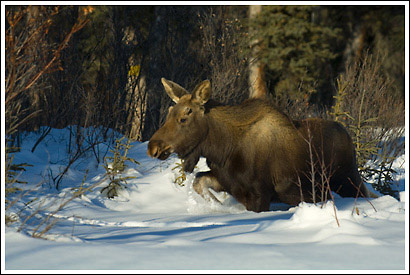
Young Bull Moose, Wrangell-St. Elias

A young bull moose wades through deep powdery snow, winter, boreal forest, Wrangell-St. Elias National Park, Alaska.

Hey Folks,

Here’s a young bull moose, a yearling, trundling through the snow. Moose have disproportionately longer legs than other members of the deer family, and it really helps them get through deep snow.

This is a helpful advantage as they seek out food in the winter, and also in evading their main predator, the wolf pack.

But the real secret they employ is a kind of double-jointed hip or knee that allows them to lift their legs higher than most ungulates, and high-step their way to safety.  When I first saw this fellow, he stepped into a deeper drift that was right up to his belly, yet he managed to clamber his way through, regather, and then set about finding himself some browse for dinner.

The word ‘moose’ comes from a North American Indian Tribe, the Abenaki, and it translates roughly as ‘he trims or cuts off’, a reference to how the Moose browses twigs and bark from trees.

Cheers

Carl

Snowshoe hare and lynx population cycles

Snowshoe hare, winter molt, white fur, Wrangell-St. Elias National Park, Alaska.

Hey Folks,

Here’s a REAL snowshoe hare photo, taken on my recent sojourn to the northern side of Wrangell-St. Elias National Park. I was very surprised at how little sign of snowshoe hares there was in this area – negligible. Everywhere else, it seems, the woods are crawling with them. This is at, or close to, the peak of the cycle for snowshoe hares; a 10 year population fluctuation that seems to be pretty consistent.

Sometimes the cycle might be 9 years, or 11, but it’s not usually far off. The population rises steadily, then faster, peaks, and falls drastically,  almost completely, in a single year. Ecologists aren’t sure as to what causes the drop in numbers, Continue reading

Caribou feeding in winter snow

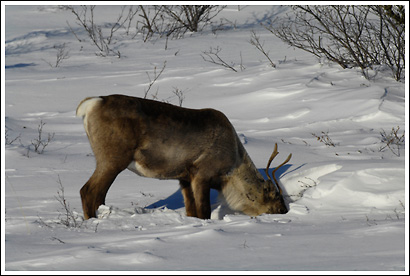
A caribou cow digging under snow for food, feeding on lichens and grasses, in winter, Wrangell-St. Elias National Park, Alaska.

Winter caribou feeding in Wrangell-St. Elias National Park

Hey Folks,

Normally I wouldn’t post a photo of an animal with its head buried under the snow. But, for caribou, this is winter life. Caribou feed on lichens and grasses, and those lie buried, often deep beneath snow’s crust for the long winter months.

Caribou have a few options to eke out their winter, and a heavy snow pack in the winter can be a tough gig for them; finding food is a mission and avoiding predators, namely, the wolf, an equally difficult, if not critical, task. So they’ll typically seek high ground,

Continue reading

Black-capped Chickadee Photo

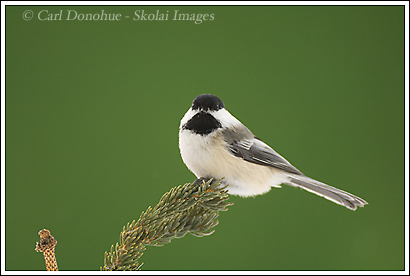
Black-capped Chickadee, Wrangell-St. Elias National Park, Alaska.

Hey folks,

Here’s a Black-capped Chickadee (Poecile atricapillus), year-round Alaska resident, perched on a small spruce tree. There’s not a lot of birds in the great north woods this time of year, so it’s always a treat when they stop by. I’ll try to get a photo of his close cousin, the Boreal Chickadee – so far, no luck.

Cheers

Carl

Pine Grosbeak photo, Wrangell-St. Elias National Park, Alaska

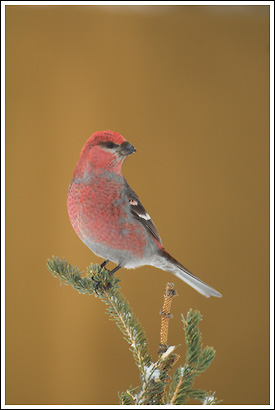
Pine Grosbeak, male, Wrangell-St. Elias National Park, Alaska.

Pine Grosbeak Photo.

Hey Folks,

Sorry for the delay in posts, again. I came in to Anchorage for a few days, and have been sitting, faithfully, at my computer trying to make it start. It locked up during an update, apparently, and then I couldn’t get it to start. I managed to back up most of the data on it, though it took forever. I thought the HD was fried, but it appears no problems there. I’m still working on getting all the programs back up, etc, and it’s taking way too long. I’m about sick of this computer business – I’m ready to head back to the safety of the woods. I’ll take 40-50 below zero temperatures over technology problems anyday. This stuff is too much hassle.

I did manage to take a few bird photos in the park before I came back out. They’re tricky little critters to shoot, but lots of fun. This male Pine Grosbeak was pretty cool, and I managed to get a few images. They’re named a ‘pine’ Grosbeak because they do so love the pine or coniferous forests (I spose Coniferous Grosbeak doesn’t sound so cool a name). Technically, they’re not a true Grosbeak, but a large Finch. The scientific name for the bird is Pinicola enucleator, which is pretty fancy. ‘Pinicola’ translates as ‘pine dweller’. They’re one of the few birds who winter this far north .. all the smarter ones fly south to warmer climes.

Cheers

Carl