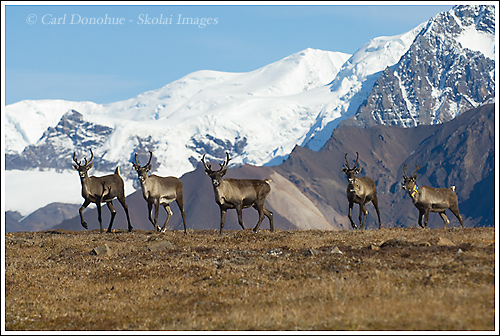
Caribou, Skolai Pass and the University Range, Wrangell-St. Elias National Park

Woodland Caribou herd, Skolai Pass, the University Range in the background, Wrangell-St. Elias National Park, Alaska.

Hey Folks,

Here’s another image from my recent trip to Skolai Pass. This, along with the previous image posted of Mt. Bona and Mt Churchill, was taken on the first day of our arrival in the pass. Pretty nice day, eh?

These caribou are part of the Chisana Herd (pronounced ‘Chushana’) and are, according to legend, the only Woodland Caribou herd in Alaska, and maybe ought be listed on the Endangered Species Act, possibly the strongest environmental legislation in the US.

Woodland Caribou are found mostly in Canada (possibly a very small population in Idaho and Washington – often referred to as a separate subspecies, Mountain Caribou), with the great herds of Alaskan caribou, such as the Porcupine Herd, or Central Arctic Herd of the north slope, like the caribou more seen in Denali National Park, being Barren Ground Caribou.

Continue reading

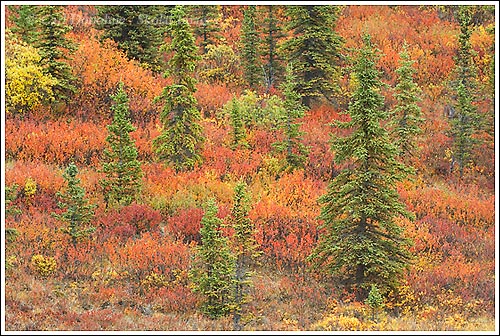
Fall Colors in the Taiga

Fall colors glow in the boreal forest, Wrangell-St. Elias National Park, Alaska.

Hey Folks,

While I’m out trudging around in the cold and wet mountains, you get to sit home and read about it, and still see the pictures!

This photo was from my recent trip to the north side of Wrangell-St. Elias National Park, off the Nabesna Road. The weather wasn’t super co-operative for grander landscape images, which was a bummer, as there are certainly some grand landscapes to be had in the area. But the weather was good for more intimate scenes, like this one.

The boreal forest is a real treasure, and hiking through it is always a treat. It’s amazing what one can find sometimes – I’v e found everything from moose racks  and caribou racks  to trekking poles, tent stakes and other trash. But this last trip was a first for me. I found a fully-loaded, good condition large caliber centerfire rifle, with a scope, sitting by a tussock in the forest. I packed it out, and handed it in to the Park Service office, and still haven’t found out exactly what happened as to how the rifle came to be there. Pretty crazy stuff.

Other than my trip was,  as always, too brief. Marred by dismal skies, I was really hoping to get some big shots of Mt Sanford, but the mountain was only rarely visible. The final morning of my trip it was out, but distant clouds to the east blocked the sun’s rays from adorning the peak – total bummer. There is a view of the mountain that I think lends itself to as fine a landscape image of grand mountains as any, but I need to put in more time, apparently, to make it happen.

As for the image above,  I spend so much of the summer hiking and trekking in the alpine areas of the park that I don’t get to spend the hours in the forest that I would like. The forest is a special place, and I always enjoy my time there. In the fall, it comes alive with color, and this year was grand, for sure. The color seemed to peak around the end of August, and only a few days later had  noticeably dropped off. I was lucky to catch it before that happened.

I’ll be back (hopefully) from my next trip with some more landscapes, and then we’ll see what the last 2 weeks of September bring for my trips. At the moment, I’m toying with a few ideas, but haven’t set anything in stone so far. We shall see.

Oh, a side note; this kind of more open boreal forest is often referred to as ‘taiga’, which is a so-called Russian word for ‘little sticks’,  expressing the smallish stature of the spruce trees. However, my Russian friend Sergei tells me that in Russia, the word taiga simply means ‘forest’. We’ll have to explore this controversy further and see wherein the truth lies. In the meantime, here’s a quiz; how many various vegetation species can you see here, and what are they (Mark Vail you go last)?

Cheers

Carl

Small Mammals in Wrangell-St. Elias National Park

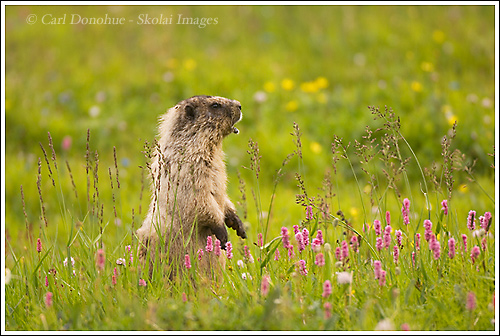
Hoary Marmot Photo

Hoary Marmot, Wrangell-St. Elias National Park, Alaska.

Last week I spent the week up at Skolai Pass, Wrangell-St. Elias National Park, Alaska. After years of hoping to photograph a marmot in the park, and having seen many of them but never actually managing to photograph one, I found this guy, right by where we camped. I made a number of nice images of him, but this one I like the most. The pink flowers in the foreground are called Pink Plumes.

I’ll be out in the backcountry again this week, hiking from Iceberg Lake to Bremner Mines. I’ll post again when I return.

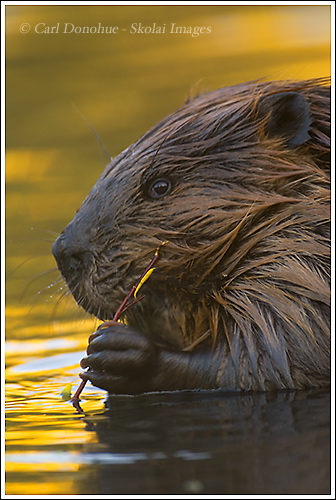
Beaver, Wrangell-St. Elias National Park, Alaska

An adult beaver browsing on willow leaves in a pond, Wrangell-St. Elias National Park, Alaska.

So this last week I spent on the north side of the park, exploring clouds and rain and drizzle. The glory of fall in Alaska. I found this small beaver  pond, replete with beaver, so I spent a few hours photographing them in their little demesne. The pond was host to a couple of adults, male and female, and their offspring, 3 young kits. It was fascinating to watch them go about their business (mainly eating) for hours on end.

The ole saying ‘busy as a beaver’ could equally hold as ‘hungry as a beaver’; all these critters do is eat, it seems. I watched this male swim to the pond’s shore, clamber out of the water, saunter down the trail, then reappear maybe 10 minutes later with a large willow sapling clenched between his teeth, dragging the branch behind him, as he re-entered the pond, and swam back towards his lodge.

I was super fortunate that he stopped to eat right in front of me, and during the course of his dinner, all of the other beavers came by, at some point, to scrounge a branch or 2 off his sapling. Apparently willow leaves are good eating for a beaver. The ruckus that followed was almost comical, the various assortment of noises being surprisingly diverse.

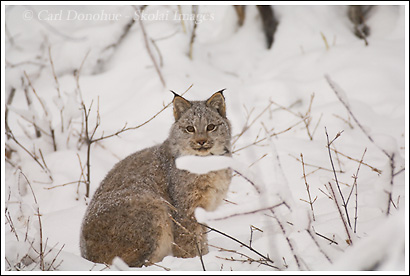
Wild Lynx, Wrangell-St. Elias National Park, Alaska

Wild lynx, Wrangell St. Elias National Park, Alaska.

I promised my buddy Ron I’d post this. Hey Ron! ?

This is a wild lynx, from Wrangell St. Elias, photographed this last winter. I was pretty lucky to get this. I couldn’t believe my luck when I spotted this gorgeous cat, and hoped and prayed I’d get a photo.

The lynx obliged me. I wish, of course, the image wasn’t quite so cluttered, particularly his little white beard created by the snow-covered branch in the foreground, but it’s the first photo I ever got of a lynx, so I’m happy enough, I reckon. He let me fire a few a frames, and then bounded off into the brush.


Snowshoe Hare, in winter, Wrangell St. Elias, Alaska

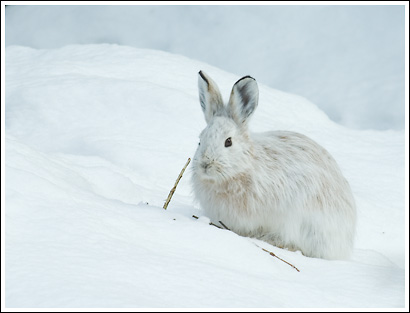
snowshoe hare in white winter coat, on snow eating a willow stem, wrangell st. Elias National Park, Alaska.

Here’s an interesting photo. As winter comes to an end, the snowshoe hares are hungrier than ever, which means I get to see them a little more. It also makes them more vulnerable to their primary predator, the lynx.

This one is just starting to change his coat back to the brown summer coat. You can see the black tips on the ears, which don’t go white, even in the mid of winter. As winter goes along, the hares get hungrier and hungrier – there is not a lot of fodder for them once the snow covers everything. You can see the willow branch this one was nibbling on when I found him.

The hares eat the bark right off the saplings .. some of the saplings around the area have been completely stripped, while others haven’t been touched. I have no idea what makes one willow sapling more delectable than another, but the snowshoe hares seem to know.

I’ll keep poking around and see if I can find some more hares to photograph in the next few days. There’s a lot of them around, but they’re pretty skittish, and don’t hang around too much when I stumble along.

Snowshoe hare tracks in Wrangell St. Elias National Park

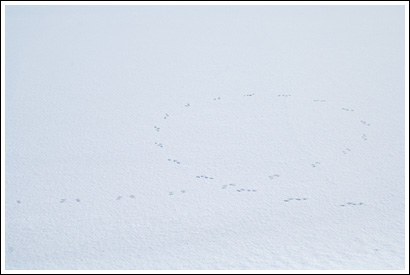
snowshoe hare tracks Wrangell St. Elias National Park, Alaska.

This image is from my recent trip.

I was walking along the edge of the lake here, on the ice, and following this set of snowshoe hare tracks. Out of nowhere they venture out on to the ice and do this really cool little loop, then back on course.

I thought it was awesome.

I know the photo’s hardly wall-hanger, but the scene caught my eye – it just seemed to interesting to wonder why the little rabbit walked a perfect circle like this .. maybe he was just exuberant about it being winter, and such a lovely day. Maybe he had just had his van fixed and was in a good mood. Maybe he just felt like walking in a circle.

Whatever the reason, I thought it was pretty cool, so I took this photo.


Least Weasel photo

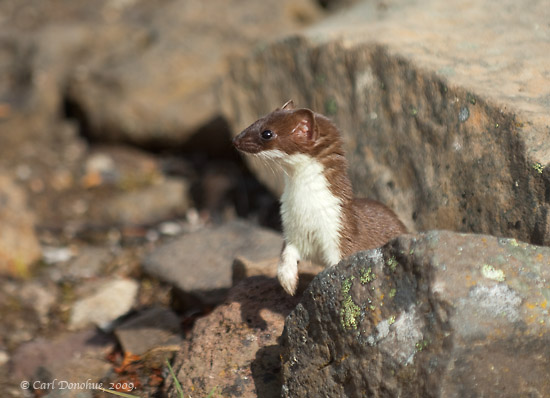
Least Weasel photo, on a rock, Skolai pass, Wrangell-St. Elias National Park, Alaska.

This photo is of a weasel (or ermine), from Skolai Pass in Wrangell-St. Elias National Park. Member of the mustelid family, the Least Weasel is the coolest little critter . imagine a small, sleek ferret on crack.

I’ve never tried to photograph an animal where I go so many images of his behind, as he raced off, or even with the animal completely gone .. this guy was SO fast, I barely managed to catch him at all .. the few moments he’d stop, look around, pose, and be gone, in a dash for cover. This photo is about 60% of the full frame version.

This photo was maybe a few hundred yards into our walk, so it was exciting. To be shooting a cool little guy like this within minutes of starting our trip was simply awesome. On the first day of our trip I managed to take my only images of a weasel from the park, my now favorite caribou image I’ve taken in the park, and my favorite image of Mt. Bona. And earlier in the morning we’d had some alpenglow on Mt Blackburn, as well. What a day.

So that’s it for the weasel. He’s running around Skolai Pass chasing voles, shrews and ptarmigan, and maybe the odd ground squirrel. I hope has a great winter, and is around to see again next year. What a treat it was for our group.

Cheers

Carl
Grizzly Bear, Wrangell-St. Elias National Park, Alaska

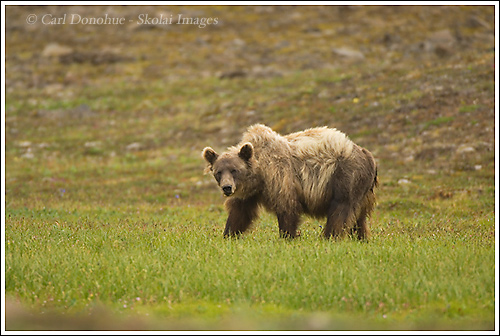
A grizzly bear (Ursus arctos) on the tundra in Chitistone Pass, Wrangell-St. Elias National Park, Alaska.

Hey Folks

I apologize for the long delays in posting here – it’s been busy this summer, with backpacking trips, and I really haven’t taken the photos I was hoping to, either. Either smoke from numerous wildfires, bad timing, or bad weather have made the summer not a great one for me, photographically, so far. Hopefully that’ll change a little as fall approaches.

This is a grizzly bear that I’ve observed in the Skolai Pass the last few years – I saw him as a younger, immature or subadult, in 2007, again last year and this year back in July.

Continue reading

Moose Rack, Wrangell-St. Elias National Park, Alaska

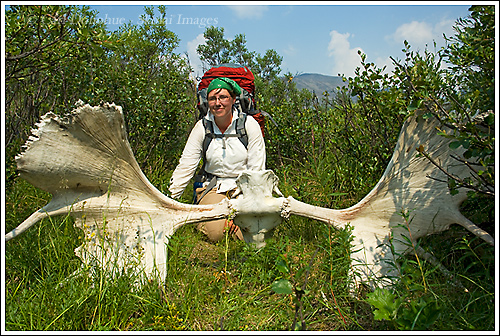
A hiker, Natalie, sits with a moose rack and skull, Wrangell-St. Elias National Park, Alaska.

Hey Folks,

I ran across what is easily the biggest moose rack I’ve ever come across in the woods a few days ago. I was on the last leg of a hike in Alaska’s gorgeous Wrangell Mountains in Wrangell-St. Elias National Park, from the Sanford River drainage over the Sanford Plateau, and down to the Dadina River.

Natalie (pictured) and I were sauntering through the forest, along the Dadina River when I spotted this rack, not far from the game trail we were walking along. This was one BIG bull moose – I don’t know what happened to the grand old fella, but he’s bones now. He must’ve been a pretty awesome creature back in the day. There are a number of wolves in the area, and grizzly bears as well, and I’m sure he fed them well, along with the myriad other carnivores in the region – wolverine, fox, marten, gulls, ravens, eagles, etc.

What a treat it must’ve been for them when he passed, and what a treat it would’ve been to see him walking through the forest beforehand. RIP, great bull.

Continue reading

Bull Moose, Long Lake

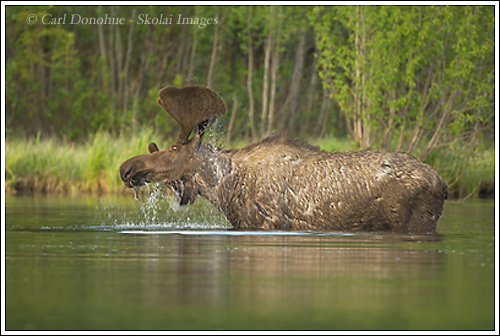
Bull Moose (Alces alces) shaking water from antlers, in a lake, springtime, Wrangell-St. Elias National Park, Alaska.

Hey Folks,

Here’s a quick one while I’m hiking. I saw this bull moose a few times this spring, feeding on the aquatic plants that grow on the lake bed this time of year. Quite a rack for early June. He’ll be quite a sought after moose come this fall when the subsistence hunters look around Wrangell-St. Elias National Park for their winter meat. As much as I like for my friends to eat well, I hope nobody gets this guy.

Cheers

Carl

Wendell Berry and Guy Tal

Winter in the Mentasta Mountains, Wrangell-St. Elias National Park.

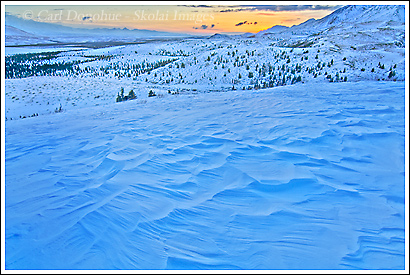
A winter sunset over the Mentasta Mountains, Wrangell-St. Elias National Park, Alaska.

Hey Folks,

“The effort to clarify our sight cannot begin in the society, but only in the eye and in the mind. It is a spiritual quest, not a political function. We each must confront the world alone and learn to see it for ourselves”. So says Wendell Berry, one of my favorite writers, in his book “The Unforeseen Wilderness”. The book, a dearly needed plea to save Kentucky’s Red River Gorge from a nefarious plan to dam it, was written nearly 40 years ago. I haven’t read the book completely yet, as I just bought it this afternoon. But I glanced at it, and this passage caught my attention. Berry continues on:

“the figure of the photographic artist – not the tourist-photographer who goes to a place, bound by his intentions and preconceptions, to record what has already been recorded and what he therefore expects to find, but the photographer who goes into a place in search of the real news of it”.*

Continue reading

The Wolf Song

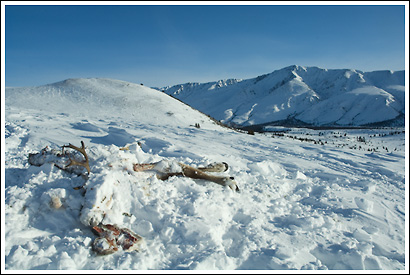
Wolf killed caribou carcass, winter, Wrangell St. Elias National Park, Alaska.

Hey Folks,

I was really, really hoping to get some wolf photos on this last trip to Wrangell-St. Elias National Park. Just one would’ve been fine.

Wolves aren’t as common in the southern reaches of the park, though they’re certainly around, so I was hoping to get lucky enough to maybe see, perchance to photograph, one on the north side of the park. The habitat on the south side isn’t (generally) as wolf friendly – more heavily forested, and lots of alpine mountain country, snow and ice.

Dall sheep and moose are the main prey for wolves in that part of the park, and though there are a lot of sheep, the numbers are smaller than the herds of caribou that wander through the north part of the park in the fall and late winter/early spring.

Continue reading

Young Bull Moose, Wrangell-St. Elias

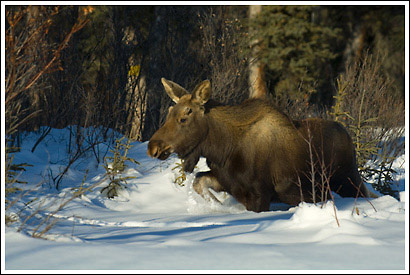
A young bull moose wades through deep powdery snow, winter, boreal forest, Wrangell-St. Elias National Park, Alaska.

Hey Folks,

Here’s a young bull moose, a yearling, trundling through the snow. Moose have disproportionately longer legs than other members of the deer family, and it really helps them get through deep snow.

This is a helpful advantage as they seek out food in the winter, and also in evading their main predator, the wolf pack.

But the real secret they employ is a kind of double-jointed hip or knee that allows them to lift their legs higher than most ungulates, and high-step their way to safety.  When I first saw this fellow, he stepped into a deeper drift that was right up to his belly, yet he managed to clamber his way through, regather, and then set about finding himself some browse for dinner.

The word ‘moose’ comes from a North American Indian Tribe, the Abenaki, and it translates roughly as ‘he trims or cuts off’, a reference to how the Moose browses twigs and bark from trees.

Cheers

Carl

Mount Sanford, Wrangell-St. Elias National Park

Mount Sanford, Wrangell St. Elias National Park, Alaska.

Hey Folks,

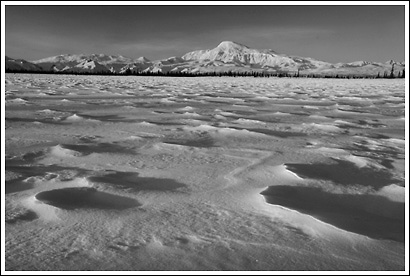
This is a photo of Mt Sanford, in winter, taken early one morning. In 2 weeks I had 3 mornings with some alpenglow. The first one I didn’t shoot because it was so socked in with cloud an hour before dawn that I didn’t figure the light was going to happen – and being tired, I slept in. I awoke, looked over, and saw a nice magenta glow on the face of Sanford, but there wasn’t really any kind of way to shoot it from where I was. Such is my life, it seems. I did enjoy a hot coffee and

Continue reading