Tag Archives: Wrangell-St. Elias National Park

Wendell Berry and Guy Tal

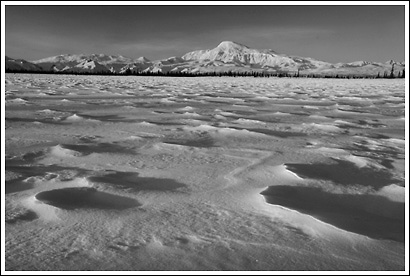
Winter in the Mentasta Mountains, Wrangell-St. Elias National Park.

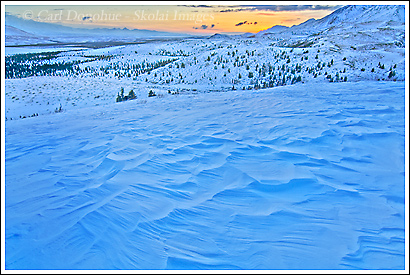
A winter sunset over the Mentasta Mountains, Wrangell-St. Elias National Park, Alaska.

Hey Folks,

“The effort to clarify our sight cannot begin in the society, but only in the eye and in the mind. It is a spiritual quest, not a political function. We each must confront the world alone and learn to see it for ourselves”. So says Wendell Berry, one of my favorite writers, in his book “The Unforeseen Wilderness”. The book, a dearly needed plea to save Kentucky’s Red River Gorge from a nefarious plan to dam it, was written nearly 40 years ago. I haven’t read the book completely yet, as I just bought it this afternoon. But I glanced at it, and this passage caught my attention. Berry continues on:

“the figure of the photographic artist – not the tourist-photographer who goes to a place, bound by his intentions and preconceptions, to record what has already been recorded and what he therefore expects to find, but the photographer who goes into a place in search of the real news of it”.*

Continue reading
The Wolf Song

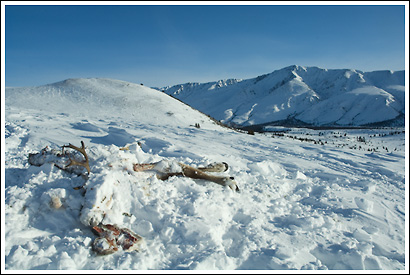
Wolf killed caribou carcass, winter, Wrangell St. Elias National Park, Alaska.

Hey Folks,

I was really, really hoping to get some wolf photos on this last trip to Wrangell-St. Elias National Park. Just one would’ve been fine.

Wolves aren’t as common in the southern reaches of the park, though they’re certainly around, so I was hoping to get lucky enough to maybe see, perchance to photograph, one on the north side of the park. The habitat on the south side isn’t (generally) as wolf friendly – more heavily forested, and lots of alpine mountain country, snow and ice.

Dall sheep and moose are the main prey for wolves in that part of the park, and though there are a lot of sheep, the numbers are smaller than the herds of caribou that wander through the north part of the park in the fall and late winter/early spring.

Continue reading

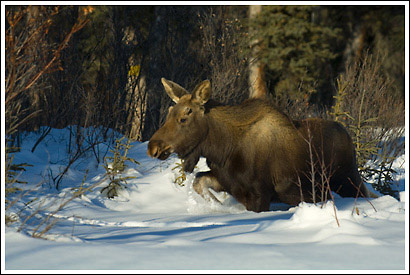
Young Bull Moose, Wrangell-St. Elias

A young bull moose wades through deep powdery snow, winter, boreal forest, Wrangell-St. Elias National Park, Alaska.

Hey Folks,

Here’s a young bull moose, a yearling, trundling through the snow. Moose have disproportionately longer legs than other members of the deer family, and it really helps them get through deep snow.

This is a helpful advantage as they seek out food in the winter, and also in evading their main predator, the wolf pack.

But the real secret they employ is a kind of double-jointed hip or knee that allows them to lift their legs higher than most ungulates, and high-step their way to safety.  When I first saw this fellow, he stepped into a deeper drift that was right up to his belly, yet he managed to clamber his way through, regather, and then set about finding himself some browse for dinner.

The word ‘moose’ comes from a North American Indian Tribe, the Abenaki, and it translates roughly as ‘he trims or cuts off’, a reference to how the Moose browses twigs and bark from trees.

Cheers

Carl

Mount Sanford, Wrangell-St. Elias National Park

Mount Sanford, Wrangell St. Elias National Park, Alaska.

Hey Folks,

This is a photo of Mt Sanford, in winter, taken early one morning. In 2 weeks I had 3 mornings with some alpenglow. The first one I didn’t shoot because it was so socked in with cloud an hour before dawn that I didn’t figure the light was going to happen – and being tired, I slept in. I awoke, looked over, and saw a nice magenta glow on the face of Sanford, but there wasn’t really any kind of way to shoot it from where I was. Such is my life, it seems. I did enjoy a hot coffee and

Continue reading

Snowshoe hare and lynx population cycles

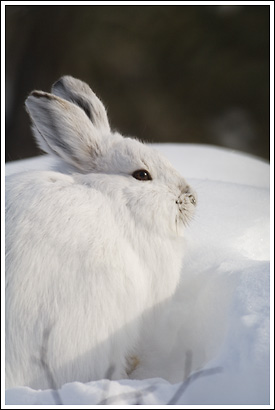
Snowshoe hare, winter molt, white fur, Wrangell-St. Elias National Park, Alaska.

Hey Folks,

Here’s a REAL snowshoe hare photo, taken on my recent sojourn to the northern side of Wrangell-St. Elias National Park. I was very surprised at how little sign of snowshoe hares there was in this area – negligible. Everywhere else, it seems, the woods are crawling with them. This is at, or close to, the peak of the cycle for snowshoe hares; a 10 year population fluctuation that seems to be pretty consistent.

Why is the Snowshoe Hare Population so volatile?

Sometimes the cycle might be 9 years, or 11, but it’s not usually far off. The population rises steadily, then faster, peaks, and falls drastically,  almost completely, in a single year. Ecologists aren’t sure as to what causes the drop in numbers, though theories abound, as always.

Continue reading

Caribou feeding in winter snow

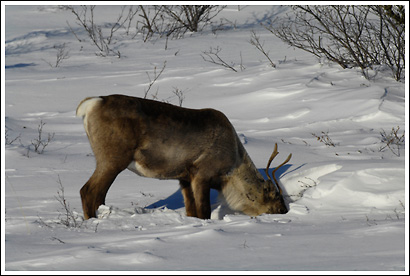
A caribou cow digging under snow for food, feeding on lichens and grasses, in winter, Wrangell-St. Elias National Park, Alaska.
Winter caribou feeding in Wrangell-St. Elias National Park

Hey Folks,

Normally I wouldn’t post a photo of an animal with its head buried under the snow. But, for caribou, this is winter life. Caribou feed on lichens and grasses, and those lie buried, often deep beneath snow’s crust for the long winter months.

Caribou have a few options to eke out their winter, and a heavy snow pack in the winter can be a tough gig for them; finding food is a mission and avoiding predators, namely, the wolf, an equally difficult, if not critical, task. So they’ll typically seek high ground,

Continue reading

Cold Feet

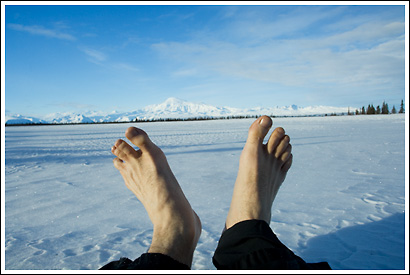
Hiker, barefoot, in winter, frozen lake, Mt. Sanford, Wrangell-St. Elias National Park, Alaska.

Hey Folks,

Life has a way, all too often, of providing us with little (or large) lessons on what we need to work on. Communication is something that all of us frequently do poorly, and here’s a good example of that, and how it can mess up your day. I’m usually pretty good about seeking advice from those who know better than me (my father will disagree, I’m sure). So when I first came to AK, I asked my good and trusted friend Ron Niebrugge for some advice.

Continue reading

Winter in McCarthy

2 Winters in McCarthy from an Aussie Photographer

Spending winter in McCarthy is a study in both extreme beauty and quiet endurance. Life in Wrangell St. Elias National Park during the coldest months revolves around the simple mechanics of survival, like hauling wood for the shack or coaxing a frozen snowmachine to life.

While most people only see this landscape in the green of summer, the true character of the backcountry emerges when the crowds vanish and the mercury drops toward minus fifty. The mountains seem to pull closer in the crisp air, and the vast silence is only broken by the occasional crunch of skis on fresh powder.

The following collection of images and stories comes from my time poking around the frozen Kennecott River and the Lakina drainage.

Whether it is chasing the magenta alpenglow on Mt. Porphyry or hunting for abstract patterns in the snow covered glacial moraines, winter photography here is a constant battle against the elements. Everything from sticking tripod legs to fogged viewfinders makes each frame a hard earned reward. It is a slow, cold way of living, but catching that soft noon light on an unnamed peak makes every subzero mile worth the effort.

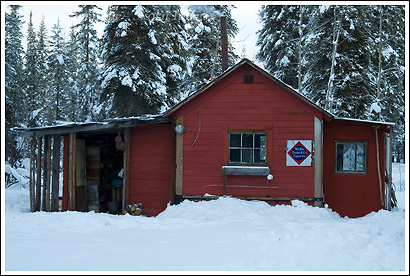
Livin in the a Little Shack Down by the River

A cabin in the woods in winter, Wrangell-St. Elias National Park, Alaska.

My humble abode. This is after I shovelled all the snow off the roof. There’s about another 6-9 inches of snow on the roof already!

Continue reading

Shadows and Light

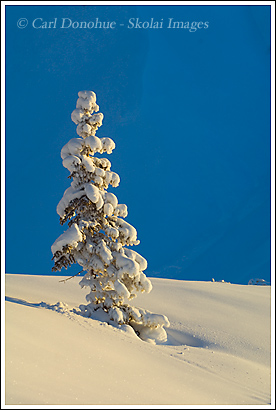
Snow covered spruce tree, Wrangell-St. Elias National Park, Alaska.

Hey Folks,

Here’s another photo I took on my most recent sojoun to Wrangell-St. Elias National Park, Alaska. I’d been hoping to find some scenes like this, but they’re hard to come by. Fresh snow still sitting on a spruce tree, in nice warm sunshine.  Usually, after a nice dump of snow, wind blows it off the trees before the weather clears up enough for this kind of photo.

One calm evening I went up on this ridge, not a breath of air was stirring down in the forest at the cabin. But up high, the wind was blowing like crazy. It was weird, it’d blow really hard for a few seconds, a gust, then stop and all was perfectly still for a few seconds, then the wind would kick up again, often from exactly the opposite direction it had last came.

This went on for a few hours. I didn’t shoot much that afternoon, but it was cool to see this crazy weather. A few days later, after we’d had some more snow fall, up I went again, and got some nicer conditions.

Continue reading

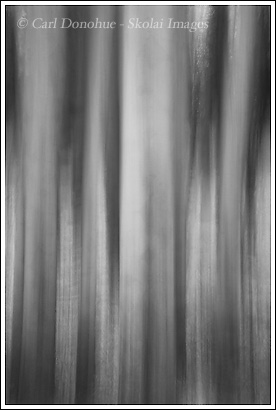
Aspen boles, Wrangell-St. Elias National Park, Alaska

Aspen boles, Wrangell-St. Elias National Park, Alaska.

Hey Folks,

Here’s an image from my most recent venture into the park. I’ve never really tried this kind of technique with photography too much, but I kind of enjoyed the results. Some of them, anyway. It was interesting to me to edit this series of photos – abstract images emote so differently, and I’ve not a lot of practice in that field, so I felt I wasn’t really sure what I was supposed to be looking for.

The technical aspect of photos is so dominant in more orthodox imagery, so editing become somewhat rote; check sharpness, exposure, etc. But abstract imagery requires a different process, and I find it hard to edit

Continue reading