Tag Archives: Winter

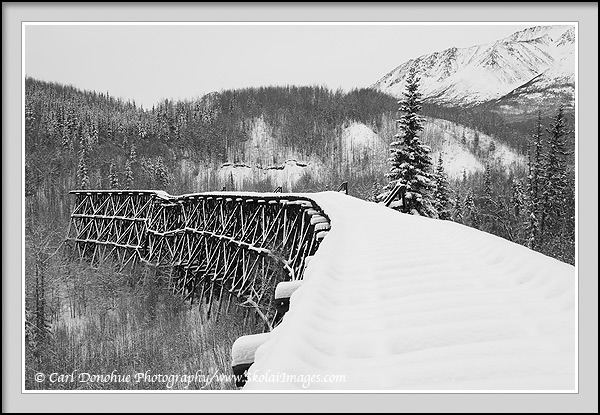
Bridge to Nowhere – Gilahina Trestle, Wrangell-St. Elias National Park.

The Gilahina Trestle fades into winter, Wrangell-St. Elias National Park and Preserve, Alaska.

Alaska’s Ultimate Bridge to Nowhere – The Gilahina Trestle fades into winter, Wrangell-St. Elias National Park and Preserve, Alaska. Click for larger version.

Hey Folks,

The Gilahina Trestle, crossing the Gilahina River, was once an impressive structure. Built in 1911 as part of the Copper River and Northwestern Railway (nicknamed “Can’t Run and Never Will”), the Gilahina Trestle was not quite 900′ long, and nearly 100′ high. Rumors say that it took less than 8 days to build, and the first train ran across its length on January 28, 1911. It’s since fallen into some disrepair, as is evident from this image. It’s a rickety ole job, at this point, and walking across it with nearly a foot of snow covering each board was, uhhm, sketchy. But I made it out for a few photos and back in one piece.

The Gilahina Trestle is now listed on the National Historic Register, which means it’ll probably come in for some funding to repair/restore it.

Continue reading

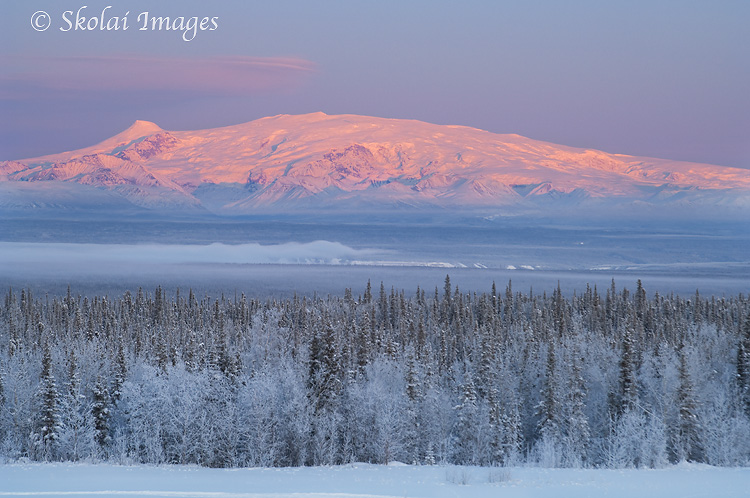
Alpenglow on Mt. Wrangell, Wrangell-St. Elias National Park and Preserve, Alaska

Winter landscape of sunset over Mt. Wrangell and the Copper River Basin. Mount Wrangell, Mount Zanetti and snow covered boreal forest of the Copper River Basin, Wrangell-St. Elias National Park and Preserve, Alaska.

Winter landscape of sunset over Mt. Wrangell and the Copper River Basin. Mount Wrangell, Mount Zanetti and snow covered boreal forest of the Copper River Basin.

Wrangell-St. Elias National Park is one of my favorite areas in the world, and certainly in Alaska.

Hey Folks,

“We had a remarkable sunset one day last November .. It was such a light as we could not have imagined a moment before, and the air also was so warm and serene that nothing was wanting to make a paradise of that meadow. When we reflected that this was not a solitary phenomenon, never to happen again, but that it would happen forever and ever an infinite number of evenings, and cheer and reassure the latest child that walked there, it was more glorious still.

The sun sets on some retired meadow, where no house is visible, with all the glory and splendor that it lavishes on cities, and, perchance, as it has never set before, …. so pure and bright a light,  …. so softly and serenely bright, I thought I had never bathed in such a golden flood, without a ripple or murmur to it.” – Henry David Thoreau, “Walking”.

For those of you perhaps unfamiliar with this essay, my advice is to read it carefully; those who’ve read it previously will do well to re-read the piece; it’s a classic.

Continue reading

Small Mammals in Wrangell-St. Elias National Park

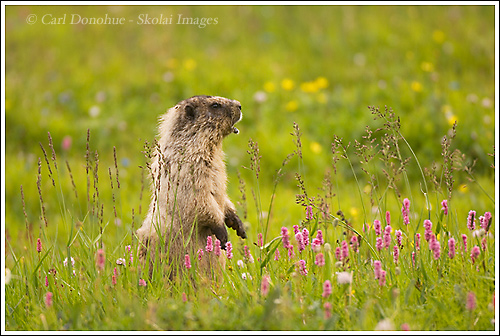
Hoary Marmot Photo

Hoary Marmot, Wrangell-St. Elias National Park, Alaska.

Last week I spent the week up at Skolai Pass, Wrangell-St. Elias National Park, Alaska. After years of hoping to photograph a marmot in the park, and having seen many of them but never actually managing to photograph one, I found this guy, right by where we camped. I made a number of nice images of him, but this one I like the most. The pink flowers in the foreground are called Pink Plumes.

I’ll be out in the backcountry again this week, hiking from Iceberg Lake to Bremner Mines. I’ll post again when I return.

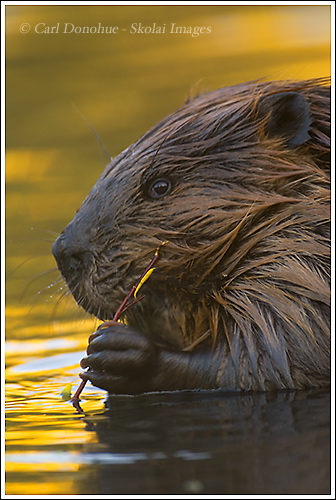
Beaver, Wrangell-St. Elias National Park, Alaska

An adult beaver browsing on willow leaves in a pond, Wrangell-St. Elias National Park, Alaska.

So this last week I spent on the north side of the park, exploring clouds and rain and drizzle. The glory of fall in Alaska. I found this small beaver  pond, replete with beaver, so I spent a few hours photographing them in their little demesne. The pond was host to a couple of adults, male and female, and their offspring, 3 young kits. It was fascinating to watch them go about their business (mainly eating) for hours on end.

The ole saying ‘busy as a beaver’ could equally hold as ‘hungry as a beaver’; all these critters do is eat, it seems. I watched this male swim to the pond’s shore, clamber out of the water, saunter down the trail, then reappear maybe 10 minutes later with a large willow sapling clenched between his teeth, dragging the branch behind him, as he re-entered the pond, and swam back towards his lodge.

I was super fortunate that he stopped to eat right in front of me, and during the course of his dinner, all of the other beavers came by, at some point, to scrounge a branch or 2 off his sapling. Apparently willow leaves are good eating for a beaver. The ruckus that followed was almost comical, the various assortment of noises being surprisingly diverse.

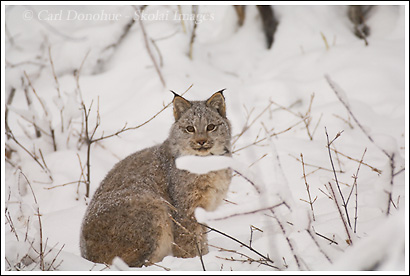
Wild Lynx, Wrangell-St. Elias National Park, Alaska

Wild lynx, Wrangell St. Elias National Park, Alaska.

I promised my buddy Ron I’d post this. Hey Ron! ?

This is a wild lynx, from Wrangell St. Elias, photographed this last winter. I was pretty lucky to get this. I couldn’t believe my luck when I spotted this gorgeous cat, and hoped and prayed I’d get a photo.

The lynx obliged me. I wish, of course, the image wasn’t quite so cluttered, particularly his little white beard created by the snow-covered branch in the foreground, but it’s the first photo I ever got of a lynx, so I’m happy enough, I reckon. He let me fire a few a frames, and then bounded off into the brush.


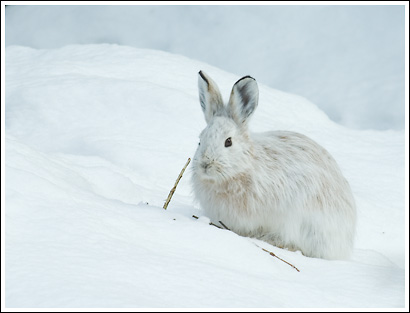
Snowshoe Hare, in winter, Wrangell St. Elias, Alaska

snowshoe hare in white winter coat, on snow eating a willow stem, wrangell st. Elias National Park, Alaska.

Here’s an interesting photo. As winter comes to an end, the snowshoe hares are hungrier than ever, which means I get to see them a little more. It also makes them more vulnerable to their primary predator, the lynx.

This one is just starting to change his coat back to the brown summer coat. You can see the black tips on the ears, which don’t go white, even in the mid of winter. As winter goes along, the hares get hungrier and hungrier – there is not a lot of fodder for them once the snow covers everything. You can see the willow branch this one was nibbling on when I found him.

The hares eat the bark right off the saplings .. some of the saplings around the area have been completely stripped, while others haven’t been touched. I have no idea what makes one willow sapling more delectable than another, but the snowshoe hares seem to know.

I’ll keep poking around and see if I can find some more hares to photograph in the next few days. There’s a lot of them around, but they’re pretty skittish, and don’t hang around too much when I stumble along.

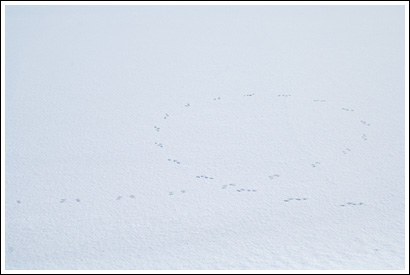
Snowshoe hare tracks in Wrangell St. Elias National Park

snowshoe hare tracks Wrangell St. Elias National Park, Alaska.

This image is from my recent trip.

I was walking along the edge of the lake here, on the ice, and following this set of snowshoe hare tracks. Out of nowhere they venture out on to the ice and do this really cool little loop, then back on course.

I thought it was awesome.

I know the photo’s hardly wall-hanger, but the scene caught my eye – it just seemed to interesting to wonder why the little rabbit walked a perfect circle like this .. maybe he was just exuberant about it being winter, and such a lovely day. Maybe he had just had his van fixed and was in a good mood. Maybe he just felt like walking in a circle.

Whatever the reason, I thought it was pretty cool, so I took this photo.


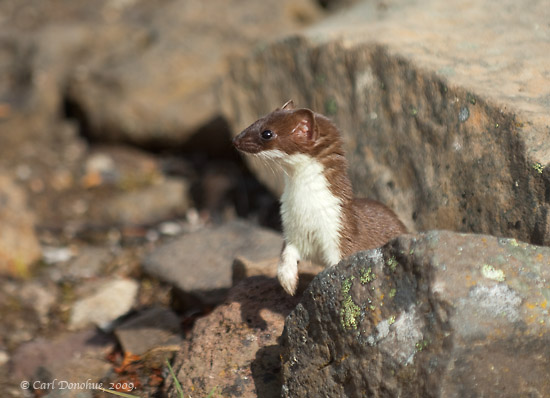
Least Weasel photo

Least Weasel photo, on a rock, Skolai pass, Wrangell-St. Elias National Park, Alaska.

This photo is of a weasel (or ermine), from Skolai Pass in Wrangell-St. Elias National Park. Member of the mustelid family, the Least Weasel is the coolest little critter . imagine a small, sleek ferret on crack.

I’ve never tried to photograph an animal where I go so many images of his behind, as he raced off, or even with the animal completely gone .. this guy was SO fast, I barely managed to catch him at all .. the few moments he’d stop, look around, pose, and be gone, in a dash for cover. This photo is about 60% of the full frame version.

This photo was maybe a few hundred yards into our walk, so it was exciting. To be shooting a cool little guy like this within minutes of starting our trip was simply awesome. On the first day of our trip I managed to take my only images of a weasel from the park, my now favorite caribou image I’ve taken in the park, and my favorite image of Mt. Bona. And earlier in the morning we’d had some alpenglow on Mt Blackburn, as well. What a day.

So that’s it for the weasel. He’s running around Skolai Pass chasing voles, shrews and ptarmigan, and maybe the odd ground squirrel. I hope has a great winter, and is around to see again next year. What a treat it was for our group.

Cheers

Carl
Wendell Berry and Guy Tal

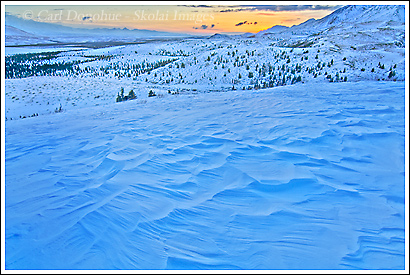
Winter in the Mentasta Mountains, Wrangell-St. Elias National Park.

A winter sunset over the Mentasta Mountains, Wrangell-St. Elias National Park, Alaska.

Hey Folks,

“The effort to clarify our sight cannot begin in the society, but only in the eye and in the mind. It is a spiritual quest, not a political function. We each must confront the world alone and learn to see it for ourselves”. So says Wendell Berry, one of my favorite writers, in his book “The Unforeseen Wilderness”. The book, a dearly needed plea to save Kentucky’s Red River Gorge from a nefarious plan to dam it, was written nearly 40 years ago. I haven’t read the book completely yet, as I just bought it this afternoon. But I glanced at it, and this passage caught my attention. Berry continues on:

“the figure of the photographic artist – not the tourist-photographer who goes to a place, bound by his intentions and preconceptions, to record what has already been recorded and what he therefore expects to find, but the photographer who goes into a place in search of the real news of it”.*

Continue reading

The Wolf Song

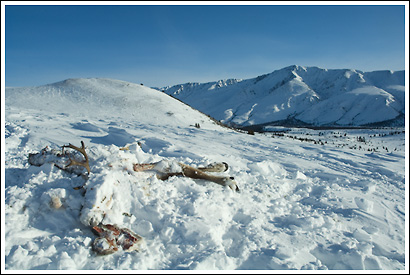
Wolf killed caribou carcass, winter, Wrangell St. Elias National Park, Alaska.

Hey Folks,

I was really, really hoping to get some wolf photos on this last trip to Wrangell-St. Elias National Park. Just one would’ve been fine.

Wolves aren’t as common in the southern reaches of the park, though they’re certainly around, so I was hoping to get lucky enough to maybe see, perchance to photograph, one on the north side of the park. The habitat on the south side isn’t (generally) as wolf friendly – more heavily forested, and lots of alpine mountain country, snow and ice.

Dall sheep and moose are the main prey for wolves in that part of the park, and though there are a lot of sheep, the numbers are smaller than the herds of caribou that wander through the north part of the park in the fall and late winter/early spring.

Continue reading

Young Bull Moose, Wrangell-St. Elias

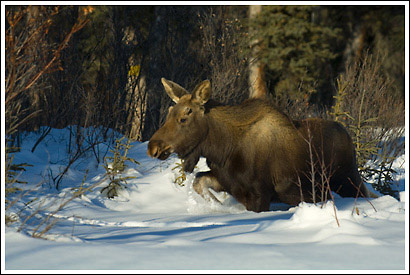
A young bull moose wades through deep powdery snow, winter, boreal forest, Wrangell-St. Elias National Park, Alaska.

Hey Folks,

Here’s a young bull moose, a yearling, trundling through the snow. Moose have disproportionately longer legs than other members of the deer family, and it really helps them get through deep snow.

This is a helpful advantage as they seek out food in the winter, and also in evading their main predator, the wolf pack.

But the real secret they employ is a kind of double-jointed hip or knee that allows them to lift their legs higher than most ungulates, and high-step their way to safety.  When I first saw this fellow, he stepped into a deeper drift that was right up to his belly, yet he managed to clamber his way through, regather, and then set about finding himself some browse for dinner.

The word ‘moose’ comes from a North American Indian Tribe, the Abenaki, and it translates roughly as ‘he trims or cuts off’, a reference to how the Moose browses twigs and bark from trees.

Cheers

Carl

Mount Sanford, Wrangell-St. Elias National Park

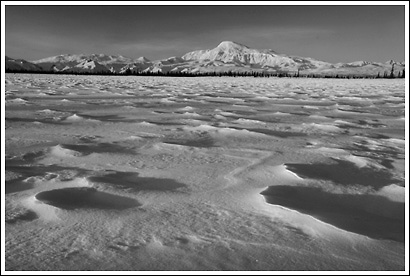
Mount Sanford, Wrangell St. Elias National Park, Alaska.

Hey Folks,

This is a photo of Mt Sanford, in winter, taken early one morning. In 2 weeks I had 3 mornings with some alpenglow. The first one I didn’t shoot because it was so socked in with cloud an hour before dawn that I didn’t figure the light was going to happen – and being tired, I slept in. I awoke, looked over, and saw a nice magenta glow on the face of Sanford, but there wasn’t really any kind of way to shoot it from where I was. Such is my life, it seems. I did enjoy a hot coffee and

Continue reading

Snowshoe hare and lynx population cycles

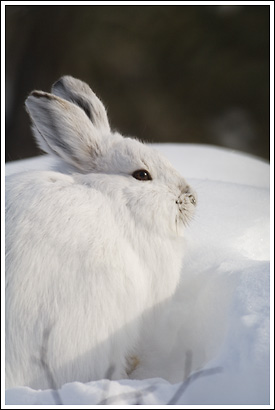
Snowshoe hare, winter molt, white fur, Wrangell-St. Elias National Park, Alaska.

Hey Folks,

Here’s a REAL snowshoe hare photo, taken on my recent sojourn to the northern side of Wrangell-St. Elias National Park. I was very surprised at how little sign of snowshoe hares there was in this area – negligible. Everywhere else, it seems, the woods are crawling with them. This is at, or close to, the peak of the cycle for snowshoe hares; a 10 year population fluctuation that seems to be pretty consistent.

Why is the Snowshoe Hare Population so volatile?

Sometimes the cycle might be 9 years, or 11, but it’s not usually far off. The population rises steadily, then faster, peaks, and falls drastically,  almost completely, in a single year. Ecologists aren’t sure as to what causes the drop in numbers, though theories abound, as always.

Continue reading

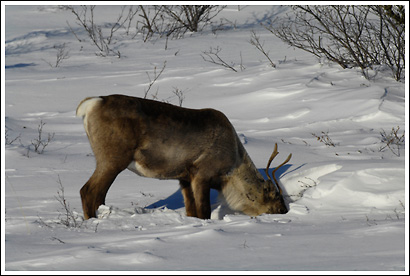
Caribou feeding in winter snow

A caribou cow digging under snow for food, feeding on lichens and grasses, in winter, Wrangell-St. Elias National Park, Alaska.
Winter caribou feeding in Wrangell-St. Elias National Park

Hey Folks,

Normally I wouldn’t post a photo of an animal with its head buried under the snow. But, for caribou, this is winter life. Caribou feed on lichens and grasses, and those lie buried, often deep beneath snow’s crust for the long winter months.

Caribou have a few options to eke out their winter, and a heavy snow pack in the winter can be a tough gig for them; finding food is a mission and avoiding predators, namely, the wolf, an equally difficult, if not critical, task. So they’ll typically seek high ground,

Continue reading

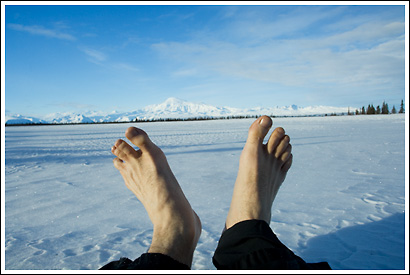
Cold Feet

Hiker, barefoot, in winter, frozen lake, Mt. Sanford, Wrangell-St. Elias National Park, Alaska.

Hey Folks,

Life has a way, all too often, of providing us with little (or large) lessons on what we need to work on. Communication is something that all of us frequently do poorly, and here’s a good example of that, and how it can mess up your day. I’m usually pretty good about seeking advice from those who know better than me (my father will disagree, I’m sure). So when I first came to AK, I asked my good and trusted friend Ron Niebrugge for some advice.

Continue reading