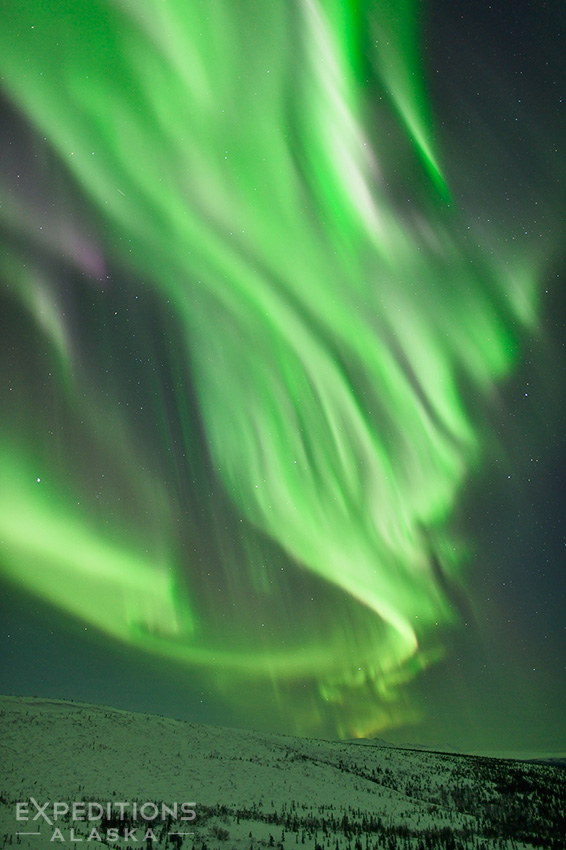
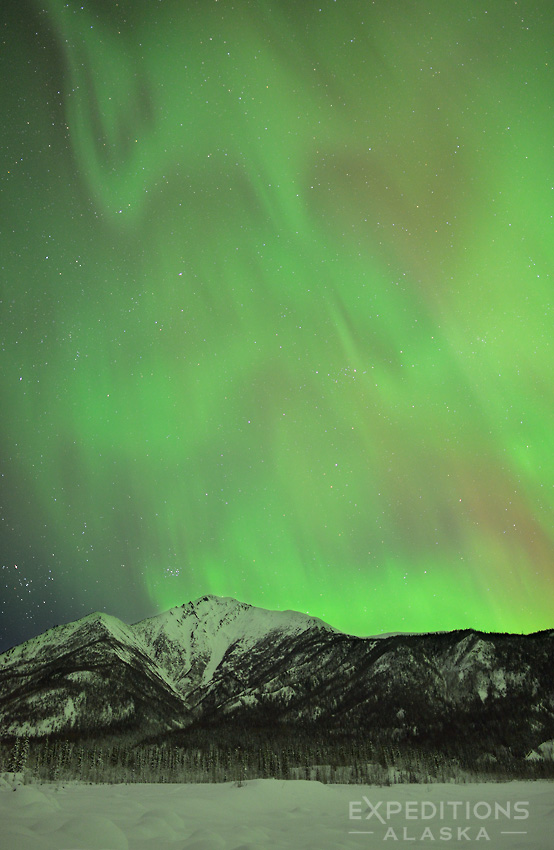
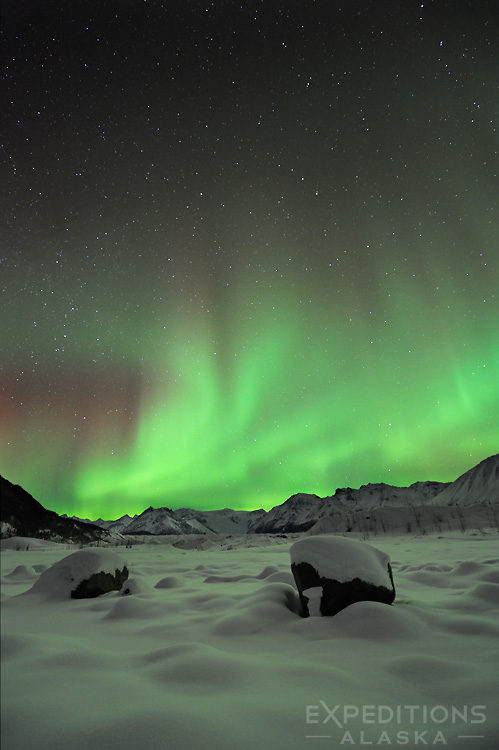
Aurora borealis photo, over Fireweed Mountain, Wrangell-St. Elias National Park and Preserve, Alaska
Hey Folks,
It’s true. This post is the key to your success. This article is THE factor that will drive you to become the most popular, most retweeted, most faved, liked, mentioned and copied Photographer of All Time In The World Ever (and we all know how well those retweets and likes will pay your mortgage).
Wrangell-St. Elias National Park and the aurora borealis photo, or northern lights, Alaska. Please click on the image above to view a larger version of this photo.
I was guiding a photo tour into the park, and we were late leaving Anchorage, due to delays with one of the guest’s flight to Alaska.
What Are the Northern Lights?
Wikipedia says this about the northern lights:
“Auroras are now known to be caused by the collision of charged particles (e.g. electrons), found in the magnetosphere, with atoms in the Earth’s upper atmosphere (at altitudes above 80 km). These charged particles are typically energized to levels between 1 thousand and 15 thousand electronvolts and, as they collide with atoms of gases in the atmosphere, the atoms become energized. Shortly afterwards, the atoms emit their gained energy as light. Light emitted by the Aurora tends to be dominated by emissions from atomic oxygen, resulting in a greenish glow (at a wavelength of 557.7 nm) and – especially at lower energy levels and at higher altitudes – the dark-red glow (at 630.0 nm of wavelength). “
Make sense? There you have it folks – the northern lights are tiny little things in the air, like dust, so small we can’t even see them, that glow because they crash into other tiny little things we can’t see. How cool is that?
They’re called the aurora borealis after the Roman Goddess of the dawn, ‘Aurora’, and the Greek god of Wind, “Borealis”. That sounds reasonable, except that the Aurora Borealis isn’t visible in either Greece or Rome.
Seems to me then we should allow people who do see them reguarly to name them. The Scottish called them “the merry dancers” or na fir-chlis.
The Scandinavians name for the northern lights translates as “herring flash”. It was believed that northern lights were the reflections cast by large swarms of herring onto the sky.
The name they gave the northern lights was “norðurljós” — which I have no idea how to pronounce. The Norse folks also called them “the fires that surround the North and South edges of the world”.
In central Asia the belief of the Chuvash peoples is that the lights were the god/goddess Suratan-tura (Birth-giving Heaven).
The Algonquin Indian folklore proclaimed that the northern lights were their ancestors dancing around a ceremonial fire.
The Athabascan people who lived in what is now known as Wrangell St. Elias National Park, saw messages from their dead, the “sky dwellers“.
I love this kind of way of seeing the world. It’s beautiful, much more beautiful than ‘the northern lights’. And as beautiful as they are, it seems fitting we should have a beautiful way to refer to them.
Our Northern Lights Photography
We’ve had some pretty great weather here through the month of February, and that means, a great time to get out and look for northern lights. Working on my own project, rather than photo tours, I was able to hit a few destinations I wanted to shoot that are a little more hit and miss; less reliable than some others, but places I wanted to shoot nonetheless.
One of those places is Wrangell-St. Elias National Park and Preserve. Inevitably I’d be in the wrong place at the wrong time in a place slightly larger than the country of Switzerland; I’d head off in one direction and then have fog and haze cloud up the skies, or I’d head off in another direction, and the lights display would be directly behind me. The mountains in front me being what I want to shoot, and the lights behind me. Not a great mix.
But, such is what happens when you have specific ideas in mind; it’s important to be flexible in nature photography, and particularly so when shooting the northern lights, but part of working on a project involves fulfilling your own ideas. Spontaneity is great, and I’m all for it. But I’m also interested in trying to make a photo of something I envision ahead of time, and working toward that.
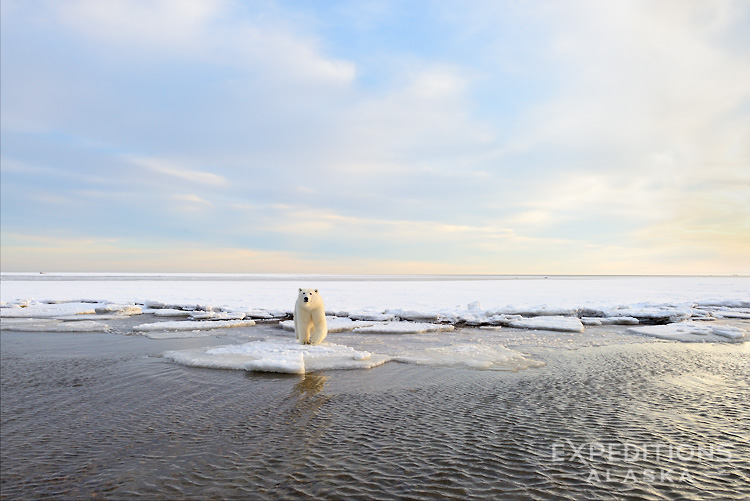
Standing on thin ice a polar bear curiously approaches. Polar Bear ice, in the Beaufort Sea, Arctic National Wildlife Refuge, Alaska. Please click on the image above to view a larger version of this photo.
Hey Folks,
Here’s a polar bear photo from my trip to the arctic last month. Given the predicament bears in the Beaufort Sea find themselves in (declines in accessible food due climate change), I thought the image a particularly relevant one.
Polar bears are classified as marine mammals, not, like their darker coated brethren to the south, mammals who earn their living on good old terra firma. Polar bears hunt, almost exclusively seals, and particularly 2 species of seals; primarily ringed seals (Phoca hispida) and less often, bearded seals (Erignathus barbatus). That alone makes polar bears particularly susceptible to population declines; any animal whose primary food source s merely one or 2 other species is somewhat vulnerable. This applies no less to herbivores who may exist on one or 2 types of plants. A crash (or boost) in the abundance of their food source will have an enormous impact on the population of their own species; a look at the lynx and the snowshoe hare cycles illustrates this.
So climate change has shifted the world for the polar bear; here’s a quick, and rough, summary of how.
The most productive waters in the arctic ocean are under sea ice, in the shallower areas over the continental shelf. Deeper water doesn’t hold light as well, and so tiny little critters like plankton and what not don’t do as well. They feed on the algae that grows and collects on the bottom of the sea ice. So where the plankton population is higher, so too is the population of the little critters that feed on plankton; shrimp and such. Fish eat shrimp, and bigger fish and regular size fish, and seals eat bigger fish. Where there’s no sea ice, there’s no algae growing. And if there’s no algae, no plankton, no shrimp, no regular size fish, no big fish, no seals and, you guessed it, skinny, hungry polar bears swimming around wondering why they can’t find any food.
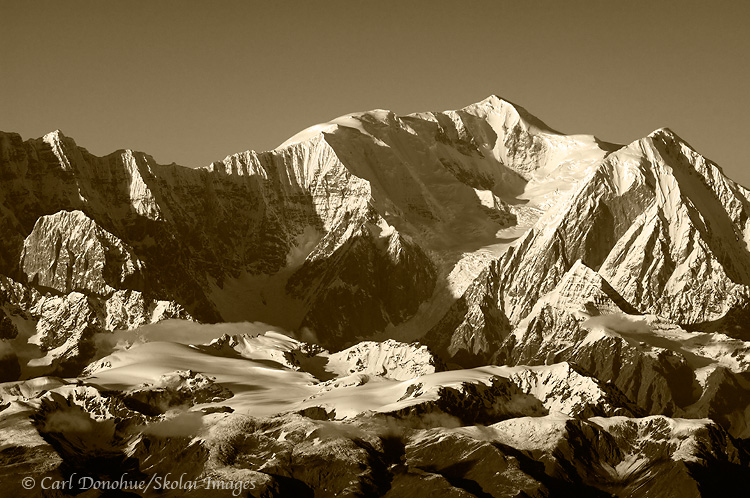
An aerial photo from the St. Elias Mountain Range, converted to B&W in photoshop. Wrangell-St. Elias National Park and Preserve, Alaska. Please click on the image above to view a larger version of the photo.
Hey Folks,
Someone asked me recently, “What’s a blog?” And after I got over the initial shock and wonder, repeatedly asking myself “is he (yes, he) for real?”, I tried my best to answer.
Seriously, what IS a blog? I guess it’s a journal or diary. Or a news outlet. Or a discussion forum. Or about a million other things.
Technically, the root of the term comes from the longer word “weblog”, meaning a log, on the web. Log like a record of some kind.
But what IS it? For me, it’s a double edged sword; a chore and a hobby. It’s work, sometimes, and sometimes it’s great fun. And sometimes it’s a pain in the a&&; especially when I have nothing of interest to write about, or when my blogging platform, wordpress, causes me no end of headaches and pain and grief as I try to solve some problem I’m having with the site. A site without a dynamic component, like wordpress, can be MUCH easier to handle than a blogging platform. If you folks out there had any idea how much of my life has been wasted as I’ve sat and stared at a screen wondering ‘now why the hell doesn’t it work’, you’d send money. Or drugs. Or money and drugs. Or, well, something. It’s ridiculous.
But I digress. Which is fine, of course, because it’s a blog, and it’s my blog, and I’m allowed to digress.
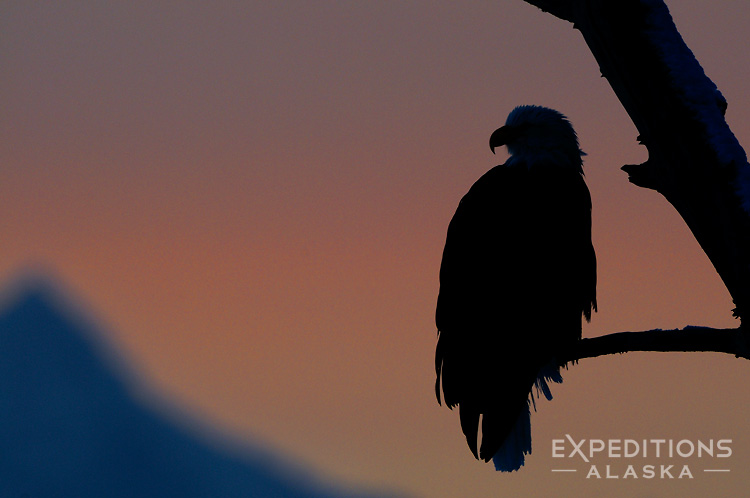
A silhouette of a bald eagle, perched in a giant Cottonwood tree, against the St. Elias Mountain Range at sunset. Chilkat Eagle Preserve, Alaska. Please click on the image above to view a larger version of this photo.
Hey Folks
One of the things I see happen most frequently in the field with groups of photographers is this kind of herd mentality that almost invariably works against the photographer. Particularly when things are not going perfectly. It’s cold, the eagles aren’t doing much, everyone’s been out for a long time, and soon enough, people start talking of packing up, of food and hot drinks, or editing images or watching TV, and before you know it, as the light ebbs, ever so slightly, people pack up and head for home/motel/town.
We all know once the light, on a gorgeous clear afternoon, goes down, the photography for the day is over, correct?
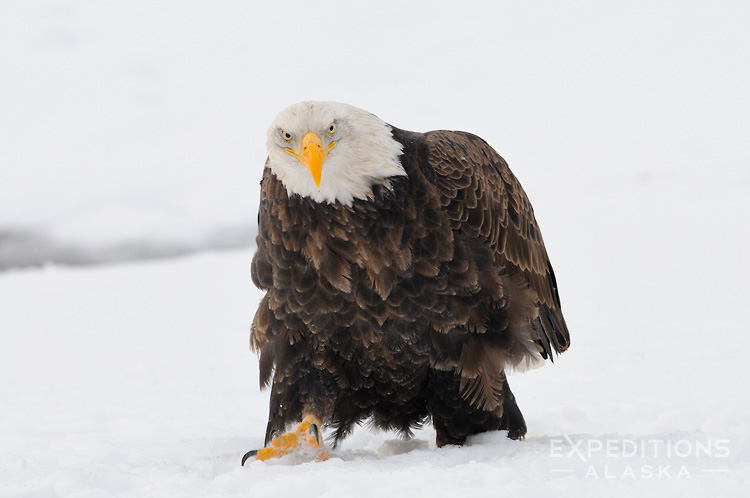
An adult bald eagle walking through soft fresh snow. Chilkat River, Haines, Alaska. Please click on the image above to view a larger version of this photo.
Writing Your Photography Business Plan
Excerpt #2
Mapping out where you want to go with your business, any business, probably starts best if you understand where it is right now. There’s no point in trying to decide how to get somewhere if we haven’t first identified where we are. There’s little point in trying to figure out a place we would like to be without knowing upfront whether or not we’re already there.
So sit down and assess, honestly, where your business is. Don’t just do the accounting and look for a profit/loss sheet. That’s important, but go beyond that. Look over your portfolio/stock files and assess where your work is. For a stock nature photographer, how’s your photography coverage of bald eagles? Los Vegas city lights? Blue whales? From a business viewpoint, that’s all about inventory (what an ugly word that is). That’s part of what your ‘product’ (perhaps an even more ugly word) is, so examine it. Write down, in some brief statement, where your work is at. For you.
How about your service? Where is that at? Email response, print quality, timeliness and efficiency of getting files off to the lab, prints off to the gallery/UPS, images off to your stock agency/website. Examine it and see where you stand. And if it sucks, note it down. If it’s awesome, note that down too.
How about your advertising? Where is that at? Beyond just advertising, how about your business marketing in general?
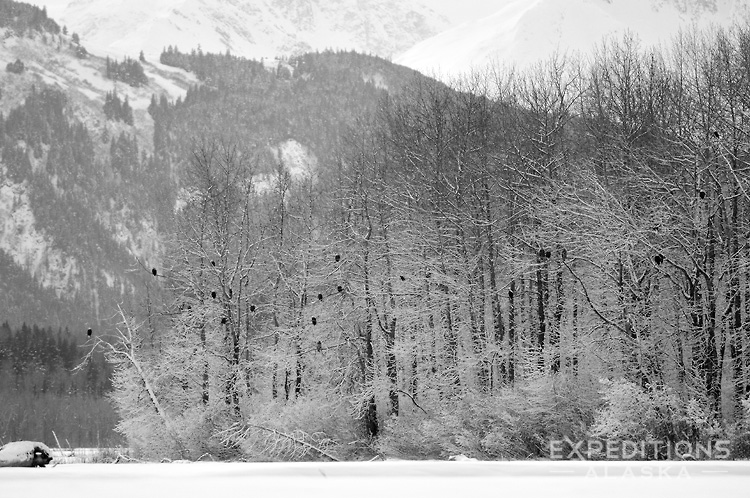
Bald eagles congregate along the Chilkat river, near Haines, Alaska, in November. Perched in the dormant Cottonwood trees. Click on the image above to view a larger version of this photo.
The Photographer’s Business Plan – part one
I’m sure all of the photographers reading this blog have written a business plan. Right? I mean, we’re all professional photographers, running our private small business with all the acumen and diligence of a studied businessman/woman. Right?
I wonder how many photographers out there calling themselves “professionals” have ever sat down and written an actual business plan. For their actual business. My guess, is very few of us have done so.
My guess, in fact, is that virtually every single photographer reading this post will spend more time on “liking” posts and “+1ing” comments and pictures on various social media than they will on mapping out some kind, any kind, of business plan. Rather than find 10 new facebook friends, or 25 new twitter followers for your business, how about spend 10 minutes working on your business plan?
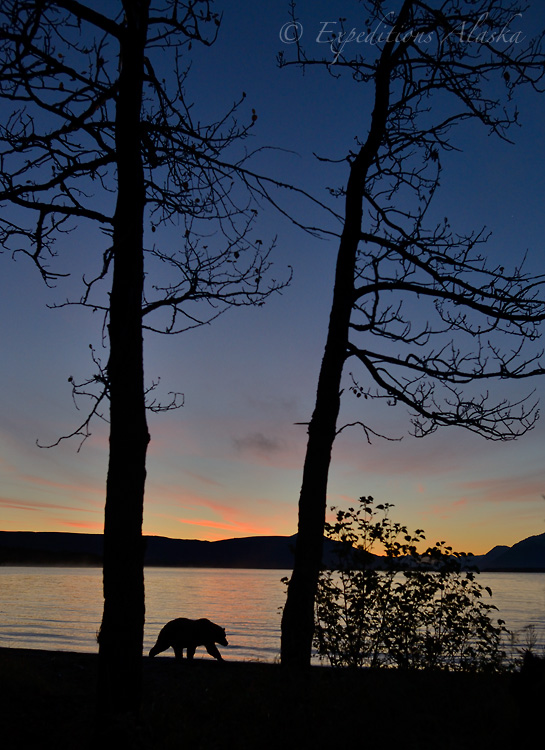
Silhouetted brown bear at sunrise, Katmai National Park, Alaska.
Timing is everything; especially for photography. Being in the “right place” at the “right time” is critical to making the “right photos”. Especially when photographing brown bears. So how, exactly, do we go about making that happen?
A million dollar question, I think.
One comment that we read and hear frequently, and I completely agree with, deals with knowing your subject. Knowing the behavior of an animal, for example, can help us predict where it might move to, what it may do, and so on. There’s no question, in my opinion anyway, that the better you know your subject, the better the photo opportunities you’ll have.
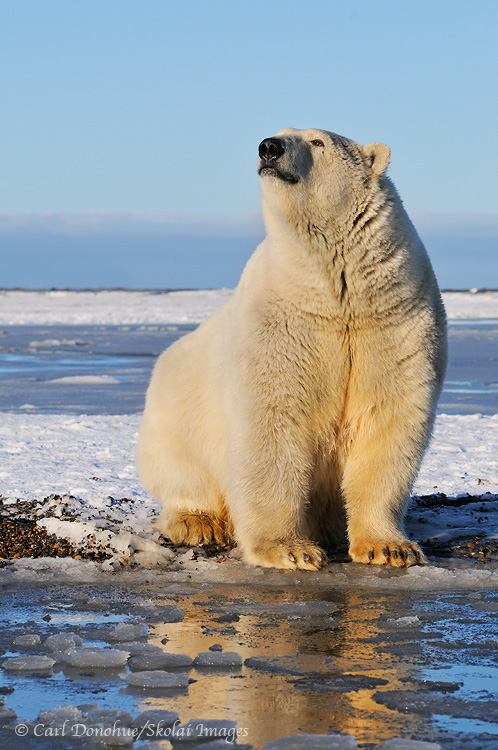
An adult polar bear sits on the shores of the Beaufort Sea, waiting for freezeup. Alaska. Please click on the image above to view a larger version of this photo.
Hey Folks,
So, I’m sure by now you’re all familiar with the 101 ways to heighten your photography reputation and business prowess through the magic of social media. There are nearly as many blog posts and articles on the secret mojos to becoming a social media icon in the world of photography and art as there are, surprisingly, photographers and artists out there in social media-land. Typically, these articles repeat the same tired old cliches: engage, time your posts carefully, be consistent, etc, etc, etc. Here’s another take on this ‘phenomenon’ of social media.
Recently I was in southeast Alaska photographing bald eagles. During that trip, I ran into 2 fellows from the BBC, filming for a wildlife documentary they’re making. Filming for another wildlife documentary they’re making. These guys have made several, and travel around the world filming for a company that makes some of the most amazing wildlife on the planet. The photographer, John Brown, also shoots stills (as well as video) and is represented by Getty images. Pretty cool gig.
I mentioned to him about possibly doing an interview with him, if he’d be so kind as to give me some time; he did, and I enjoyed a great couple of hours chatting with the 2 of these guys about wildlife photography and filmmaking and all the stuff the rest of us merely dream of. I’ll edit that interview down in the near future and put together an article from it.
During the course of the conversation, I don’t recall John mentioning social media once. Not once. He didn’t give me his twitter handle, or his facebook profile, or refer me to his G+ page. He mentioned his website, but the rest of the conversation was about his work; his photography and his art.