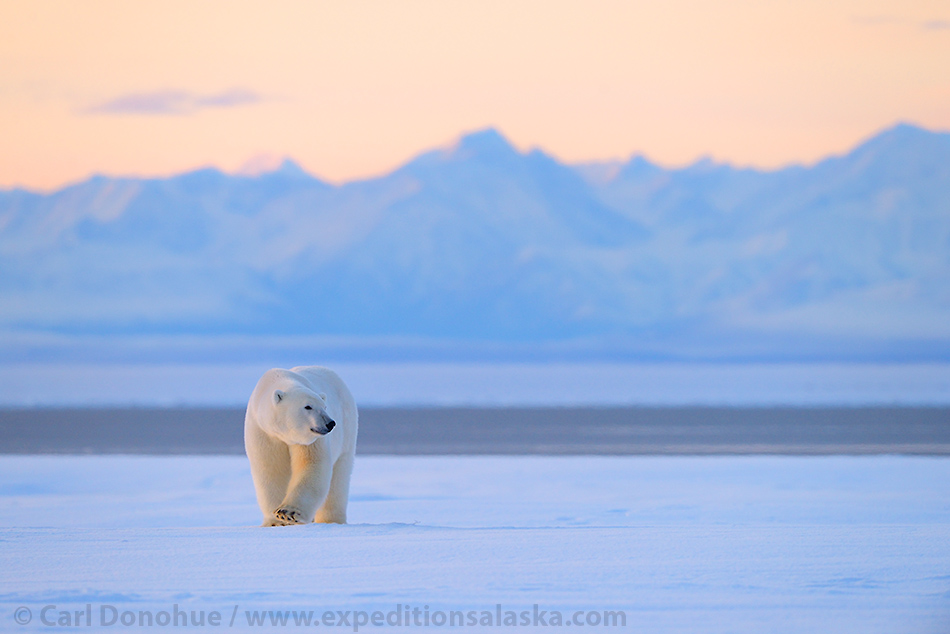
A Polar Bear and the Brooks mountains range in the background, Arctic National Wildlife Refuge, ANWR, Alaska.
Hey Folks
Here’s an image from my recent trip to the arctic to photograph polar bears. The light was great, and the landscape just swept away behind him. The more I shoot, the more these kinds of images seem to ring home for me.
There are a lot of places that are popular for polar bear photography nowadays, but few where you can grab a polar bear image with a massive mountain range in the background; and the infamous ANWR Section 1002 coastal plain in the foreground.
Polar Bear, Ursus maritimus, at sunrise, on Section 1002 of the ANWR coastal plain, and the Brooks Mountains Range in Arctic National Wildlife Refuge, Alaska.
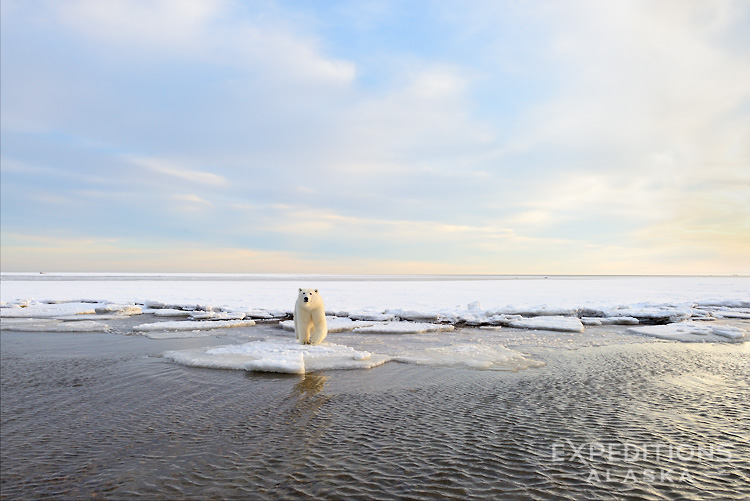
Standing on thin ice a polar bear curiously approaches. Polar Bear ice, in the Beaufort Sea, Arctic National Wildlife Refuge, Alaska. Please click on the image above to view a larger version of this photo.
Hey Folks,
Here’s a polar bear photo from my trip to the arctic last month. Given the predicament bears in the Beaufort Sea find themselves in (declines in accessible food due climate change), I thought the image a particularly relevant one.
Polar bears are classified as marine mammals, not, like their darker coated brethren to the south, mammals who earn their living on good old terra firma. Polar bears hunt, almost exclusively seals, and particularly 2 species of seals; primarily ringed seals (Phoca hispida) and less often, bearded seals (Erignathus barbatus). That alone makes polar bears particularly susceptible to population declines; any animal whose primary food source s merely one or 2 other species is somewhat vulnerable. This applies no less to herbivores who may exist on one or 2 types of plants. A crash (or boost) in the abundance of their food source will have an enormous impact on the population of their own species; a look at the lynx and the snowshoe hare cycles illustrates this.
So climate change has shifted the world for the polar bear; here’s a quick, and rough, summary of how.
The most productive waters in the arctic ocean are under sea ice, in the shallower areas over the continental shelf. Deeper water doesn’t hold light as well, and so tiny little critters like plankton and what not don’t do as well. They feed on the algae that grows and collects on the bottom of the sea ice. So where the plankton population is higher, so too is the population of the little critters that feed on plankton; shrimp and such. Fish eat shrimp, and bigger fish and regular size fish, and seals eat bigger fish. Where there’s no sea ice, there’s no algae growing. And if there’s no algae, no plankton, no shrimp, no regular size fish, no big fish, no seals and, you guessed it, skinny, hungry polar bears swimming around wondering why they can’t find any food.
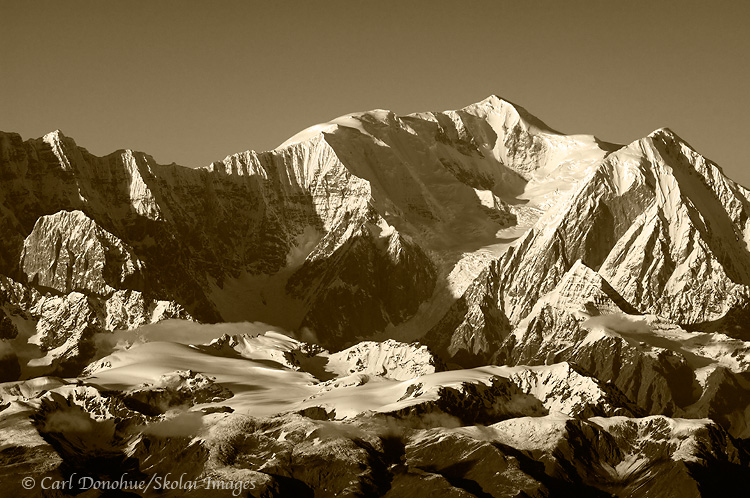
An aerial photo from the St. Elias Mountain Range, converted to B&W in photoshop. Wrangell-St. Elias National Park and Preserve, Alaska. Please click on the image above to view a larger version of the photo.
Hey Folks,
Someone asked me recently, “What’s a blog?” And after I got over the initial shock and wonder, repeatedly asking myself “is he (yes, he) for real?”, I tried my best to answer.
Seriously, what IS a blog? I guess it’s a journal or diary. Or a news outlet. Or a discussion forum. Or about a million other things.
Technically, the root of the term comes from the longer word “weblog”, meaning a log, on the web. Log like a record of some kind.
But what IS it? For me, it’s a double edged sword; a chore and a hobby. It’s work, sometimes, and sometimes it’s great fun. And sometimes it’s a pain in the a&&; especially when I have nothing of interest to write about, or when my blogging platform, wordpress, causes me no end of headaches and pain and grief as I try to solve some problem I’m having with the site. A site without a dynamic component, like wordpress, can be MUCH easier to handle than a blogging platform. If you folks out there had any idea how much of my life has been wasted as I’ve sat and stared at a screen wondering ‘now why the hell doesn’t it work’, you’d send money. Or drugs. Or money and drugs. Or, well, something. It’s ridiculous.
But I digress. Which is fine, of course, because it’s a blog, and it’s my blog, and I’m allowed to digress.
Huge congratulations to all those who did so well in the recent BBC and Natural History Museum Wildlife Photographer of the Year competition. Overall winner Greg du Toit has a remarkable image in “Essence of Elephants”. The winners of all the various categories should be proud of some fantastic photography.
I saw an interview with Paul Souders, winner of the “Animals in their Environment” category on BBC here. Congrats to Paul for an incredible image, and a great job in the interview.
Paul deserves huge kudos for getting out their, on his own, and doing the work. He doesn’t simply trek off to a well known and much favored hot spot and follow the hordes with their long lenses to do his photography.
Sure, Churchill is one of the great polar bear photography meccas, but no tundra buggy and over-sized group for his trip. Just himself, his boat and hours upon hours of exploration trying to find a subject; it’s worth noting Paul spent over a week on his trip and saw only 2 polar bears, after spending 12-14 hours riding up to 30 miles a day on the ocean; the first of the 2 promptly raced off never to be seen again.
This should be inspirational to so many of us who do this work. We don’t need a dozen bears in the vicinity, and we don’t need to follow the footsteps of the masses and we don’t need to shoot gigabytes of images to make a great image. We need to be creative, diligent and persistent. And, of course, having your own boat doesn’t hurt either!
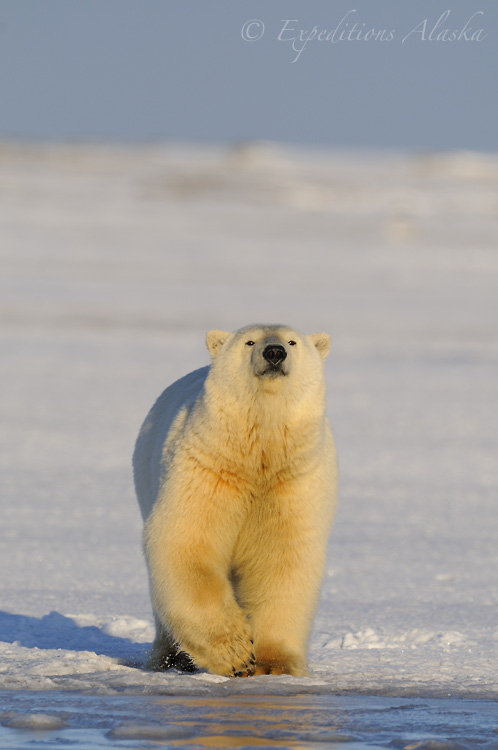
Polar bear (Ursus maritimus) on a barrier island of the coast of arctic Alaska.
Hey Folks,
Recently, a federal judge in Alaska, handed the US Fish and Wildlife Service (F&WS) some homework, when he decided that the agency had been a little overzealous in their designation of critical habitat for the polar bear. In 2010, the Obama administration set aside nearly 190 000 square miles of onshore and off-shore critical habitat for the polar bear. That’s an awful lot of land (larger than the state of California). But polar bears, it seems, are an awful lot of bear.
Last month a federal judge ruled that it’s apparently ‘too much’ land. Which is in itself noteworthy, as the judge isn’t really there to decide what’s too much and what isn’t too much land for a polar bear. The judge is supposed to simply review the decision and see whether it follows the law.
The judge also said the F&WS decision had some “procedural deficiencies”; much better. This means, they hadn’t quite followed the law. So what was one of those deficiencies? How about this one? Section 1533(i) of the Endangered Species Act
A screenshot of how google images displays photos, hotlinking the original file, with a “Save Image” option.
Hey folks,
*Update, Nov 13, 2013 – there is now a formal antitrust complaint registered by CEPIC, the Center of the Picture Industry, thousands of photographers and picture agencies, against Google on this matter. See here.
So, by now a number of people around the web have commented on the new Google Images display; some even talking about how nice and clean the interface looks. What I haven’t seen is anyone discuss how the Google Mobile App now works.
At left is a screenshot from my iPad of how Google Images, using the google app, displays photos on mobile devices. Underneath the image is a tiny thumbnail showing where they’ve extracted this photo from (and where the source file is hosted – in this case, my website).
When the visitor clicks “Options”, under the file, the 3 options are “Save Image”, “Similar Images” and “View Web Page”. That’s right, the very first option is “Save Image” – Google grant you the option to save the full size jpeg right from my website, without you ever having to actually visit my website.
This is a pretty ballsy move, I must say. There’s been quite a bit of chatter around the ole interwebs about the new google images, on various web masters forums and so on, as well as some of the social media. Twitter, Google plus, etc. See Official Google Rollout, or Webmasters World. Safe to say, a lotta people are peeved. I’m surprised no one has mentioned this (that I’ve seen, anyway).
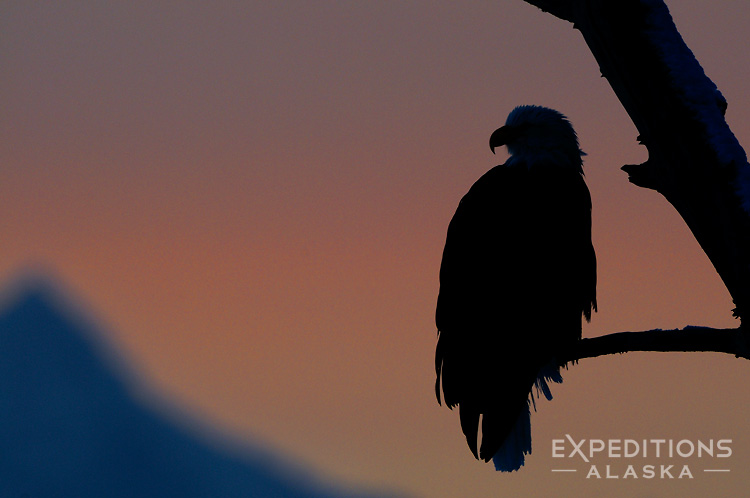
A silhouette of a bald eagle, perched in a giant Cottonwood tree, against the St. Elias Mountain Range at sunset. Chilkat Eagle Preserve, Alaska. Please click on the image above to view a larger version of this photo.
Hey Folks
One of the things I see happen most frequently in the field with groups of photographers is this kind of herd mentality that almost invariably works against the photographer. Particularly when things are not going perfectly. It’s cold, the eagles aren’t doing much, everyone’s been out for a long time, and soon enough, people start talking of packing up, of food and hot drinks, or editing images or watching TV, and before you know it, as the light ebbs, ever so slightly, people pack up and head for home/motel/town.
We all know once the light, on a gorgeous clear afternoon, goes down, the photography for the day is over, correct?
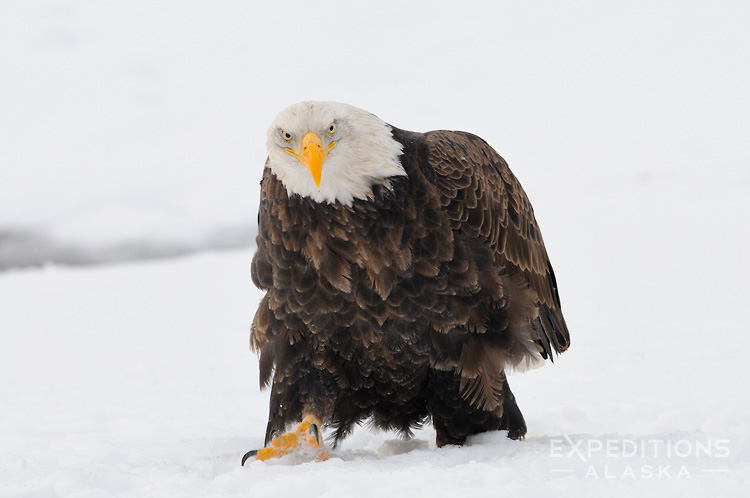
An adult bald eagle walking through soft fresh snow. Chilkat River, Haines, Alaska. Please click on the image above to view a larger version of this photo.
Writing Your Photography Business Plan
Excerpt #2
Mapping out where you want to go with your business, any business, probably starts best if you understand where it is right now. There’s no point in trying to decide how to get somewhere if we haven’t first identified where we are. There’s little point in trying to figure out a place we would like to be without knowing upfront whether or not we’re already there.
So sit down and assess, honestly, where your business is. Don’t just do the accounting and look for a profit/loss sheet. That’s important, but go beyond that. Look over your portfolio/stock files and assess where your work is. For a stock nature photographer, how’s your photography coverage of bald eagles? Los Vegas city lights? Blue whales? From a business viewpoint, that’s all about inventory (what an ugly word that is). That’s part of what your ‘product’ (perhaps an even more ugly word) is, so examine it. Write down, in some brief statement, where your work is at. For you.
How about your service? Where is that at? Email response, print quality, timeliness and efficiency of getting files off to the lab, prints off to the gallery/UPS, images off to your stock agency/website. Examine it and see where you stand. And if it sucks, note it down. If it’s awesome, note that down too.
How about your advertising? Where is that at? Beyond just advertising, how about your business marketing in general?