Category Archives: Rants

A new day on the way

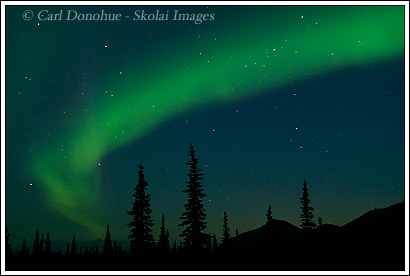
Northern Lights over Wrangell-St. Elias National Park, Alaska.

Hey Folks,

I can’t overstate the import of what the world saw this past week. For the first time ever the people of the US elected an African American president, Barack Obama, and the value that such a moment carries is immeasurable. A bare 40 years have past since Bill Russell became the first African American head coach in the NBA. 10 years ago the world saw the first black CEO of a Fortune 500 company (how ironic is it that Franklin Raines became CEO of — wait for it — Fannie Mae!!!!) There are innumerable examples of things like this all highlighting the magnitude of this moment. But perhaps none more than this one;

Continue reading
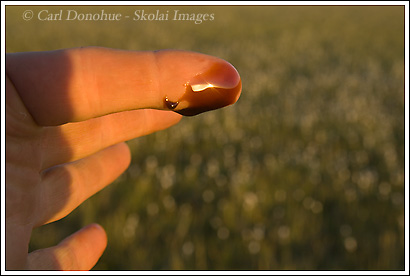
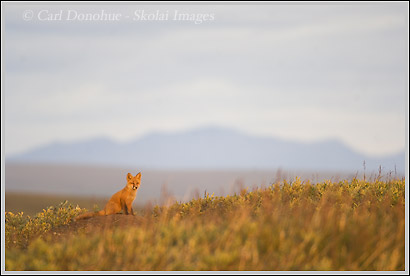
The Golden Oil of ANWR – it’s over!

oil in ANWR

Hey Folks,

By now, you’ve all heard the rumors, I’m sure. How the massive oil fields, despoiling the pristine earth lying deep beneath the frozen, barren tundra of the lonely coastal plains of the Arctic National Wildlife Refuge (known by its acronym ANWR), could save our planet. How, if only those whacko enviro-freaks, who are bent on ruining the lives of countless hard-working patriotic Americans, have consistently and ruthlessly undertaken to bully the American Congress and the oil industry into submission, and not allow the oil and natural gas that is currently being wasted underground to be extracted and delivered to gas stations across America.

I’m sure you’ve read the facts, and seen how, if the estimated 10 billion barrels of ANWR oil could be drilled and refined, gasoline prices at the pump would plummet; but not just the gas prices, Continue reading

Red fox kit, Arctic National Wildlife Refuge, alaska

red fox kit on the coastal plain, arctic national wildlife refuge, alaska.

Hey Folks,

I just saw this article on CNN’s website. From the first paragraph, ‘President Bush said Saturday that the Saudis’ modest increase in oil production “doesn’t solve our problem,” ‘ – The whole tone of the article is an acknowledgement that such a relatively small increase in oil supply, for the US, is meaningless. This increase could bring gas online to the American market almost immediately. At the same time, the current US administration is arguing for the opening of the Arctic National Wildlife Refuge (ANWR) to oil and gas extraction. The US Govt’s own studies yield a mean peak in oil supply from the Refuge of under 900 000 barrels a day. That peak would arrive about 10-12 years AFTER the oil supply came online – and the oil is expected to take 10-15 years to come online after any legislation allowing drilling their might be passed. In other words, it is expected, under optimal conditions, to be 25 years before that peak in supply is reached. So if the Govt decides next year to open the Refuge to drilling (fortunately the US Senate just voted it down, again, for this year), we could hope for fewer than 900 000 barrels a day to come forth in the year 2033.

The second point about this is that one of the lines being touted most strongly for drilling in the Wildlife Refuge (ANWR): Continue reading

Conservation Photography

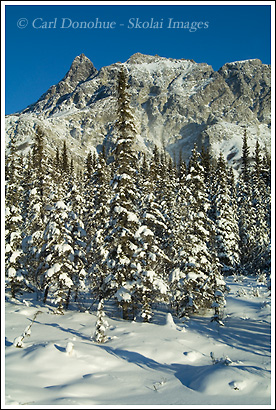
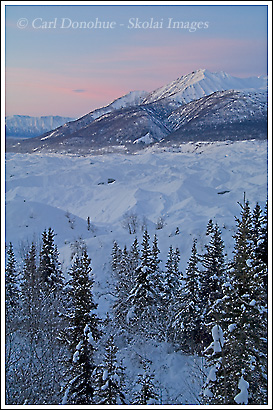
Crystalline Hills, Wrangell Mountains, winter, Wrangell-St. Elias National Park, Alaska.

Hey Folks,

I stumbled across this article earlier today, and thought it might be a good topic for a post. The subject is conservation photography, rather than typical nature photography. “Although nature photography can appeal to a viewer’s aesthetic sensibilities, the truth is that photography has much more potential to play a role in conservation than has yet been realized. When photographic skills, creative talent and scientific understanding converge on a subject the outcome can be powerful.”

I think it’s a great article, and an important one, but I think it’s simultaneously important that we remain aware of the capacity in which photography can harm our, as well as our audience’s relationship with the natural world.

Continue reading

The Arctic National Wildlife Refuge

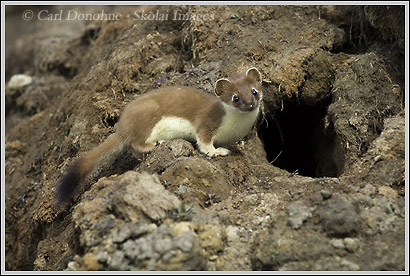
Weasel, ANWR, Arctic National Wildlife Refuge, Alaska

Hey Folks,

Here’s a follow up to my recent post on proposals to drill for oil in the Arctic National Wildlife Refuge, Alaska. Whilst that post concentrated on facts and figures and data and so forth, I think greater arguments ought be made. As you can see from a cursory read of that post, it’s too easy for folks to cut up a pie in any way they choose in order that it might yield the slices that best fit their appetite. I suppose part of the reason for this is that the pie itself is, ultimately, generated by our cultural institutions, our way of living, our way of seeing the world.

The potential number of barrels of oil the Arctic National Wildlife Refuge may yield is somewhat of an abstraction – what constitutes a “barrel”, for example? How large is the footprint of a drilling rig? How many caribou will that impact?

Any measurements we choose to use are simply yardsticks of our own worldview (I guarantee you, for example, that the Porcupine Caribou Herd would, if asked, probably give a very different answer to even our cleverest scientists). What if we don’t look upon the world with that viewpoint, however? How else might we be able to see the world, and in what ways might we possibly benefit from a different angle? Continue reading

Drilling for Oil on the Coastal Plain, ANWR, Alaska

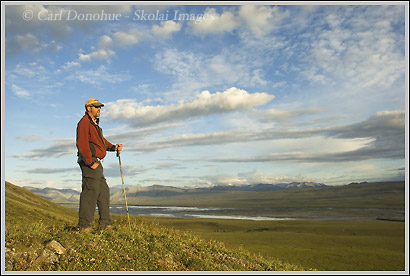
Hiker hiking on the coastal plain near the Canning River, Brooks Range, Arctic National Wildlife Refuge, Alaska.

Hey Folks,

As it hits the news again here in Alaska today, I thought I’d post about the current proposal to drill for oil in the Arctic National Wildlife Refuge. This post is from an earlier version on my other website, Expeditions Alaska. The photo above is a buddy of mine hiking on the coastal plain near the Canning River, Section 1002, of the Arctic National Wildlife Refuge (ANWR). I presume most readers here have heard something about this, so I’ll skip the introductions, and go straight to my arguments here. I’m not a big fan of arguing by numbers, but we can discuss the ANWR issue with “facts” if you care to: in doing so, it might be interesting to approach this issue by first looking at, and dismantling, the arguments of proponents of drilling. Next month I’ll look at some other reasons, probably more important, IMO, why we need to be as active as we can in our opposition to proposed legislation. First, a look at the typical arguments put forward by those in favor of drilling:

1. National Security, dependence from Middle East foreign oil & the US is ‘better off’ if we drill our own oil. Continue reading

Say no to Aerial Predator Extermination in Alaska

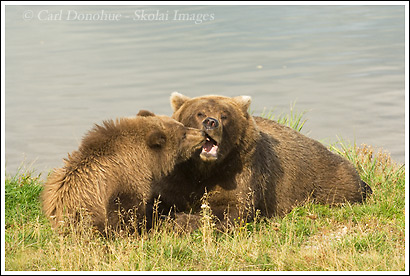
Grizzly bear sow and cub, nuzzling, Katmai National Park, Alaska.

Hey Folks,

I read yesterday afternoon of a couple of pieces of legislation currently under consideration in Alaska that concern me greatly. Bill SB 176 and bill HB 348 are proposals by the Alaska Board of Game that prepare for a mandate by the Board of Game to pursue what they call “aerial predator control programs” of wolves, brown bears and wolverines. SB 176 is an attempt to give the Board of Game free reign over the decision making process, with no requisite consideration of input from the scientific community – i.e., if the folks on the Board feel like mandating aerial shooting, or den killings of wolf pups, they need show no concern or evidence of supporting scientific study. HB 348 is a proposal to shift wildlife to a category they call “public assets”, which includes minerals, oil, and so forth, effectively removing them from public voice. This means the Board of Game can then make decisions such as aerial shooting with no input from or responsibility to the people of Alaska. I’ve written to local legislators here in Alaska on this issue, and I thought I’d post an amalgam of my letters here.

Continue reading

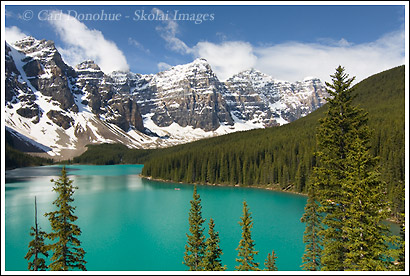
Moraine Lake Photo, Wenkchemna Peaks, Banff National Park, Alberta, Canada

Moraine Lake photo, Wenkchemna Peaks, Banff National Park, Alberta, Canada.

Hey Folks

Here’s another image from the Canadian Rockies – immortalized on the Canadian $20 bill. Moraine Lake is one of the classic views of the Canadian Rockies, indeed, of anywhere. It’s a special place. The lake is most likely mis-named – it’s probably not a moraine that formed it at all, but a rock slide. The peaks that tower above the inviting turquoise lake are called the Wenkchemna Peaks. “Wenkchemna” is the Stoney Indian word for 10. The Stoney Indians lived in the area, and guided early European settlers and explorers in the region.

Samuel Allen and Walter Wilcox were 2 of the first European explorers in the area, and they’re generally credited with much of the initial exploration of the Canadian Rockies – given, of course, that various Indian Nations already lived there, and had done so for centuries, and called the place home. Wilcox was especially fond of Moraine Lake and Wenkchemna Peaks,

Continue reading

Exxon Valdez Oil Spill and the Supreme Court

Sunrise in wintertime, Kennecott Glacier, Wrangell-St. Elias National Park, Alaska.

Hey Folks,

I was going to write tonight about another company that I’ve had great dealings with, and do a little plug for them, but I’ve changed my mind. The news has been all about the Exxon Valdez case, so maybe I’ll make a few notes here about this subject. For those of you who haven’t been following it (and I haven’t followed this latest round too closely), the US Supreme Court is currently hearing arguments from Exxon and the plaintiffs, folks from the the Prince William Sound, Alaska area, specifically concerning punitive damages. I’m no lawyer, so my comments are worth the price you’re paying to read them – but I’ll share them here regardless. 🙂

In late March 1989 the Exxon Valdez oil tanker dumped nearly 11 million gallons of crude oil into Prince William Sound. These estimates come largely from simple math – 53 million (the number of gallons originally onboard), minus what was later reclaimed from the vessel equalled 10.8 million gallons missing, i.e., spilled. Many watch groups argue these estimates, though widely accepted, are underreported, because much of the oil recovered from the ship was diluted with sea water. The accident occurred, investigations found, primarily because the ship’s captain was drunk and sleeping at the time. Continue reading

Webhost digitalinet – a review.

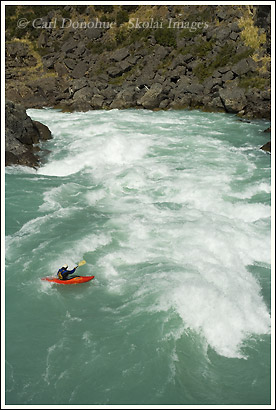
A kayaker runs the huge whitewater of the first of 5 Class V rapids on the Baker River, Patagonia, Chile.

hey Folks,

So whilst I’m locked down in the dungeon of Anchorage, waiting on the mechanics to tell me my van is fine, and any possible breakdowns were/will be my own doing, I’m dealing with another issue. My backpacking/guiding website, Expeditions Alaska was set up, with the help of a friend Bugsy, a fantastic artist from Atlanta (now in LA), years ago, and hosted, at the Bugs’ recommendation, on digitalinet.com. Well, it’s been an adventure, but digitalinet can go to he**.

Their website indicates 24/7 tech support, and toll free phone support. Their website fails to provide any phone # or contact information, other than a standard form to fill out, at all. Not even an email address. I did, via extensive Google searching, extract a few of phone numbers that were supposedly related to digitalinet.com .. 2 of them were no longer working, the other 2 both yielded immediate voice mail messages, and I couldn’t get anyone to return a single call from either of them.

Continue reading