
Hey Folks,
Here’s a photo I took last spring of a male Pine Grosbeak in Wrangell-St. Elias National Park. I had set up a couple of feeders around the Shack and these gorgeous birds would come in every day and have a good ole time.
Other regular visitors to the buffet were Black-capped and Boreal Chickadees, Common Redpolls, Hairy and Downy Woodpeckers, Gray Jays and, of course, the effervescent Red Squirrel. Ravens came by, from time to time, but rarely dropped down to the feeder.
The Pine Grosbeaks were my favorite though.
The grosbeaks are actually a finch, the largest of the boreal finches. A group of these birds together is called, wait for it, a ‘gross’ of grosbeaks. They’re such a cool bird, and very tolerant of my puttering around the cabin; they’d generally ignore my comings and goings.
I grabbed a small white spruce sapling that some snow-machiners had run over and destroyed, and used it to set up the perch. For a background I hung a fleece blanket up and positioned it for a nice clean background. It’s a little bit ‘contrived’, but hopefully it works OK.
It was pretty amazing to see how quickly the birds learned of a new food source. Within a couple of hours of setting up the feeder birds were chomping down. I was able to keep the feeder squirrel free for a month or so, but soon enough the little fellow’s persistence paid off, and I had to reconfigure the setup.
After a little while I just set up 2 feeders, far enough apart that the squirrel could feed at whichever one he chose and would tolerate the birds eating from the other one. He’d get pretty defensive if saw anything else eating ‘his’ supper. He regularly chased away Snowshoe hares that were easily 4 or 5 times larger than himself when they came by in the evening. I even heard one story, from a neighbor, of a red squirrel chasing a least weasel off a snowshoe hare carcass it had only just killed. That’s pretty darn awesome!
It was pretty cool to have the same birds drop by every day, and watch them closely. I came to recognize a few of the individuals, but no more than maybe 3 or 4. This male was pretty bold, and would approach readily if I ventured outside with some seed. The birds hung around through the coldest months, but pretty much disappeared by the end of March.
I hope to get back out to the park soon, and will see if I can find this guy hanging around the neighborhood.
Pine Grosbeak photo, Wrangell-St. Elias National Park, Alaska
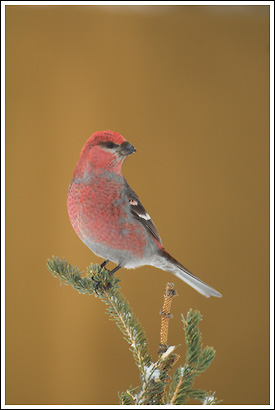
Another Pine Grosbeak Photo.
Sorry for the delay in posts, again. I came in to Anchorage for a few days, and have been sitting, faithfully, at my computer trying to make it start. It locked up during an update, apparently, and then I couldn’t get it to start. I managed to back up most of the data on it, though it took forever. I thought the HD was fried, but it appears no problems there. I’m still working on getting all the programs back up, etc, and it’s taking way too long. I’m about sick of this computer business – I’m ready to head back to the safety of the woods. I’ll take 40-50 below zero temperatures over technology problems anyday. This stuff is too much hassle.
I did manage to take a few bird photos in the park before I came back out. They’re tricky little critters to shoot, but lots of fun. This male Pine Grosbeak was pretty cool, and I managed to get a few images.
They’re named a ‘pine’ Grosbeak because they do so love the pine or coniferous forests (I spose Coniferous Grosbeak doesn’t sound so cool a name). Technically, they’re not a true Grosbeak, but a large Finch. The scientific name for the bird is Pinicola enucleator, which is pretty fancy. ‘Pinicola’ translates as ‘pine dweller’. They’re one of the few birds who winter this far north .. all the smarter ones fly south to warmer climes.
Black-capped Chickadee Photo
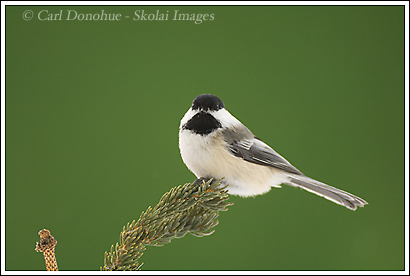
Here’s a Black-capped Chickadee (Poecile atricapillus), year-round Alaska resident, perched on a small spruce tree.
There’s not a lot of birds in the great north woods this time of year, so it’s always a treat when they stop by. I’ll try to get a photo of his close cousin, the Boreal Chickadee – so far, no luck.
Spruce Grouse
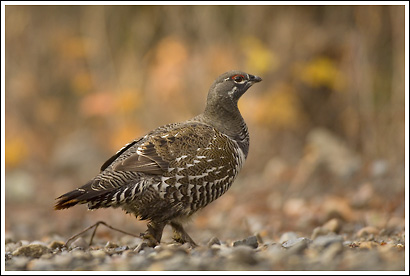
Here’s a male spruce grouse that I photographed. These birds are SO cool, and will completely bury themselves under the snow in the winter, blasting up from their hides in a frenzied eruption of snow, feathers and noise when you stroll by – and scaring the hiker immeasurably in the process.
I’ve not had any luck with photographing grouse in the park before, though I have photos from other places, so this one I was glad to catch.
Northern Shoveller, Wrangell-St. Elias National Park, Alaska
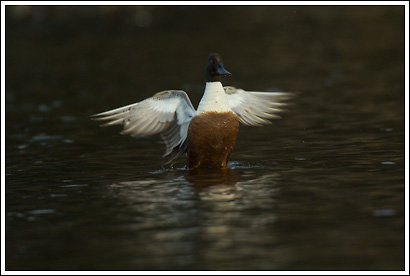
Here’s a male Northern Shoveller, photographed from my tent blind on the north side of Wrangell St. Elias National park, Alaska.
I had little luck with these birds, but a ton of fun. And lots of sitting, hidden in my little blind, waiting for them to come close.
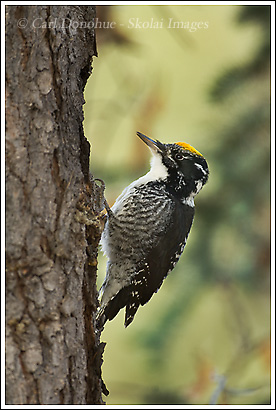
3 Toed Woodpecker photo
Hey Folks,
Here’s a 3-toed woodpecker (three-toed woodpecker – Picoides dorsalis) from Wrangell-St. Elias National Park.
Welcome back, albeit briefly. I’m going to spend the next couple of months recharging a bit, and breaking from the net and blogging and writing and reading and blah, blah, blah. A little quiet time will do me good, I think. Hopefully during that time I’ll pick up some new images and also try to come up with some ideas to write about that will make the blog a little more interesting. We’ll see how that goes.
I’ll try to make a post or 2 along the way. In the meantime, you folks be careful out there.
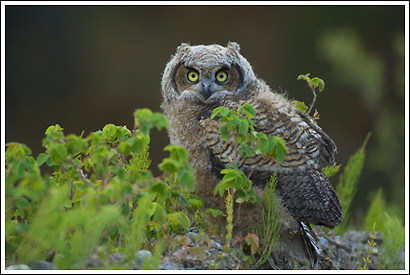
Great horned owl chick, Wrangell St. Elias national park, Alaska
Hey Folks,
I was gunna call this post “You Can Call Me Al”. 🙂 🙂 🙂
I really wanted to get some owl photos this winter, and I heard them outside the cabin nearly every night. But i could never manage to spot one. I did run across a nest towards the end of winter, but it was buried in a thick grove of trees, and too high up to afford any photos, without seriously disturbing the nest.
So I pretty much figured no owls for me this year.
Until this particular evening comes along. I’d photographed trumpeter swans, loons, some flowers, and was poking around just as dark rolled in (dark as it gets in Alaska in June) and look what I find. Eventually there turned out to be 3 Great Horned Owlets, and an adult in the area. The adult was kinda skittish, and bailed, so I didn’t stay around long, and the light was toast anyway (this was shot at 1/30th of a second, f4). But I was overjoyed to even see, nevermind get to photograph, these little guys.
They’re SO cute! Here’s another.
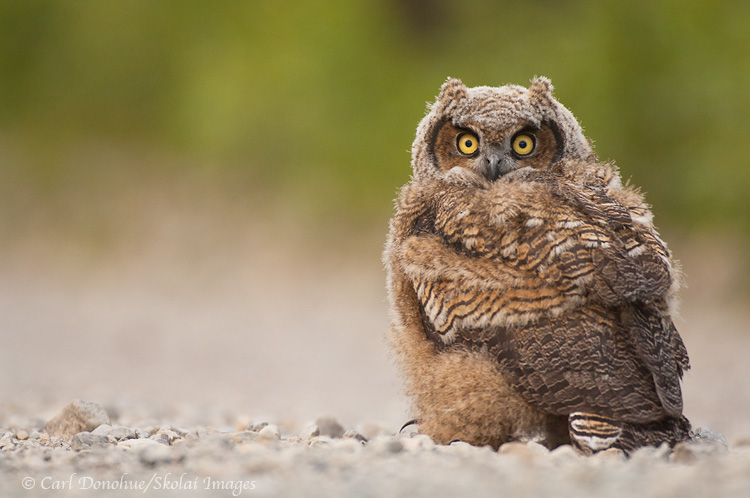
Great Horned Owl chick (owlet – Bubo virginianus)
Wrangell-St. Elias National Park and Preserve, Alaska. The chicks were just fledging and learning to fly. This little guy had landed on the grounded, and before long flew off to a nearby white spruce tree in the boreal forest. This little guy wasn’t quite sure what to make of the weird guy with the camera, laying prone on the ground nearby.
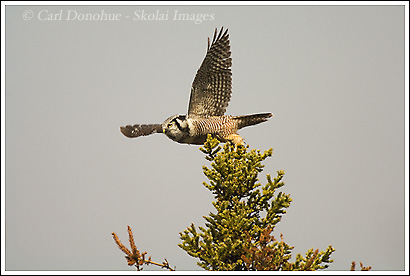
Northern Hawk Owl photo
Hey Folks,
Owls rock!
Here’s a Northern Hawk Owl (Surnia ulula) taking flight from its perch on the top of a white spruce tree.
These owls seem to be much more tolerant of my presence than their larger cousins, the Great Horned Owl. They’re also much more active during the daytime. Northern Hawk Owls tend to live in the boreal forests of the north, but do move south in leaner years when food is scarce. This year it looks like a bumper year for owls up here, so I doubt many of them will head south. Hopefully, that means I’ll get some photos. ?
Alan Murphy would be proud. Adapt, improvise, overcome. Well done.
I think grosbeaks are under appreciated beautiful birds! Great photo Carl! Looks like you need a slightly taller blanket. 🙂
hey Peter,
Thank you, appreciated.
Hey Ron,
Thanks – and I agree – Grosbeaks are beautiful birds and rarely get the love they deserve. I said the same thing about my blanket when I was curled up underneath it and the temperature sank to minus 50?F. 🙂
Actually, what I needed here was simply to string the wire on which the blanket was hanging a little higher.
Cheers
Carl
Pingback: Alaska Motorcycle Road Trip