Hey Folks,
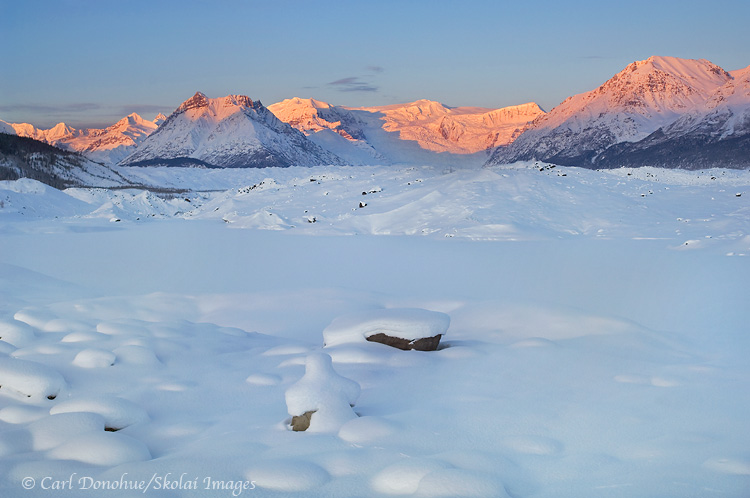
The Wrangell Mountains in winter. Alpenglow catches the eastern edge of the range. This view is looking up the Kennicott Glacier. At right is the edge of Bonanza Ridge, Jumbo, Then Stairway Icefall, Donohue Peak just left of center, and the Ahtna Peaks behind that to the left.
Winter’s finally wrapping itself up here in the north; it lingers much as the sun’s final rays cling to these high peaks at days end. Spring makes it’s way north slowly, and and is completely diurnal for now. The days, growing longer weekly, yield. But the night belongs to the winter, the cold, dark silence of the quiet time.
This is the first real “view” I ever had in Wrangell-St. Elias National Park and Preserve, all those years ago when I first ventured north on a backpacking adventure. I’d taken a bus from Fairbanks south, and the weather wasn’t so great; not raining, but overcast. I didn’t really have any idea of the scale of the landscape I was amongst at the time. The bus dropped me off on the highway, at the Edgerton Cutoff, and I hitch-hiked from there in to McCarthy (about 90 miles). That was an adventure in itself, maybe I’ll recount it another time.
Upon arriving in McCarthy – well, let me correct that – upon arriving just outside McCarthy (the road ends at the Kennicott River. A small footbridge leads across the river, and it’s a half mile walk in to town), I set up camp by the river, had a bite to eat, and went for a walk up the river, toward the Glacier. The sun had come out, and it was a gorgeous afternoon. This scene, sans the snow and alpenglow, was pretty much what I looked at from my tent. And I hadn’t even begun my backpacking trip yet! Regardless what the next week or so brought me, I knew I’d be back here sometime.
And so I have been. Many times, in fact. And hopefully, many more. I’ve hiked and explored quite a bit of the park, including some pretty remote areas in the backcountry. Wrangell-St. Elias National Park is home to some pretty grand scenery, I assure you, and I fully intend to explore some more, and find and photograph some of those lesser known gems I stumble upon. But, I also enjoy going back to some of the scenes that caught my eye on that first ever trip here, and are, largely, the reason I’m in Alaska today. And, I hope, will be for tomorrow.
Winter, Wrangell-St. Elias National Park and Preserve

This photo from my most recent trip to Wrangell-St. Elias National Park and Preserve, over the Xmas- New Year. The note below was penned one beautiful evening last winter, by candlelight in a tiny cabin in the Alaska. There’s nothing quite like the silence and the cold of the boreal forest in an Alaskan winter.
The Paradox of Silence and the Cold
Silence is the aural equivalent of stillness. Both appear related to time, or at least our perception of it. Winter in the north seems to be abundant in both. The northern winter, often so harsh and unrelenting, is also the time when the place becomes still and silent.
Sometimes it feels so still, so beautifully still, that I am sure time must have paused. Time, perhaps, rests, fatigued after the frenzied bustle of summer and the frantic world of countless reproductions eases. The textbooks tell me that such is not possible, but maybe, just maybe, they’re wrong. I remain unconvinced. Time just may well pause here in the north.
How can they say time doesn’t stand still? Surely even the slightest of movements would be apparent in this world of calm and yet there is none. Nothing moves here, why time? The air, so still. A fresh layer of snow muting even the slightest of sounds, mutes even movement. The sun, ever low on the horizon, hangs, and it too pauses, before continuing its journey to the next of days.
The depth to this stillness is the exclusive domain of winter – no other season holds time quite like this – not a breath, a whisper, a thought to break the silence. The air is too brittle, so thin it’s almost fragile.
The cold, so lifelike at times; a sinewy, shy, elusive fellow, comes in the night to greet me in the morning. His welcome is my solace – without it, who alone could tolerate this stark, silent vastness? The cold becomes my friend, I can accept him or resist him; the latter is clearly a path toward my discontent. Rather, like a lover, the cold is best embraced, accepted, and loved. Without my shivers for company, what solace could the cold know?
Like an old friend, I open the door when he knocks, for I know his approach well, as he, in turn, anticipates, my opening the door. A greeting, the cold, I embrace, you bring me warmth.
Carl
With the long foreground here and the sun-drenched mountains, you have successfully captured both the cold, distant openness of Alaska and the beauty. Great image.