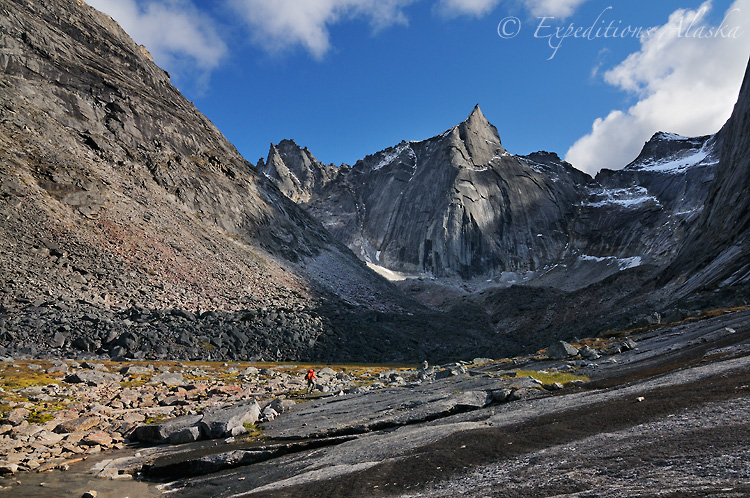
A backpacker walking in the Aquarius Valley, Gates of the Arctic National Park, Alaska. Few of the visitors here ever get this far back up in the valley; it’s a bit of a mission to get way back here.
Hey Folks,
Looking over a few old Image folders on my hard drive I found this photo (among others) that I hadn’t yet processed. This one I took on a hike in Gates of the Arctic National Park. We backpacked up into the subalpine area with 5 people, and did a combination of basecamping/dayhiking and backpacking. It’s rugged, steep country, and can be challenging underfoot.
This dayhike, we started out with myself plus 4 people, and by mid-afternoon were down to just myself and one other; Jodee V, who’ll walk just about anywhere! The rest of the group had stopped along the day, each person reaching their own threshold of how many rocks they wanted to walk over.
What struck me about this photo is how, for me, it perfectly evokes the exact feeling that walking in the mountains gives me. It’s infinitely vast and expansive, yet also confined and defined. It’s a feeling of being both everything and nothing, all at once. It’s an amazingly “alive” feeling.
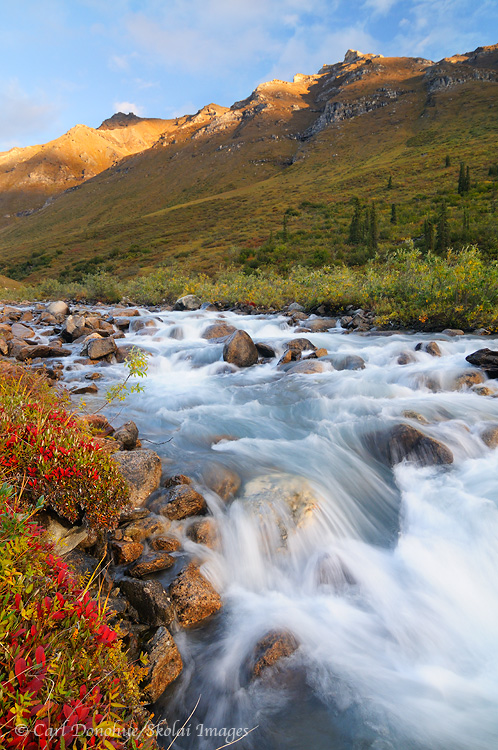
Fall colors along Arrigetch Creek in Gates of the Arctic National Park, Sunrise over the Brooks Mountains, Alaska. Please click on the image above to view a larger version of this photo.
Hey Folks,
Here’s an image I took in August on a trip to the Arrigetch Peaks, in Alaska’s Gates of the Arctic National Park and Preserve. We’d had a great early morning hike up in to and around the Maidens Valley for sunrise, and I shot a few nice images of the peaks catching early light. Afterward we hiked back to camp to catch an hour or so of sleep before breakfast, but I took a few shots along the creek before my nap.
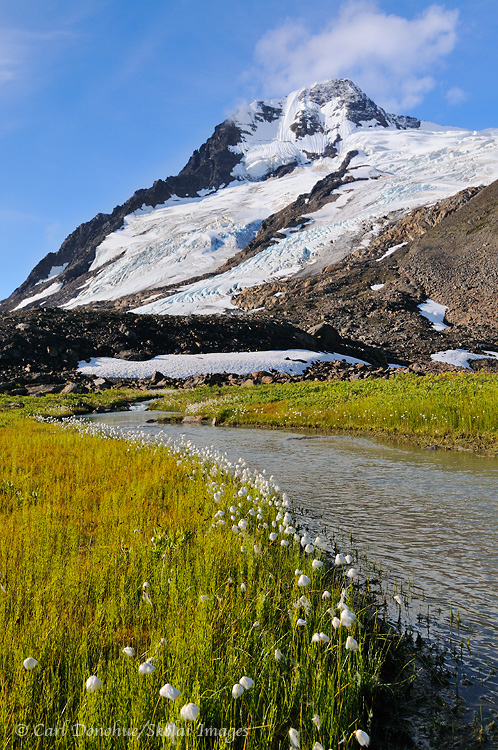
Alaska Cotton, and glacier, near Iceberg Lake, Wrangell-St. Elias National Park and Preserve, Alaska. Please click on the image above to view a larger version of this photo.
Hey Folks,
We just got off a great hike in the Chugach Mountain Range, Wrangell-St. Elias National Park; the Iceberg Lake to Bremner Mines route, a popular hike I’ve done a number of times now. This trip was an exciting adventure, as always, with a mixture of weather, some great folks to hike with, tons of cool stuff to see.
We actually took what is for me a new route part of the way, and skipped one of the climbs; heading straight for a glacier moraine and on to the ice instead. That was kinda cool, and I did find a great spot to camp that I hadn’t been to before, which is always a treat.
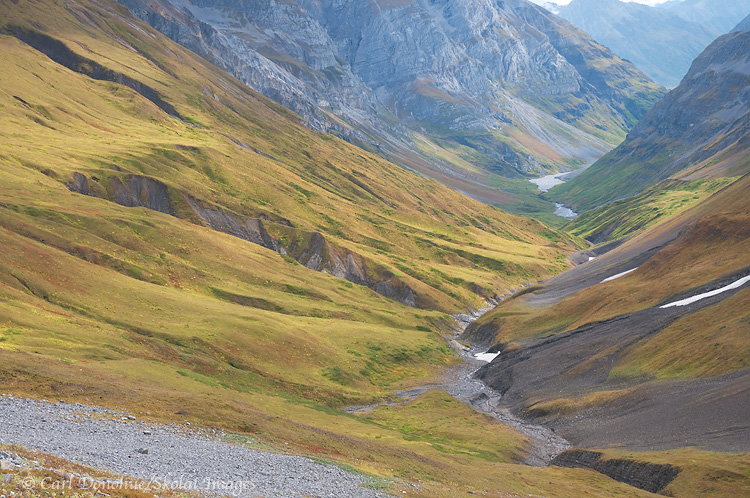
Hidden Creek valley, in the Wrangell mountains. A popular backpacking route, Hidden Creek in the Wrangell Mountains over to the Lakina River is a wonderful hike. Wrangell-St. Elias National Park and Preserve, Alaska.
Hey Folks,
I’ve headed out again for the next trip, but will schedule this post in advance. This is from close to the pass above Hidden Creek, looking back down the valley we’d just hiked. We walked up the south side of the valley (right side in the frame), then crossed and climbed up to a bench on the north side of the pass. Camping up there was simply awesome. 2 bands of Dall sheep were wandering the mountains above us, and we saw mountain goats higher still.
Hidden Creek is simply stunning. This particular afternoon, we crested the pass and camped on the other side of the saddle, which is where the previous post’s photo (“Reflections”) was taken. Suffice it to say that the back half of the trek is just as rocking as the front half.
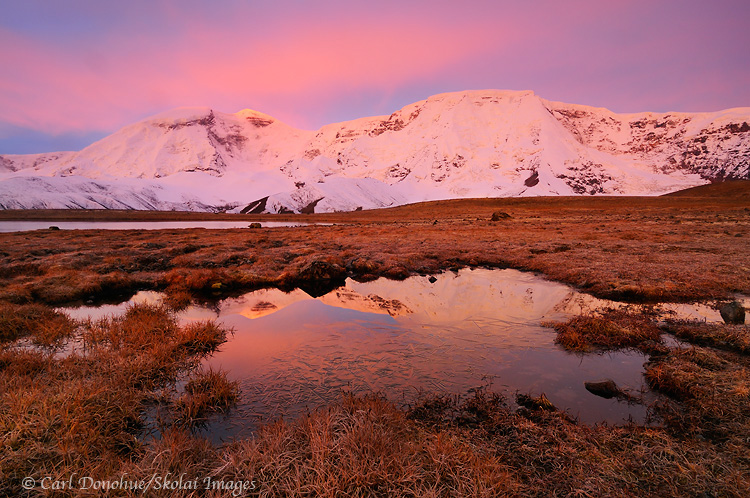
Dawn rises over Mount Jarvis, alpenglow lighting the mountain and it’s reflection. Fall, Mt. Jarvis, Wrangell-St. Elias National Park and Preserve, Alaska.
Mt Jarvis, in all it’s 13 421′ glory.
A recent trek up around the Mt Jarvis area yielded some amazing scenery and fantastic views. I hadn’t been to the area before, and will definitely be heading back next year. To camp within a few hundred yards of this mountain face is a treat indeed. We were pretty lucky, for sure, considering we were camped at about 7200′ in the Wrangell Mountains in September!
We had a real mix of weather, from snow storms and rain to gorgeous sunny days; which I’ll take gladly. The trek was a lot of fun, with a great couple from Chicago, Brad and Tracey. I appreciated their flexibility and easy going nature, which allowed me to sneak out a morning or 2 and grab some photos. Tracey joined me once or twice, and both Brad and Tracey got up early on our final morning to make a a mad dash out the Nabesna Rd in the hopes of snaring some nice alpenglow on Mt Sanford. Much appreciated, Tracey and Brad. What a gorgeous morning that turned out to be.
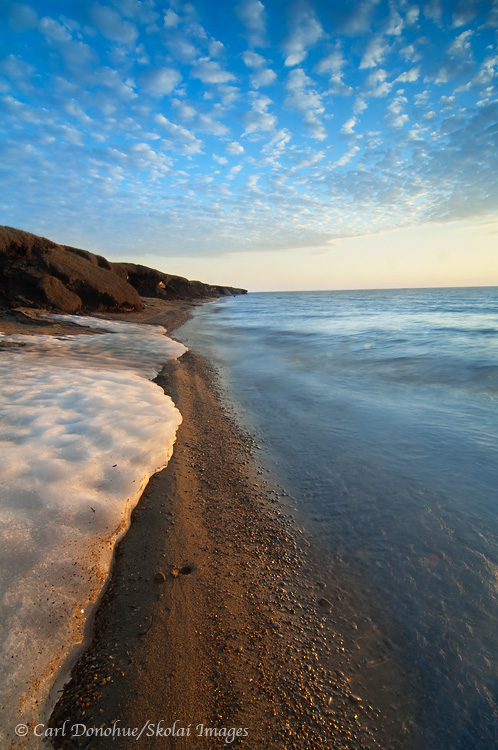
The Beaufort Sea along the coastal plain of the Arctic National Wildlife Refuge (ANWR). The Arctic Ocean sea ocean, after spring breakup, rests on the beach. Melting permafrost in the bluffs signals warming temperatures. Arctic Ocean, Coastal Plain, ANWR, Alaska. Click for a larger photo.
I hiked from our final camp across the coastal plain (well, across part of the plain, not the whole thing) with Steve Weaver hoping to photograph some of the icebergs we’d seen the previous day along the shoreline. Unfortunately, strong southerly winds had blown almost all the ice out to sea, and we were largely thwarted. This patch of ice, however, had been resting on shore, stranded when the tide rolled out, and we made a few images.
Coastlines are such dynamic landscapes, and in the Arctic particularly so. They can change drastically in a day or less, and do so frequently.
This photo was taken around 1:15am .. maybe later. I think Steve and I arrived back at camp around 4:00am, and I went to bed at nearly 5:00am. up at 10:00am-ish to break camp, roll the raft, and wait for a bush plane.
We arrived, finally, in Coldfoot, around 5:30pm,(the temp was 90deg F, a start contrast from the Arctic Ocean we’d just left) unpacked the gear from the plane, sorted it and loaded the van, ate dinner, and hit the road, rolling into the Yukon River area stop late at night.
Then up early the next morning to drive from there to Anchorage. 36 hours later it was out the door to pick up folks for the next trip to Wrangell-St. Elias National Park and Preserve. Summertime can be like that in Alaska.
I’ve been out to the Beaufort Sea here a number of times, now every time I’ve been so fortunate as to have an absolutely glorious final evening. The wind wasn’t bad at all, the bugs had quieted down, and the expansive vastness of the place really moves me. It’s a fantastic experience, to see such a harsh and rugged environment also be so sensitively fragile; the quiet tundra, the shorebirds, a whisper of air and the glowing rays of the sun, low on the horizon.
After the trek back to camp I simply couldn’t go to bed, but sat for nearly 45 minutes by my tent, just watching, listening and enjoying the grace of the Arctic coastal plain. It’s a phenomenal place.
The bluffs on the left of the frame, like Castles Made of Sand, slowly slip into the sea – eventually.
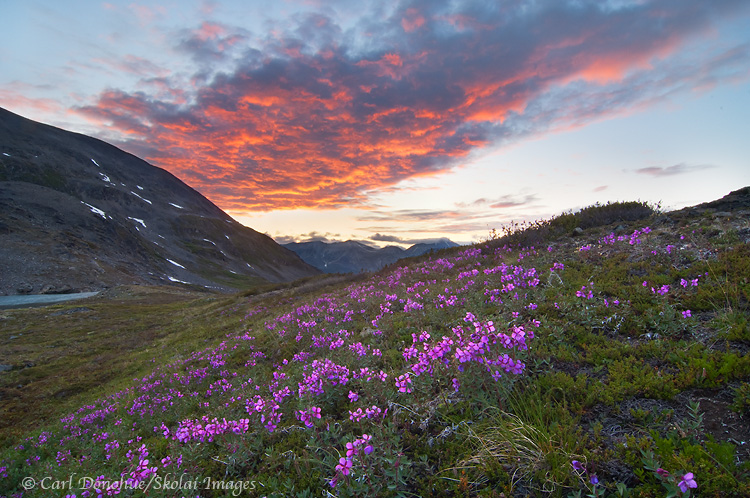
Dwarf Fireweed on an alpine hillside and a fiery sunset in the Chugach Mountains, Wrangell-St. Elias National Park and Preserve, Alaska. The latin or scientific name for Dwarf Fireweed is Epilobium latifolium and it is classified in the Evening-Primrose Family, or Onagraceae.
Hey Folks,
Here’s an image I took several years ago on a backpacking trek through the eastern Chugach mountains in Wrangell-St. Elias National Park and Preserve. I finally got around to processing it today. The image is a compilation of 4 separate exposures, blended together manually in Photoshop.
This is from a backpacking trip we do from Iceberg Lake to Bremner Mines in Wrangell-St. Elias National Park and Preserve. It’s a spectacular trek, and a real favorite of mine. Last summer, 2009, one participant did the trek with me for his 2nd time. We cross 2 glaciers, traverse 4 high alpine passes, and camp in some of the prettiest spots I’ve ever been to.
Summer’s approaching quickly and I’m looking forward to trudging around the mountains again. I’ll be heading over to Wrangell-St. Elias National Park this week to do some exploring, some photography and soak up some of the big mountain country. As such, I’ll be gone for a while, but hope to have some new photos to post when I return, with some stories to accompany them. Following this next few weeks I’m heading up to the Arctic National Wildlife Refuge (ANWR) for 2 weeks on the Canning River. Then it’s back to Wrangell-St. Elias for the rest of the summer, before 2 weeks in Katmai National Park in fall to photograph the great grizzly bear. That should be an amazing 2 weeks, for sure.
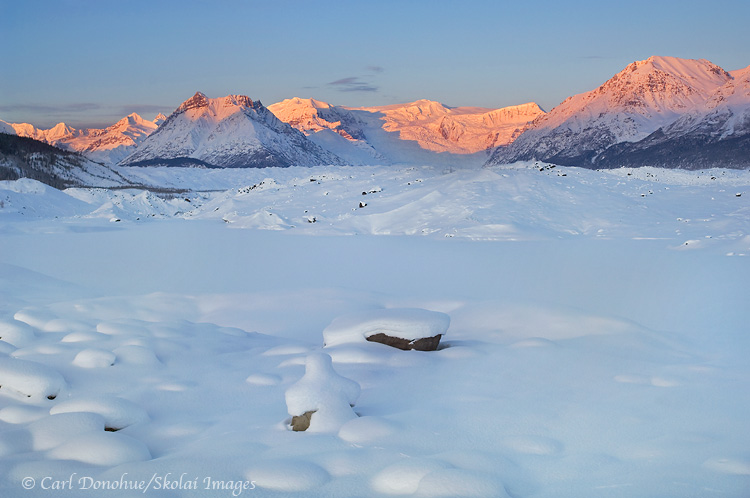
Winter snow covers Kennicott Glacier and alpenglow catches the peaks of the Wrangell Mountains and Stairway Icefall, Wrangell St. Elias National Park and Preserve, Alaska.
Hey Folks,
The Wrangell Mountains in winter. Alpenglow catches the eastern edge of the range. This view is looking up the Kennicott Glacier. At right is the edge of Bonanza Ridge, Jumbo, Then Stairway Icefall, Donohue Peak just left of center, and the Ahtna Peaks behind that to the left.
Winter’s finally wrapping itself up here in the north; it lingers much as the sun’s final rays cling to these high peaks at days end. Spring makes it’s way north slowly, and and is completely diurnal for now. The days, growing longer weekly, yield. But the night belongs to the winter, the cold, dark silence of the quiet time.
This is the first real “view” I ever had in Wrangell-St. Elias National Park and Preserve, all those years ago when I first ventured north on a backpacking adventure. I’d taken a bus from Fairbanks south, and the weather wasn’t so great; not raining, but overcast. I didn’t really have any idea of the scale of the landscape I was amongst at the time. The bus dropped me off on the highway, at the Edgerton Cutoff, and I hitch-hiked from there in to McCarthy (about 90 miles). That was an adventure in itself, maybe I’ll recount it another time.
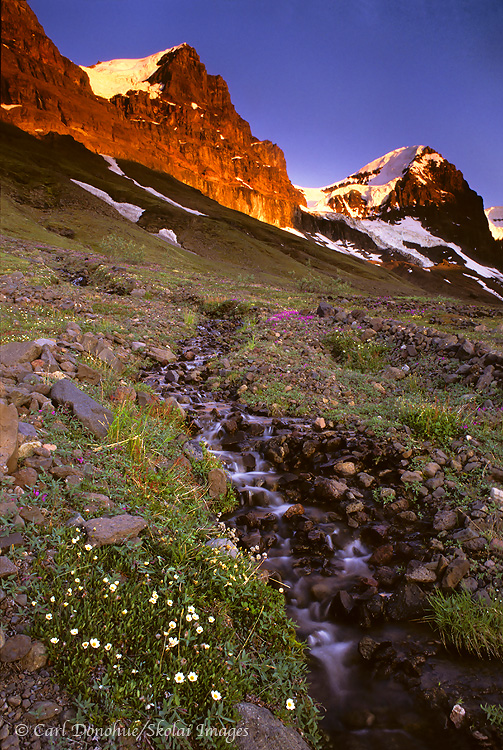
Skolai Pass, Hole in the wall rock formations, glaciers, Wrangell-St Elias National Park and Preserve, Alaska. The flowers you see here are (white ones) Mountain Avens (Dryas octopetala) and Dwarf Fireweed (Epilobium latifolium)
Hey Folks,
It’s always nice when a magazine editor wants your photo for their story, and you get published. Especially when it’s a photo from one of your favorite places anywhere.
But it’s WAY nicer when you get published in a magazine you enjoy, read and value. This image posted here is in the current edition of backpacker magazine, page 65 – full page vertical, which is nice.
The image accompanies an article on backpacking “the Goat Trail”, in Wrangell-St. Elias National Park and Preserve. This was the first route I ever hiked in Wrangell-St. Elias, and definitely a favorite of mine, so having my image chosen to accompany the story represents much more than just another published photo and a check to me.
It’s also cool for me because a few of my friends are published in the same edition of the magazine. It’d be remiss of me not to mention Ron Niebrugge, also a photographer I admire.
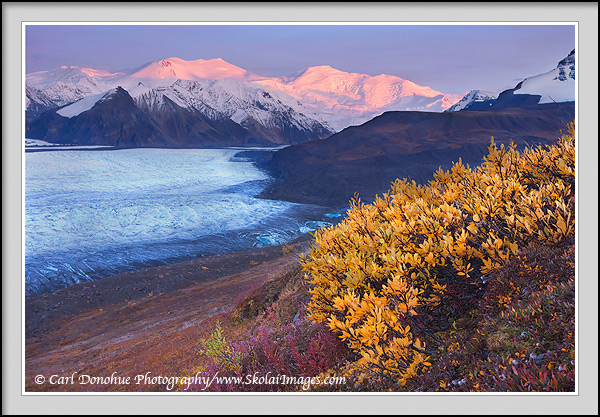
Tallest peaks in the University Range, Mt. Churchill and Mt. Bona rise dramatically from Russell Glacier, catching the last rays of the day, Fall colors in the foreground, Wrangell-St. Elias National Park, Alaska.
Hey Folks,
Here’s an image that I am amazingly lucky to have made. Probably luckier than I deserve to be. Not because of the luck involved in catching this scene like this; this image has been a long, long time in coming. The scene is taken from the south end of Chitistone Pass, near Skolai Pass, Wrangell-St. Elias National Park, Alaska. I’ve spent more time here than I probably should admit to, waiting, hoping and wondering if I’d ever actually happen to catch it in the light that I knew graces these peaks from time to time.
Finally, this September, I was up at Skolai Pass with our phototour and we were really blessed with some great weather. I was giddy with excitement and I’m sure the folks along on the trip were wondering just what they’d got themselves into.
Within 20 minutes of landing we’d already found and photographed a Least Weasel, which I’d never had the opportunity to photograph inside the park previously. Next up we ran into some Woodland caribou, apparently the only woodland caribou herd in Alaska, so that was pretty awesome.