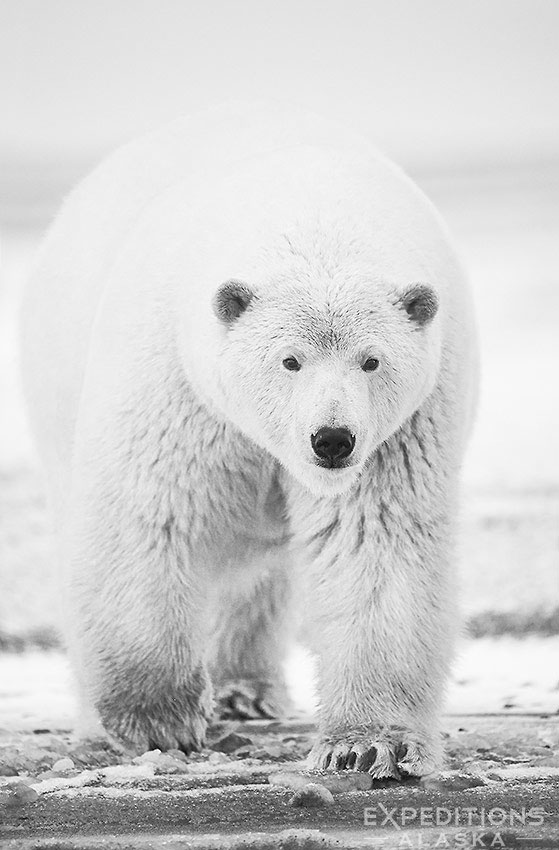
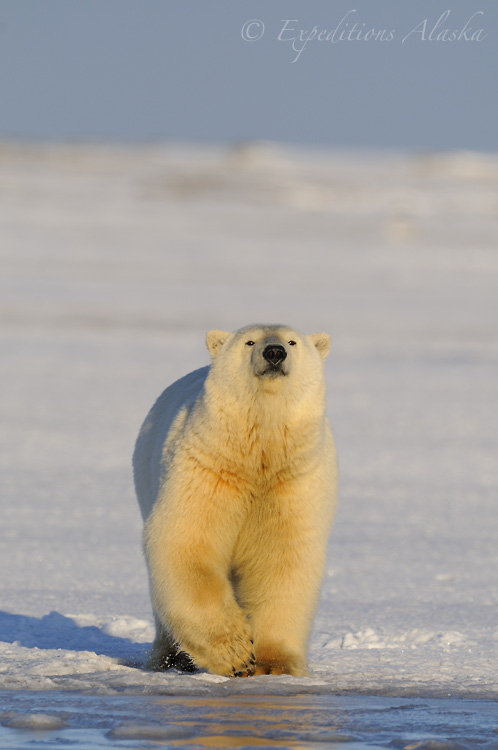
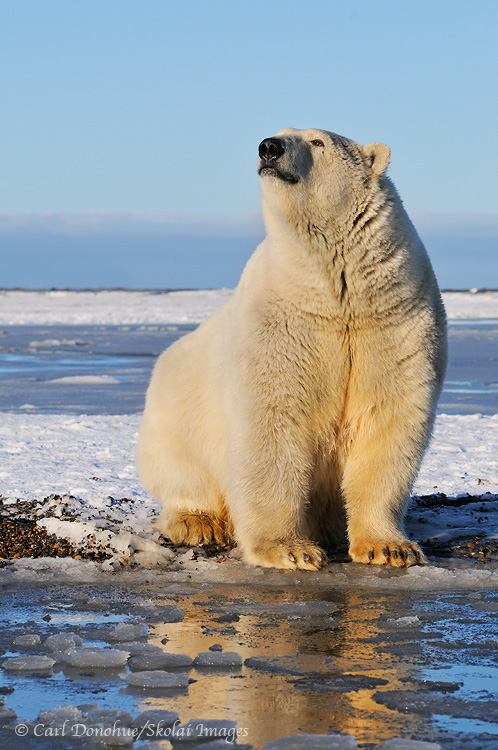
A black and white rendition of this young polar bear approaching the camera. Arctic National Wildlife Refuge, Alaska.
Hey Folks,
Sometimes I wonder if anyone’s still here.
These days, when I do blog, it’s mostly over at Expeditions Alaska. I definitely recommend you check it out over there, if you’re interested, and click on the “Get It By Email” link to stay connected and updated with all the goings on.
I simply found keeping a couple blogs going not worth the time. Maybe I’ll post here from time to time when I get bored, LOL.
Anyway, here’s a polar bear photo from this past fall. We spent a couple weeks in the arctic, again, and had some great photography opportunities with the bears. Never ceases to amaze me how fascinating it is to observe and photograph these incredible creatures. I’ve never really found another animal quite like the polar bear.
I converted this photo to black and whit to see how ti might come out and was pleasantly pleased with the results. What do you think?
Here’s a free ebook, available only to subscribers of my Expeditions Alaska newsletter. And, even better, here a bunch of absurdly great reasons why you want this ebook.
It’s free
It’s a great eBook
Over 80 polar bear photos
My newsletter is awesome
Polar bears are super cool, and
Nobody should need more than 5 reasons for this eBook.
So what is it? It’s a collection of photos of polar bears. Over 80 of them. I’ve written a piece or two about the bears as well. I think it’s a pretty cool little project. Download a copy and let me know what you think. I’d love to hear your review of it.
I thought I’d share this video on my site here. I wrote the tune, a number of years ago, and recorded it with some friends in Atlanta, GA, when I lived there. Great musicians all of them, and it was a treat to record with them. I played the guitar parts.
The video and stills I shot in 2013 on my Alaska Polar Bear Photo Tour in the Arctic National Wildlife Refuge. One or 2 of the clips were shot by clients on the trip, and thanks go to Sue P and Munir K for their permission to use their clips. See my collection of stock polar bear photos here.
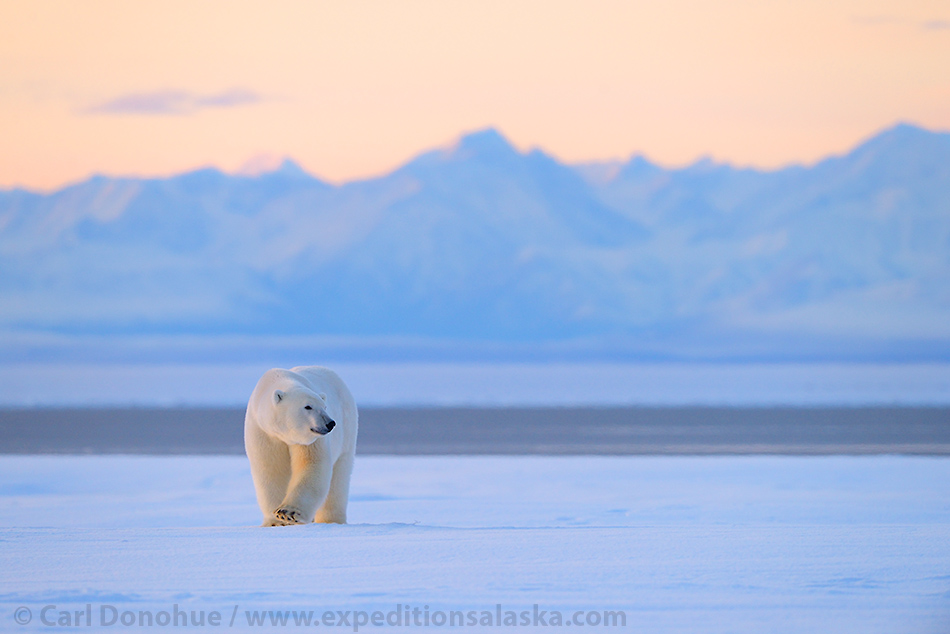
A young polar bear on the prowl, silhouetted against a colorful sunrise, on the frozen ground of the Arctic National Wildlife Refuge (ANWR), Alaska. Polar bear, Ursus maritimus, Alaska. Please click on the image above to view a larger version of this photo.
Hey Folks,
Everyone loves a great sunrise or sunset, right? And everyone loves polar bears; seriously, does anyone NOT love polar bears? So who loves the 2 together?
We set out this morning with high hopes, clear skies and the beginning of color on the horizon. Everyone hoped for a nice sky and some polar bear activity. Hoping, and getting are two different things.
So how does it play out? The sunrise turned out to be, in a word, spectacular. The morning itself, frustrating.
We found some polar bears relatively soon, but they weren’t really in a great location. On top of that, they were asleep. certainly, polar bears are so photogenic that even asleep, they make a great subject. But they were sleeping just below a short embankment, with the colorful sky above and beyond and so we couldn’t find a way to really make it work. One option might have been to shoot multiple exposures, steadily, and then blend the 2 together to properly capture detail in the foreground and the background. I shot a couple of images like this, but even as I was photographing, I knew it wasn’t really happening. OK stuff, but nothing grand.
A Polar Bear and the Brooks mountains range in the background, Arctic National Wildlife Refuge, ANWR, Alaska.
Hey Folks
Here’s an image from my recent trip to the arctic to photograph polar bears. The light was great, and the landscape just swept away behind him. The more I shoot, the more these kinds of images seem to ring home for me.
There are a lot of places that are popular for polar bear photography nowadays, but few where you can grab a polar bear image with a massive mountain range in the background; and the infamous ANWR Section 1002 coastal plain in the foreground.
Polar Bear, Ursus maritimus, at sunrise, on Section 1002 of the ANWR coastal plain, and the Brooks Mountains Range in Arctic National Wildlife Refuge, Alaska.
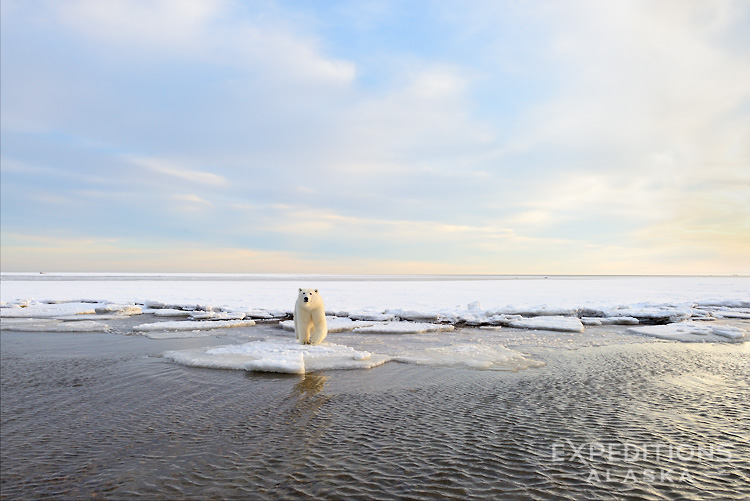
Standing on thin ice a polar bear curiously approaches. Polar Bear ice, in the Beaufort Sea, Arctic National Wildlife Refuge, Alaska. Please click on the image above to view a larger version of this photo.
Hey Folks,
Here’s a polar bear photo from my trip to the arctic last month. Given the predicament bears in the Beaufort Sea find themselves in (declines in accessible food due climate change), I thought the image a particularly relevant one.
Polar bears are classified as marine mammals, not, like their darker coated brethren to the south, mammals who earn their living on good old terra firma. Polar bears hunt, almost exclusively seals, and particularly 2 species of seals; primarily ringed seals (Phoca hispida) and less often, bearded seals (Erignathus barbatus). That alone makes polar bears particularly susceptible to population declines; any animal whose primary food source s merely one or 2 other species is somewhat vulnerable. This applies no less to herbivores who may exist on one or 2 types of plants. A crash (or boost) in the abundance of their food source will have an enormous impact on the population of their own species; a look at the lynx and the snowshoe hare cycles illustrates this.
So climate change has shifted the world for the polar bear; here’s a quick, and rough, summary of how.
The most productive waters in the arctic ocean are under sea ice, in the shallower areas over the continental shelf. Deeper water doesn’t hold light as well, and so tiny little critters like plankton and what not don’t do as well. They feed on the algae that grows and collects on the bottom of the sea ice. So where the plankton population is higher, so too is the population of the little critters that feed on plankton; shrimp and such. Fish eat shrimp, and bigger fish and regular size fish, and seals eat bigger fish. Where there’s no sea ice, there’s no algae growing. And if there’s no algae, no plankton, no shrimp, no regular size fish, no big fish, no seals and, you guessed it, skinny, hungry polar bears swimming around wondering why they can’t find any food.
Huge congratulations to all those who did so well in the recent BBC and Natural History Museum Wildlife Photographer of the Year competition. Overall winner Greg du Toit has a remarkable image in “Essence of Elephants”. The winners of all the various categories should be proud of some fantastic photography.
I saw an interview with Paul Souders, winner of the “Animals in their Environment” category on BBC here. Congrats to Paul for an incredible image, and a great job in the interview.
Paul deserves huge kudos for getting out their, on his own, and doing the work. He doesn’t simply trek off to a well known and much favored hot spot and follow the hordes with their long lenses to do his photography.
Sure, Churchill is one of the great polar bear photography meccas, but no tundra buggy and over-sized group for his trip. Just himself, his boat and hours upon hours of exploration trying to find a subject; it’s worth noting Paul spent over a week on his trip and saw only 2 polar bears, after spending 12-14 hours riding up to 30 miles a day on the ocean; the first of the 2 promptly raced off never to be seen again.
This should be inspirational to so many of us who do this work. We don’t need a dozen bears in the vicinity, and we don’t need to follow the footsteps of the masses and we don’t need to shoot gigabytes of images to make a great image. We need to be creative, diligent and persistent. And, of course, having your own boat doesn’t hurt either!
Polar bear (Ursus maritimus) on a barrier island of the coast of arctic Alaska.
Hey Folks,
Recently, a federal judge in Alaska, handed the US Fish and Wildlife Service (F&WS) some homework, when he decided that the agency had been a little overzealous in their designation of critical habitat for the polar bear. In 2010, the Obama administration set aside nearly 190 000 square miles of onshore and off-shore critical habitat for the polar bear. That’s an awful lot of land (larger than the state of California). But polar bears, it seems, are an awful lot of bear.
Last month a federal judge ruled that it’s apparently ‘too much’ land. Which is in itself noteworthy, as the judge isn’t really there to decide what’s too much and what isn’t too much land for a polar bear. The judge is supposed to simply review the decision and see whether it follows the law.
The judge also said the F&WS decision had some “procedural deficiencies”; much better. This means, they hadn’t quite followed the law. So what was one of those deficiencies? How about this one? Section 1533(i) of the Endangered Species Act
An adult polar bear sits on the shores of the Beaufort Sea, waiting for freezeup. Alaska. Please click on the image above to view a larger version of this photo.
Hey Folks,
So, I’m sure by now you’re all familiar with the 101 ways to heighten your photography reputation and business prowess through the magic of social media. There are nearly as many blog posts and articles on the secret mojos to becoming a social media icon in the world of photography and art as there are, surprisingly, photographers and artists out there in social media-land. Typically, these articles repeat the same tired old cliches: engage, time your posts carefully, be consistent, etc, etc, etc. Here’s another take on this ‘phenomenon’ of social media.
Recently I was in southeast Alaska photographing bald eagles. During that trip, I ran into 2 fellows from the BBC, filming for a wildlife documentary they’re making. Filming for another wildlife documentary they’re making. These guys have made several, and travel around the world filming for a company that makes some of the most amazing wildlife on the planet. The photographer, John Brown, also shoots stills (as well as video) and is represented by Getty images. Pretty cool gig.
I mentioned to him about possibly doing an interview with him, if he’d be so kind as to give me some time; he did, and I enjoyed a great couple of hours chatting with the 2 of these guys about wildlife photography and filmmaking and all the stuff the rest of us merely dream of. I’ll edit that interview down in the near future and put together an article from it.
During the course of the conversation, I don’t recall John mentioning social media once. Not once. He didn’t give me his twitter handle, or his facebook profile, or refer me to his G+ page. He mentioned his website, but the rest of the conversation was about his work; his photography and his art.