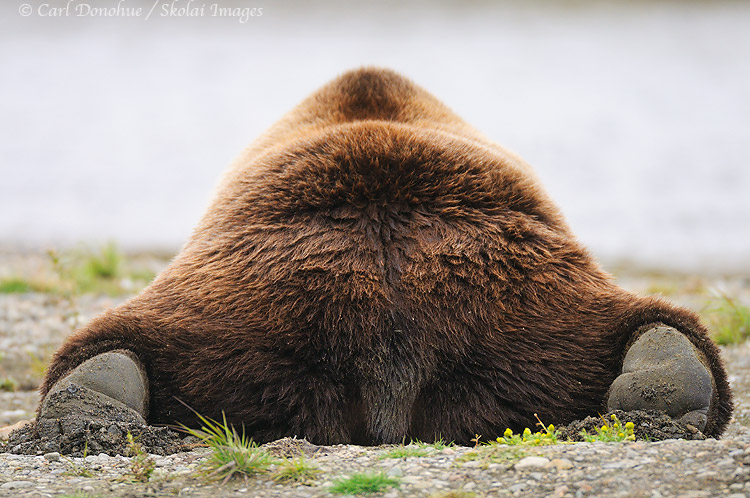
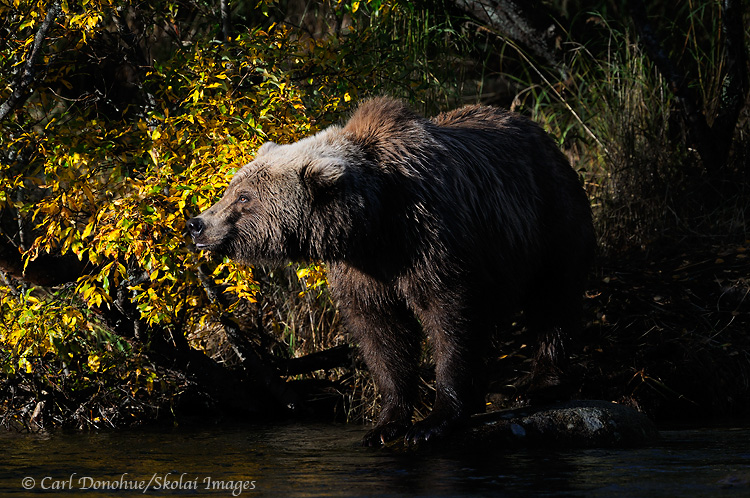
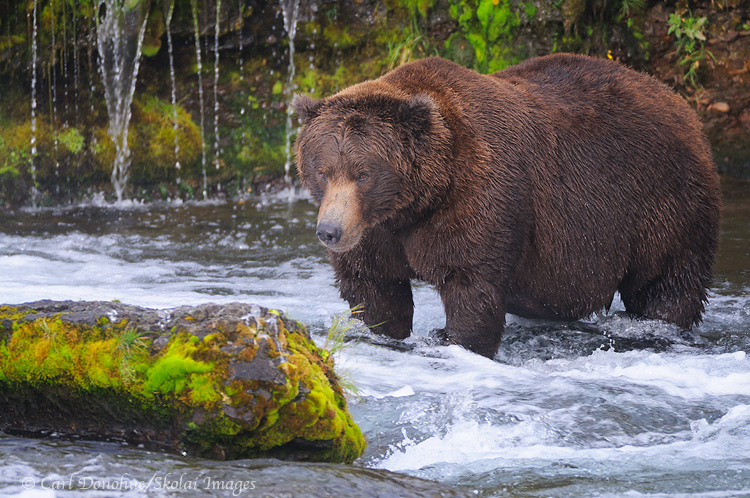
A grizzly bear, rear view, Katmai National Park and Preserve, Alaska. Please click on the image above to view a larger version of the photo.
Hey Folks,
As often as I’ve run across discussions about art and photography, I’ve never really heard anyone ask this question. Most artists, painters, writers, musicians, sculptors, dancers, etc, practice, routinely. But how much practice do you, as a photographer, actually do?
I don’t mean “time in the field shooting”. I mean time in the wood shed, practicing, honing your chops? I mean sitting working on a particular technique, idea, composition, theoretical study, etc.
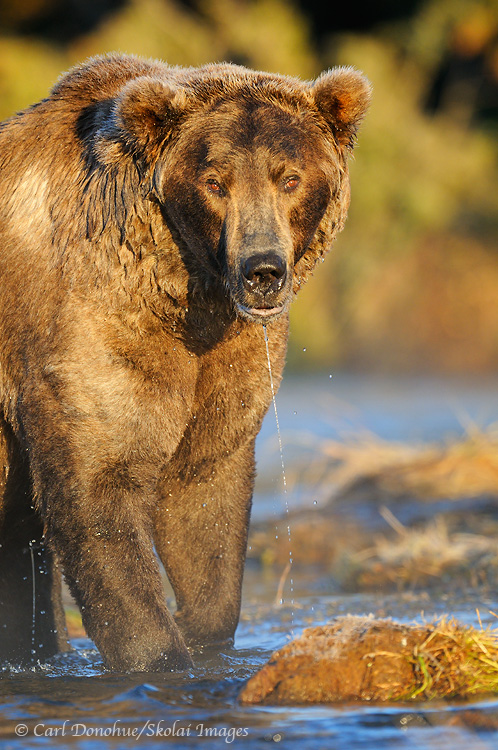
A large male (boar) brown bear walking up a salmon stream in early morning light, fall. (Grizzly bear, Ursus arctos). Katmai National Park and Preserve, Alaska.
Edit: Well, I had initially posted this ahead of schedule, planning on being out of town this week. However, 7″ of snow and more on the way put paid to my motivation to drive through the Chugach Mountains to Wrangell-St. Elias National Park, so I’m still in town. Maybe next week I’ll get gone.
Conservative preacher Bryan Fischer of the American Family Association writes “One human being is worth more than an infinite number of grizzly bears. Another way to put it is that there is no number of live grizzlies worth one dead human being.”
I wonder if he feels the same way about, say, cigarettes, or motor vehicles. Even something as commonplace as fast food diets are responsible for far more human ill health than any grizzly bear (or grizzly bear population) ever has been. When he cries for their riddance, he’ll have some integrity.
He goes on (and on); “If it’s a choice between grizzlies and humans, the grizzlies have to go. And it’s time.”
More ignorance. It’s already BEEN time, Mr Fischer. Grizzly bears were virtually wiped out, via human hands, from the vast majority of their former range years ago. Lots of years ago.
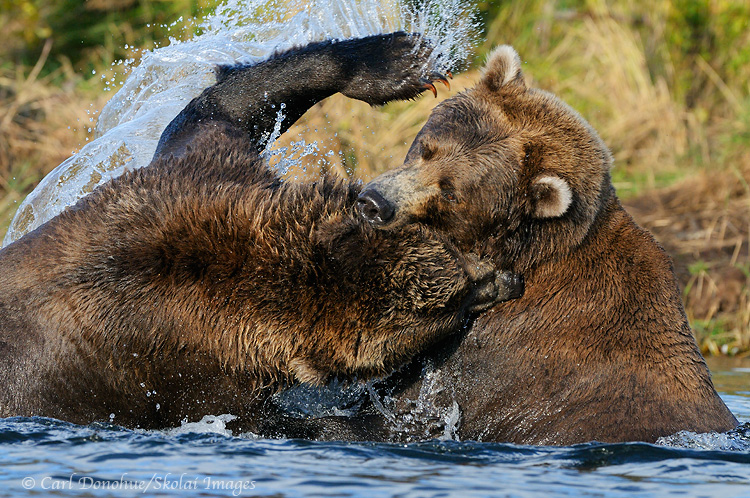
How ’bout that for a left hook! 2 young grizzly bears fighting in a salmon stream. Rarely do real vicious fights break out, but when they, these well-armed opponents can do some serious damage to one another. Grizzy bears, or coastal brown bears (Ursus arctos), playfight in Katmai National Park and Preserve, Alaska.
Hey Folks,
I’ve finally added some new grizzly bear images to my website – after way too much time. I’ve just added nearly 250 new grizzly bear images from my trips to Katmai in 2009 and 2010. Check them out; some of the images have appeared on the blog in the past, but many of them have not; those photos are from this most recent trip.
So, how about this particular photo?
We were shooting 2 other bears when I saw this scuffle start to erupt behind us. Time to move and move fast, these little eruptions (usually) don’t last too long. So we shouldered the tripods and heavy gear, and moved quickly through the long marshy grass to be in position to shoot this ‘fight’.
Knowing what might happen is a big help when you’re photographing wild animals. It can make all the difference between being ready for something awesome, and completely missing it. (See my recent blog post on Expeditions Alaska about how often we miss).
We saw these 2 young bears playfight several times during the 2 weeks I was down there.
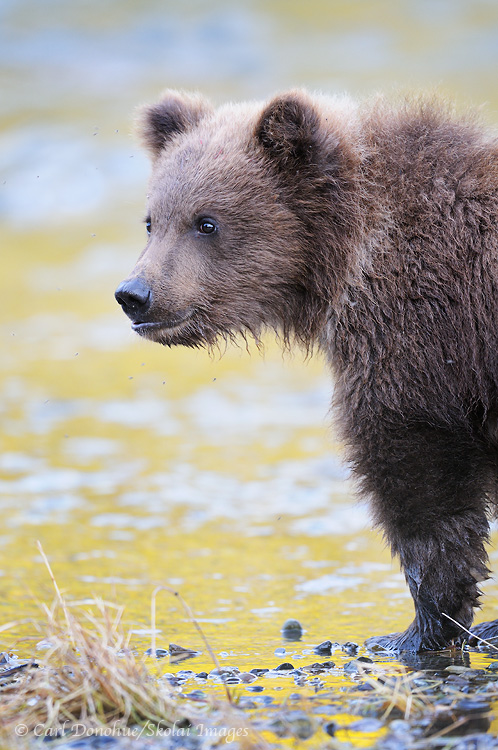
Brown bear cub photo. A young brown bear (Grizzly bear, Ursus arctos) cub. Brown bear cubs will stay with their mother for 2-3 years before venturing out alone. Brown bear cub, Katmai National Park and Preserve, Alaska.
Hey Folks,
Here’s a young spring bear cub photo from the recent photo trip I led to Katmai National Park and Preserve. This youngster had 3 siblings, and it was a real treat to get to see them play and tumble together.
Catching a photo of one by himself, without the others in the frame, was more difficult than one might guess it would be. There were almost always other bears in the frame.
Last year, for some reason, there were not too many spring cubs in the area at all, but this year the area was home to quite a few. They’re such a blast to photograph, and oh-so charismatic. Each has his/her own character, and some of them are unbelievably plucky little critters. We watched one take quite a dunking from his mother, after he tried to steal a salmon from her. She grabbed him in her mouth, shook him back and forth like a rag doll, and literally buried him in the river. I thought ‘well, that’ll teach the little guy a lesson’ – Hardly! He came up growling louder than before, grabbed the fish in his mouth, and took off with it before his mother could even snap at him. They’re just way too cute!
These little baby bears are born in the dark of winter, tiny and defenseless. Their mothers-to-be enter a den in late fall, usually anywhere from late October through November. Brown bears almost always enter their den during a snow storm, or immediately before a snow storm. The theory most folks ascribe to is the snow storm will cover both the entrance and the tracks leading to the den, hiding both the bear and the den’s location.
Late January or early February, though sometimes as late as March, the cubs are born, blind and virtually helpless.
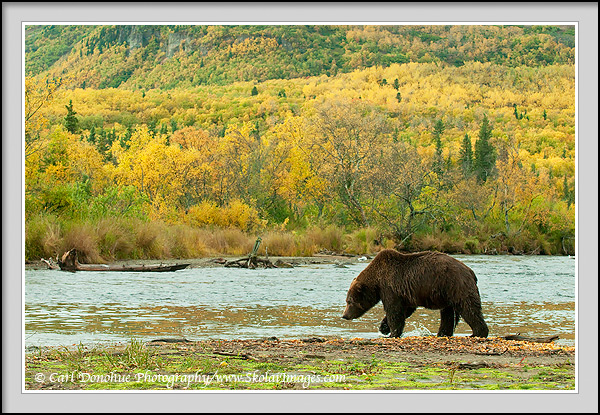
Grizzly bear and fall color, standing in warm afternoon light on the edge of a salmon stream. Ursus arctos, brown bear, Katmai National Park and Preserve, Alaska.
Hey Folks,
As I mentioned in a post a few days back, I am pretty excited about some of the grizzly bear photos I took on this most recent trip to Katmai National Park. Over the years I’ve spent so many weeks there, shooting and re-shooting photos of grizzly bears, that it can be difficult to really bring home some new images. This photo is one I was super happy with.
I took, of course, countless images of bears eating salmon, chasing salmon, catching salmon, standing around, sitting down, sleeping, fighting, playing, etc. But what I really wanted to capture was some dramatic images in dynamic weather or dynamic lighting situations.
Male grizzly bear, brown bear photo, (Ursus arctos) Katmai National Park, Alaska. Please click on the thumbnail to view a larger version of the photo.
Hey Folks,
Just a quick note here to say if you can, check out this online radio interview (GONE) Tuesday, May 4, 2010, at 9pm EST. I’ll be talking with photographers Greg D and E.J. Peiker, and host Dave Warner. It should be a lot of fun to do, and hopefully interesting and useful as well. I know I’m excited about it, Greg and EJ are great photographers whom I’ve admired for a long time, and it’ll be nice to talk with them.
We’ll be talking about wilderness photography, backpacking and hiking and photographing, as well as some environmental/conservation topics that might be relevant to nature photography.
Greg also had the idea of present a few images online and we can discuss those and present a little more context about the work. I’m not really sure all of what we’ll talk about yet, but the show is open to call in, and it’d be great to hear from you on air. Hopefully the conversation will be interesting.
The broadcast can be heard live here. If you miss the show, it will be edited and available as a podcast soon after – I’ll add a link to this post when that becomes available.
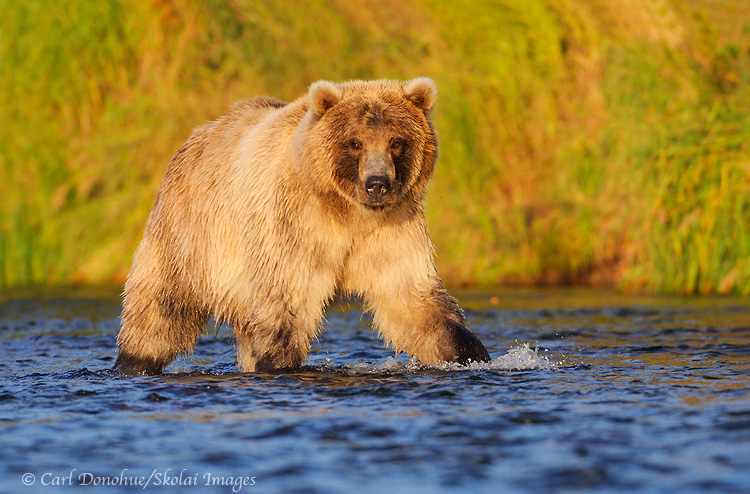
A young brown bear (Ursus arctos) walks through a stream hunting for spawning Sockeye Salmon. Grizzly bear, or coastal brown bear, Katmai National Park and Preserve, Alaska.
Hey folks
Won’t be long until the bears are running around the woods again!!!
I’ll be in the woods for the coming week, but I thought I’d post a brown bear photo, and schedule a couple of other blog posts for while I’m gone.
Catching this young blonde colored brown bear in some nice light was quite a treat. That’s the benefit of spending time in the field. Most wildlife photography, it seems, is done in places where the subject is pretty much a given; places like Homer for bald eagles, Yellowstone for elk, Churchill for polar bears, and Katmai National Park and Preserve for grizzly bears, or brown bears.
As I said in a recent post, on my recent trip to Katmai National Park and Preserve I really hoped to make some images that featured not only the great grizzly bears, but also the awesome fall colors of the boreal forest .
The Black Cottonwoods of the area provide the perfect background for photographing grizzly bears, but rarely do photographers seem to combine the 2. Most folks come up to Alaska and shoot the bears in the summer, and I think they’re missing out.
The classic shot of a grizzly bear fishing for salmon at Brooks Falls is nice, and only generally possible mid-summer, of course, but there are a lot of other opportunities around in the fall that can be equally exciting.
Great fall colors make stunning backdrops, and can really bring a vibrancy to the image. Stepping back, zooming out, and letting the scene dictate the photos is often the key.
In this photo I enjoy the sense of relationship between subject and environment – the dichotomy is largely only a function of our thought processing. The idea that the “environment” is something other than everything is a little peculiar; the subject IS the environment, as equally as the environment is the subject. There is really no difference between the bear and his habitat.
This Post is About Motion Blurs, Art and Technique
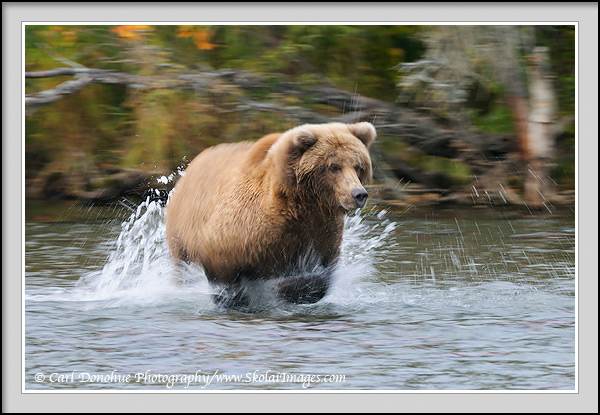
One of the photos I wanted this year was some slower shutter speed blurs of grizzly bears chasing spawning Sockeye Salmon (Oncorhynchus nerka) up the river.
This kind of image is difficult to do with grizzly bears; well, not difficult to do, but difficult to manage a photo that works.
More so, I think, than with most other animals.
The result of this is that it seems to take about 5 times as many attempts to get a decent ‘panblur’ of a grizzly bear than it might, for example, of a caribou or wolf.
What’s a Panblur Photo?
What I’m calling a ‘panblur’, for those of you who aren’t certain, is a technique of slowing down the shutter speed when shooting movement, so that the subject becomes blurred, rather than crisp and sharp.
You can see in the image above the spashing water and the legs of the bear are not to sharp at all. By panning the camera along with the bear as it races through the water,
“People usually consider walking on water or in thin air a miracle. But I think the real miracle is not to walk either on water or in thin air, but to walk on earth. Every day we are engaged in a miracle which we don’t even recognize: a blue sky, white clouds, green leaves, the black, curious eyes of a child — our own two eyes. All is a miracle.” – Thich Nhat Hahn.
Hey Folks,
Well, with all the comments about landscapes versus bear photos on the last few pages, I thought I’d try a compromise. I know, I know, compromises end up pleasing no one, right? Well, so be it.
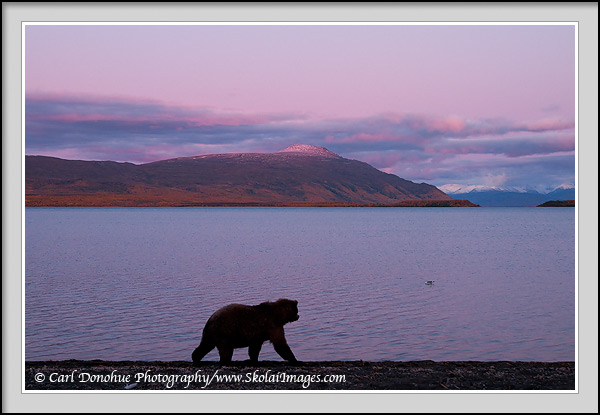
This is possibly the last photo I took on my trip last month, a sunset over Naknek Lake – I was hoping for some nice clear skies the following morning – and actually had a big sunrise – but then it clouded over, very soon afterward, and no good light was had for the morning shooting. Then I had to pack and get ready for the plane to come pick me up. The trip was all over too soon.
The photo is one exposure, so no real photoshop trickery – I even left the gull in the bay (@ Ron 🙂 ).
The real reason I wanted to post this photo was, honestly, a talk I went to listen to tonight, at a local bookstore, by a great Alaskan writer, Bill Sherwonit.