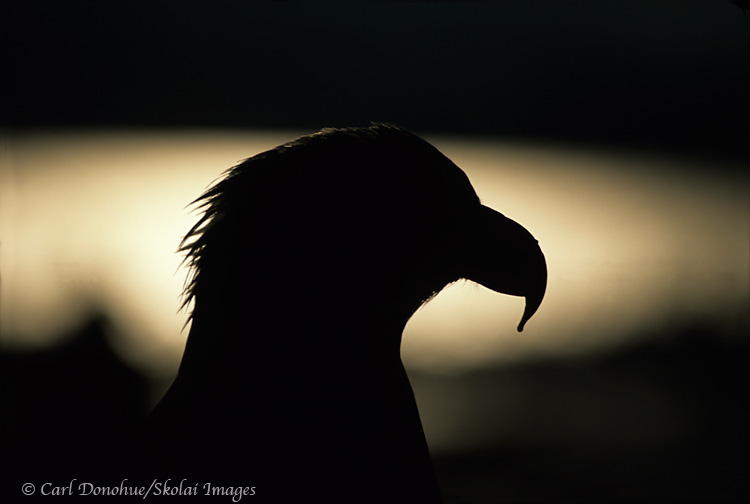
An adult Bald Eagle silhouetted headshot, on perch, Homer, Alaska. (Haliaeetus leucocephalus). This photo was taken with photo equipment, by a photographer. The 2 worked together. The eagle co-operated only briefly.
The Myth,
I read it again last night. This nonsense has to stop. Why do photographers so often have such a hard time simply acknowledging that what we do is inherently technological? As such, technological advances (i.e., new gear) can (and typically do) play an enormous role in the work we produce. Perhaps much more so than most other art forms.
You’ve all seen the kind of commentary I’m talking about; another piece about how painters don’t talk endlessly about their paintbrushes. Or, even more inanely, how if Art Wolfe were to shoot with a P&S camera, he’d still produce a remarkable portfolio. It’s the photographer, not the camera, that produces great work, blah, blah, blay.
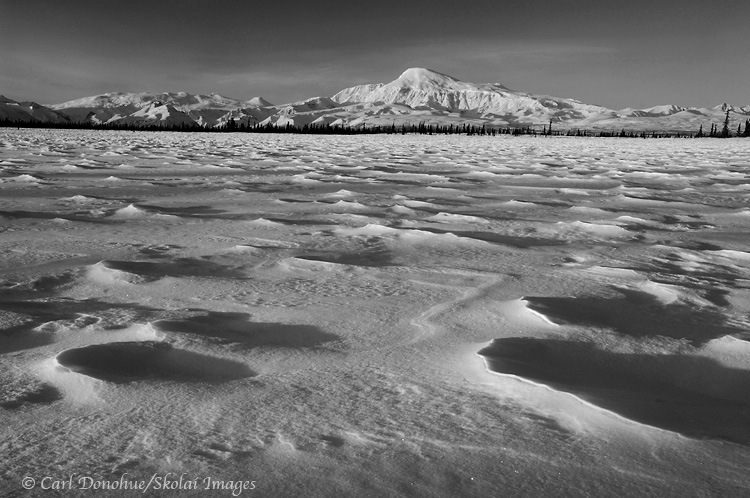
Black and white photo of Mount Sanford, one of the highest peaks in the Wrangell Mountains, at dawn, from a small frozen kettle pond. Winter snow creates patterns on the frozen lake. Mt. Sanford, Wrangell-St. Elias National Park and Preserve, Alaska. Please click on the thumbnail above to view a larger version of this photo.
Hey Folks,
Here’s an image of Mount Sanford, Wrangell-St. Elias National Park and Preserve, I took a while ago, that I converted to black and white in photoshop. I shot this after the alpenglow had faded, and the sun rose high enough in the sky to light up not just Mount Sanford’s massive peak, but the entire floor of the Copper River Basin.
It’s very easy to be tempted to pack up and head off after the alpenglow on a mountain wanes; I often find the light immediately following the alpenglow to be unappealing to me. The sky has a weird yellowish tint to it, and the contrast between the dark, shaded foreground and the brightly lit peak is too great to really photograph well; for me, anyway.
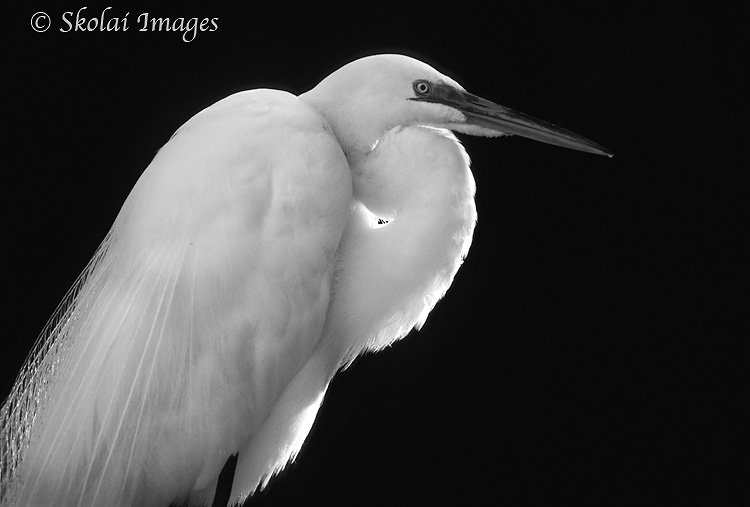
Black and white photo of Great Egret, St. Augustine, Florida.
Hey Folks
“The word photography is based on the Greek ???(photos) “light” and ????? (graphé) “representation by means of lines” or “drawing”, together meaning “drawing with light” (ya gotta love Wikipedia).
“Photography means painting/drawing with light”.
It’s time photographers (and photography) mature, and walk away from this virtually meaningless phrase. The phrase is a fabrication, deception at best, and has never been valid. Let it rot. We’re not painters, we’re photographers. We no more “draw with light” than does any person with their finger in the sand. Pixels and film aren’t light, they don’t even “capture” light, they merely represent it – to propose otherwise suggests only a childlike understanding of what light might actually be.
If interpreted in this callow manner, all painting would similarly be “painting with light”. Indeed, all visual art could be a form of painting with light; drawing with pencils and crayons, digital graphic arts, sculpture, pottery, dance, et al. Van Gogh painted with light. Michaelangelo painted with light. Early aboriginal cave paintings were painted with light; with no light, there’d be no painting. Most certainly, there would be no viewing these paintings. The idea that we paint with light is no more valid than saying carpenters sculpt houses with stardust.
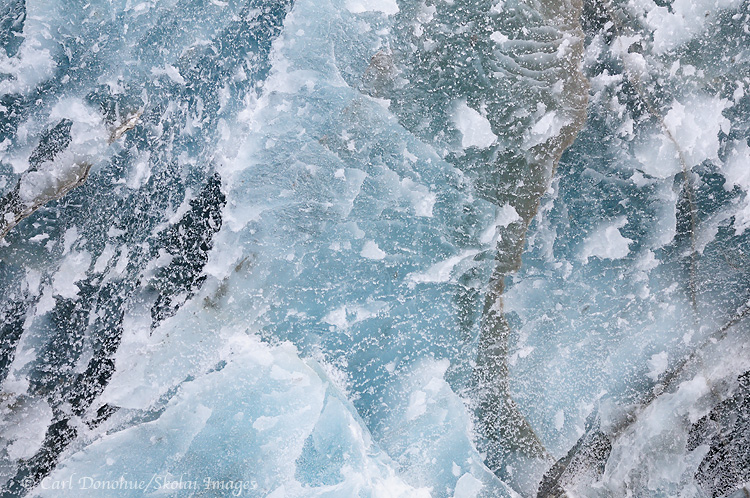
Wrangell-St. Elias National Park and Preserve, Wrangell Mountains and the Kuskulana River, Kuskulana Glacier, near Nugget Creek mine. Winter, Alaska. This photo is a closer look at the ice wall on the Kuskulana Glacier, from the photo I posted last week. I probably spent about an hour or 2 here, checking out this fascinating place.
Hey Folks,
My friend Guy Tal posted (as usual) another great read on his blog; “Photography and the Environment”. I urge you to read his treatise; it’s a solid piece. Guy has a great knack for writing on particular topics without seeming to offend those who disagree with him, which makes his a powerful voice. At the same time, he’s not wishy-washy. that’s a hard line to toe.
One question Guy asks in the article is “Will another photograph on a web site in a stock library truly change public opinion? How about another thousand? Another million?”
I’d suggest, however, that this is the wrong question to consider.
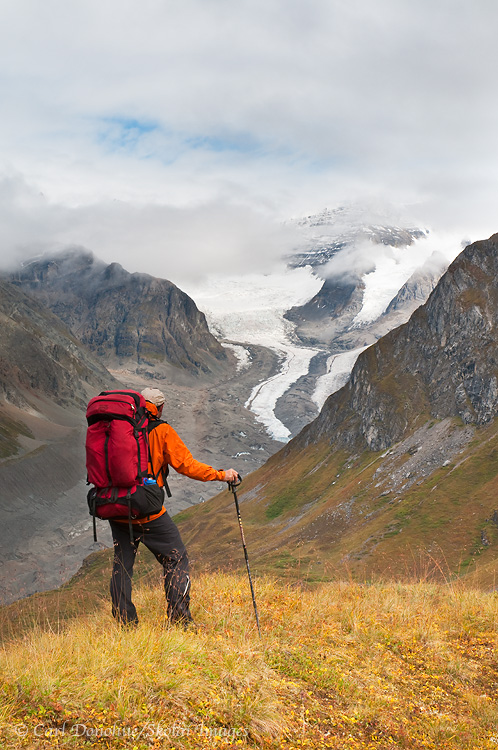
A backpacker/hiker stands and looks up the Lakina River drainage to the Lakina Glacier, on the side of Mount Blackburn. Wrangell mountains, Wrangell-St. Elias National Park and Preserve, Alaska. Please click on the image above to view a larger version of this photo.
Hey Folks,
If art is exploration, then perhaps one of the best modes of “practice” we might undertake is the challenge of the new; stepping outside our comfort realms and engaging something new. Stepping toward the unknown.
The process of learning is stimulating in itself, but I think it’s more than that, too. It’s stepping back and revisiting how to learn. Going through the process of picking up at the beginning, and working toward building a comfort level with some kind of form.
Art involves, essentially, that process. With that in mind, I find it great practice to pick up something I’ve not done before, something I know nothing about, and step into it. This winter, for example, my goal is to learn to telemark ski. I’d fooled with it briefly last year, but didn’t really understand or know the process. Also, as I found out this fall, had all the wrong gear for learning on. So, I’ve set myself up this winter with a nice rig, and taken some lessons.
The good news; what started out as essentially a “Special Ed” class is gradually molding into something resembling telemark skiing. It’s great fun, and quite a workout. On top of that, it’s stimulating!
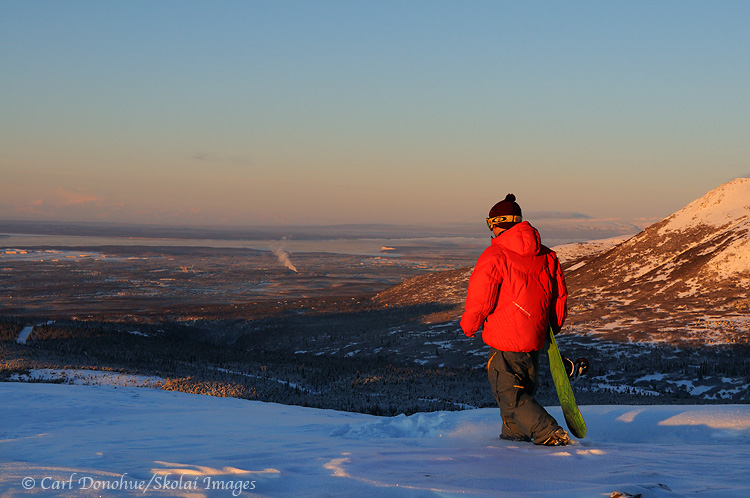
I was photographing toward the mountains when 2 snowboarders came on by. I snapped this photo of one of them before he took off down the mountain. A snowboarder walks across the ridge near Flatop Mountain, Glen Alps, near Anchorage, in winter, Alaska. Mt. McKinley, known as “Denali” in the distance. Please click on the image above to view a larger version of this photo.
Hey folks,
A quick word of advice. If you think it looks like a nice afternoon to go out and shoot some photos (i.e., the light is rockin’, fresh snow on the mountaintops, etc, etc, etc), the very best of advice I might offer you is this: Head out on your own.
I know better than to think I might do some photography when I head out with non-photographers. Well, I like to THINK I know better, but I today did it yet again. Sometimes I’m a just a flatout non-learner, I guess.
So, as the setting sun turned the sky and nearby mountains a glorious pink, instead of photographing the grandeur, I was packed up and skiing my way back to the parking lot, my camera and tripod safely tucked away inside my daypack.
Photography and non-photographers just don’t mix well. The first time I was given this lesson was years ago, in a discussion with the late Bill Silliker, Jr (a great photographer and a good man); we were talking about being a photographer versus being a musician. Bill had been a drummer in his younger days. His words were “Carl, one of the best things, for me, about photography as a gig is that I don’t need a bass player”.
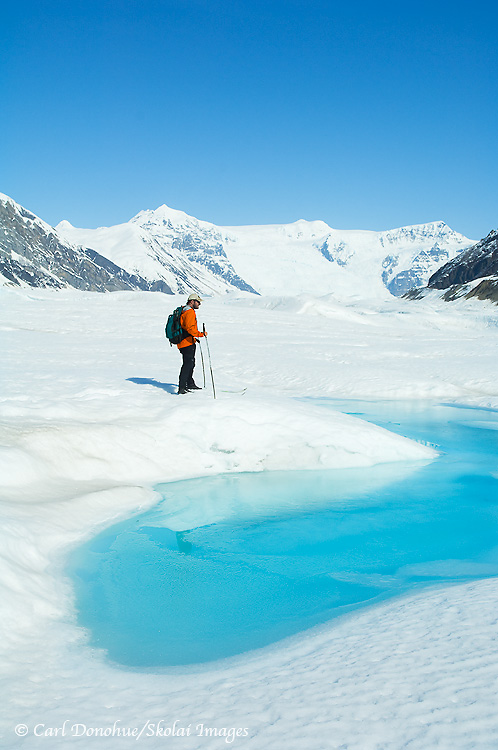
Backcountry skiing, exploring the Root Glacier, with Stairway Icefall in the background. Springtime brings melt, opening a small pool of water on the glacier’s surface. Cross country skiing, Wrangell-St. Elias National Park and Preserve, Alaska. Please click on the image above to view a larger version of this photo.
Hey Folks,
I think art involves exploration, the process of stepping into the unknown, and taking a journey of sorts. In this way, I think we might relate the idea of art to the idea of “icon photography” discussed earlier. Seeking out the new is a vital fragment of making art, in my opinion.
At some point, we delineate art from craft. Art, to me, involves a greater element of the unknown, while craft is more a process of refinement and control. One hones one’s craft, but I don’t think that’s necessarily the case with art. Art might simply involve turning a new direction with each step (though maybe it doesn’t have to do so). We don’t have to refine anything.
On a trek through the mountains, I enjoy the exploration, the wander itself. Though I guide hikes in places I’m obviously familiar with, I make an effort to reserve at least a trip or 2 each season as an exploratory hike. This summer, for example, we’re heading out on a Arrigetch Peaks backpacking trip in Gates of the Arctic National Park. A park I’ve visited once, my very first remote hike in Alaska (wow, what a great memory that is). Venturing into the unknown is an artful process; a game of chance. I don’t know what we’ll find on the trip, and that itself is motivation for the undertaking; to simply experience that gift of the hidden.
Jazz musicians understand this, every time they step to the mic to improvise a solo they do exactly this. That’s the beauty of jazz. That’s also the beauty of art. The other is artifact.
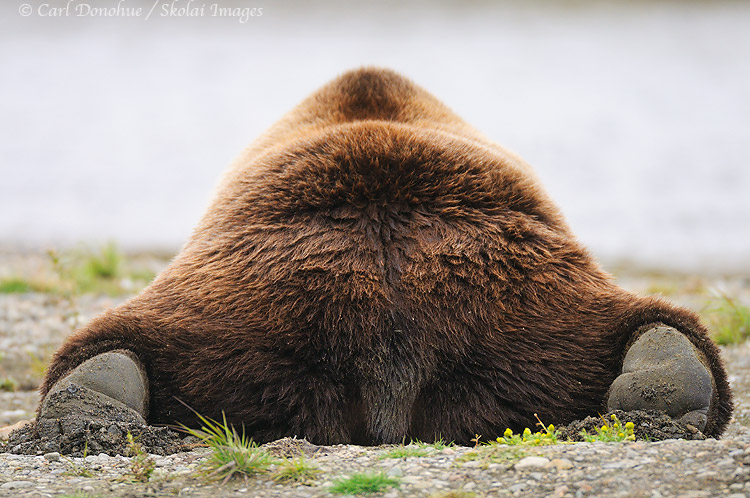
A grizzly bear, rear view, Katmai National Park and Preserve, Alaska. Please click on the image above to view a larger version of the photo.
Hey Folks,
As often as I’ve run across discussions about art and photography, I’ve never really heard anyone ask this question. Most artists, painters, writers, musicians, sculptors, dancers, etc, practice, routinely. But how much practice do you, as a photographer, actually do?
I don’t mean “time in the field shooting”. I mean time in the wood shed, practicing, honing your chops? I mean sitting working on a particular technique, idea, composition, theoretical study, etc.
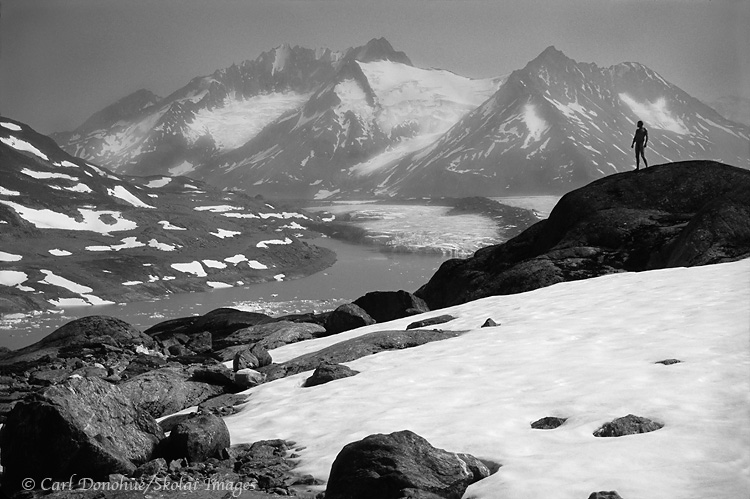
A backpacker stands, naked, in the Chugach Mountains, Wrangell-St. Elias National Park and Preserve, Alaska.
Hey Folks,
“It can be a difficult journey to live a creative life, if you live within an environment which does not understand or value creativity. Seek-out and surround yourself with positive soulmates”.
I read this note on a Status Update on facebook a while back, posted by a great photographer from Australia, Steve Coleman. Steve posts consistently valuable stuff on his facebook page, and I try to read every one of his insights. It’s nice to see someone so giving of their talent. I’ve never met Steve, but looking over his website I can tell you I already know I like the guy; click on ‘Workshops‘. That page tells me all I need to know; what a wonderful perspective!
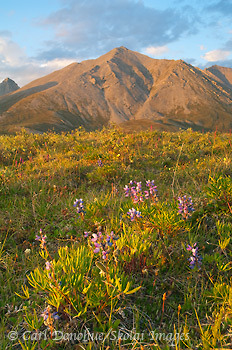
A small bloom of Arctic Lupine in the Brooks Mountain Range catch last light of the summer day. Land of the midnight sun, the Arctic National Wildlife Refuge, or ANWR, in arctic Alaska where the coastal plain meet the Brooks Mountain Range.
Back in September the US F&WS (Fish and Wildlife Service) announced, as part of their Comprehensive Conservation Plan, that “the Service will conduct wilderness reviews for three Wilderness Study Areas (WSAs) for potential inclusion within the National Wilderness Preservation System. These three WSAs encompass almost all refuge lands not currently designated as wilderness”. This is good news. I’ll reiterate my favorite part of the quote: “These three WSAs encompass almost all refuge lands not currently designated as wilderness“.
There are numerous steps involved, and, if recommended by the US F&WS, approval is required by the Dept Director, the Secretary of the Interior, and the President. Then, the final decision lies with the US Congress; the actual authority to designate land as ‘wilderness’.
It’s almost comical, really and I’ve written at length on the issue of conserving the refuge. But such a rigorous and formalized process to meander through in order to deem lands “wild”. Implicit in the word wild is ‘free will’ – yet not quite so wild as to be free of the rigmarole of official procedure, of course.
Anyone who suggests the 19 million acres of the Arctic National Wildlife Refuge isn’t a wilderness either hasn’t been there or is simply in denial. Perhaps I could say it more clearly this way; if the Arctic National Wildlife Refuge doesn’t qualify for ‘wilderness designation’, then we might as well remove that term from our vocabulary. Surely there is no place more deserving of such designation than the Refuge?
The “wilderness reviews” should be completed by Feb 2011, which will be followed by a released draft, more public comment, more revisions, and hopefully, a final plan and recommendation in May 2012. Apparently wilderness takes careful planning and review; it’s not simply created overnight.
A reminder that Dec 06, 2010, marks the coming anniversary of the establishment of the Refuge; I’m working on a little project for it, and should have it online soon. Stand warned. 🙂