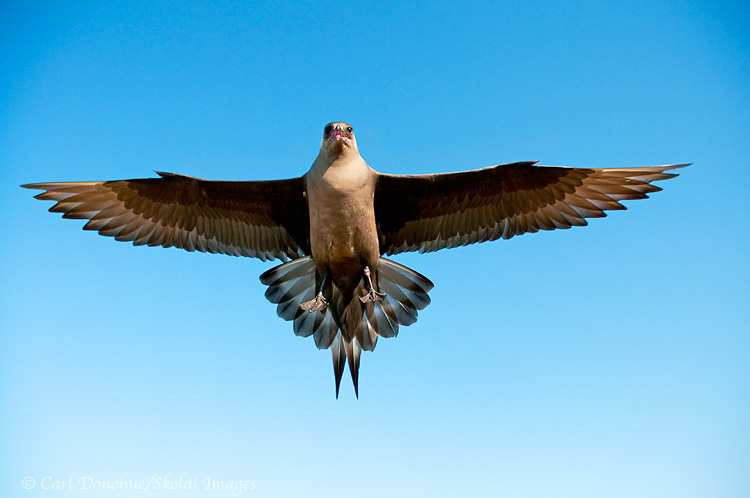
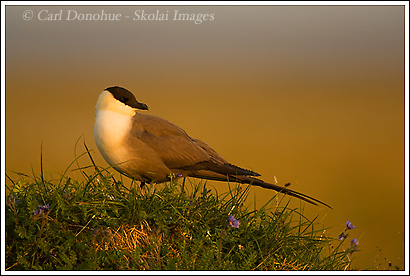
A Parasitic Jaeger (Stercorarius parasiticus) in flight over the coastal plain of the Arctic National Wildlife Refuge (ANWR), Alaska. Click the image to view a larger version of the photo.
Hey Folks,
One afternoon we hiked out around the coastal plain of the Arctic National Wildlife Refuge just because. We must’ve wandered a little close to a Jaeger nest, as this bird suddenly appeared from nowhere and made its displeasure known.
The Parasitic Jaeger is also called the Arctic Skua or the Parasitic Skua. While not a “parasite“, the bird is well known for it’s piracy of other birds’ food. Stealing food is often called “kleptoparasitism” by folks who like to use large prodigious words to describe simple, everyday stuff; scientists, for example.
Though solitary, they’ll often ‘gang up‘ on other birds to steal food. One of the folks on our trip, Steve Weaver, was witness to such an act, when he saw and photographed 4 Jaegers harassing a Red-throated loon, finally driving it from its nest and eating the eggs the loon had been defending. Amazing stuff.
The Jaeger isn’t simply a thief though – the bird also hunts for prey, such as rodents, small birds and insects – Jaeger is the German word for ‘hunter‘.
Parasitic Jaegers look kinda like a gull, but the wings and flight are more falconesque. Pelagic birds, they spend the bulk of their time at sea, coming ashore to breed. The young will often spend the first couple of years of their lives over the seas, not returning to land until they reach breeding age.
Some of you might recall the Long-tailed Jaeger photo I posted previously from a trip to the Arctic National Wildlife Refuge (ANWR) a couple of years ago. The Parasitic Jaegers are closely related, a little larger, but not so large as the Pomarine Jaeger.
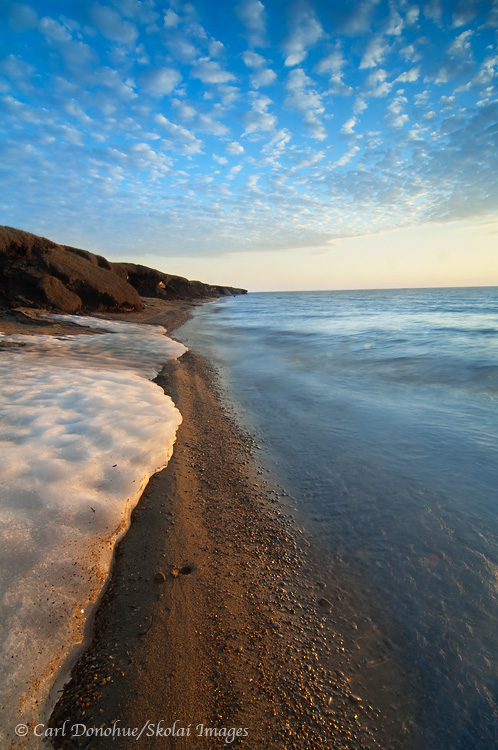
The Beaufort Sea along the coastal plain of the Arctic National Wildlife Refuge (ANWR). The Arctic Ocean sea ocean, after spring breakup, rests on the beach. Melting permafrost in the bluffs signals warming temperatures. Arctic Ocean, Coastal Plain, ANWR, Alaska. Click for a larger photo.
I hiked from our final camp across the coastal plain (well, across part of the plain, not the whole thing) with Steve Weaver hoping to photograph some of the icebergs we’d seen the previous day along the shoreline. Unfortunately, strong southerly winds had blown almost all the ice out to sea, and we were largely thwarted. This patch of ice, however, had been resting on shore, stranded when the tide rolled out, and we made a few images.
Coastlines are such dynamic landscapes, and in the Arctic particularly so. They can change drastically in a day or less, and do so frequently.
This photo was taken around 1:15am .. maybe later. I think Steve and I arrived back at camp around 4:00am, and I went to bed at nearly 5:00am. up at 10:00am-ish to break camp, roll the raft, and wait for a bush plane.
We arrived, finally, in Coldfoot, around 5:30pm,(the temp was 90deg F, a start contrast from the Arctic Ocean we’d just left) unpacked the gear from the plane, sorted it and loaded the van, ate dinner, and hit the road, rolling into the Yukon River area stop late at night.
Then up early the next morning to drive from there to Anchorage. 36 hours later it was out the door to pick up folks for the next trip to Wrangell-St. Elias National Park and Preserve. Summertime can be like that in Alaska.
I’ve been out to the Beaufort Sea here a number of times, now every time I’ve been so fortunate as to have an absolutely glorious final evening. The wind wasn’t bad at all, the bugs had quieted down, and the expansive vastness of the place really moves me. It’s a fantastic experience, to see such a harsh and rugged environment also be so sensitively fragile; the quiet tundra, the shorebirds, a whisper of air and the glowing rays of the sun, low on the horizon.
After the trek back to camp I simply couldn’t go to bed, but sat for nearly 45 minutes by my tent, just watching, listening and enjoying the grace of the Arctic coastal plain. It’s a phenomenal place.
The bluffs on the left of the frame, like Castles Made of Sand, slowly slip into the sea – eventually.
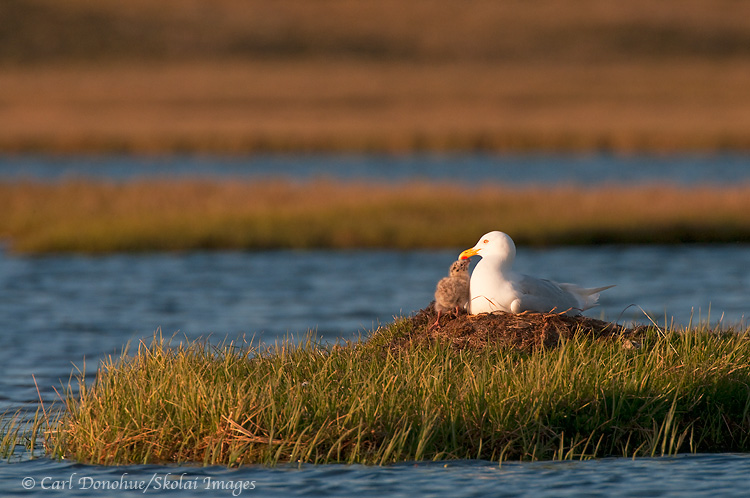
A glaucous gull sits with its chick on a nest on the coastal plain in the Arctic National Wildlife Refuge, ANWR, Alaska, ( Larus hyperboreus). Please click on the thumbnail to view a larger version of the photo.
Hey Folks,
I posted this ahead of time; right now I’m out on a hike, but thought I’d post this image from my recent trip to the Arctic National Wildlife Refuge. Taken on the final evening of our trip, this Glaucous gull (Larus hyperboreus) and chick were a beautiful sight in gorgeous light.
The gulls are pretty common in the refuge in summertime, and can be pretty aggressive in defense of their young. This gull and its mate were busy most of the evening dive bombing a Red-throated loon that was nesting nearby; apparently too close nearby for the gulls’ peace of mind.
Hope you enjoy the photo. I’ll be back from the current trip soon enough, and wil try to post a few more images and some video from the trips. Until then,
Pectoral sandpiper, ANWR, Alaska
Here’s a Pectoral sandpiper photo, taken on our recent trip to ANWR, the Arctic National Wildlife Refuge, Alaska. The shorebirds out on the coastal plain were really a treat – we were so lucky to see a number of cool birds. I’ll try to write a thorough report when I get time.
In the meantime, dig this.
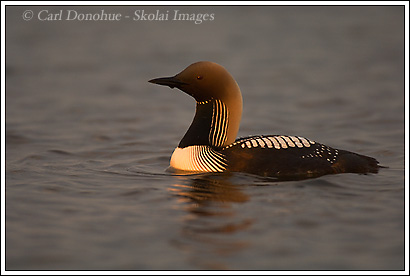
Pacific Loon, Section 1002, ANWR, Alaska
Here’s a Pacific Loon image I got late one evening near the Canning River, on the coastal plain of the Arctic National Wildlife Refuge, ANWR, Alaska. This photo took me quite a while, and a lot of walking, to swing.
I think it was nearly 2am when I clicked the shutter here. I’d been over near this pond earlier, but not able to get close. I ended up walking around for a long time, finding a few other birds to photograph, and then cam back by the loon pond.
This loon and its mate were getting more and more comfortable with this strange tripod-toting creature wandering around, and finally came close enough for me to manage a few photos. I wish the light was a little brighter, and the wind not present, as the rippled effect on the water isn’t as nice as a calmer surface, but one takes what one can in the arctic. At least the wind kept the bugs at bay.
Section 1002, the coastal plain, of the Arctic National Wildlife Refuge is the area hotly debated over with the proposals to drill for oil. I think the wildlife that live there, will be much better off if drilling and gas extraction aren’t allowed; I think we’ll be better off for it, too.
Long-Tailed Jaeger, Arctic National Wildlife Refuge, Alaska
I just got back in from a long and really cool trip to the Arctic National Wildlife Refuge – awesome place! This is a photo of a Long-tailed Jaeger, sitting on a small mound on the coastal plain, taken around 1:00am; gotta love that summer arctic thing!
I’ve got about a million things to do, so this is just a quick short post – but do stay tuned. I have some ground-breaking stuff here, new, never before taken photos from the Refuge, and some discussion that will likely amaze a number of readers – the Arctic National Wildlife Refuge is a topical place right now, with the oil prices, and all.
I’m sure you’ll find some of my findings very interesting, maybe a little disturbing (or disturbed), and even surprising.
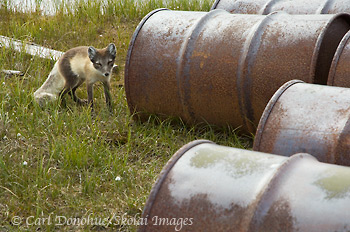
Arctic fox and oil barrels on the coastal plain, Arctic National Wildlife Refuge, Alaska. Please click on the image to view a larger version of the photo.
Hey Folks,
Excuse my rant; but, this is my blog, and I’m about to wander in the mtns for a while. Before I go, I need to speak out.
I read earlier today of ex-Alaska Governor Sarah Palin’s latest comments about the current disaster in the Gulf of Mexico. She states “Radical environmentalists: you are damaging the planet with your efforts to lock up safer drilling areas”.
Her basic premise is that the Deepwater Horizon catastrophe is the work and responsibility of “extreme environmentalists”. Let’s disregard, for now, the fact that she’s been a proponent of offshore drilling for years now (including her 2008 run for VP where she repeatedly claimed that Drill Baby, Drill “also means safely tapping into our offshore sources, safely, environmentally safe”. In her own words, whilst debating then-Senator Joe Biden she stammered “You even called drilling — safe, environmentally-friendly drilling offshore — as raping the outer continental shelf. There — with new technology, with tiny footprints even on land, it is safe to drill and we need to do more of that“.
“friendly”? If it weren’t so sad it would be farcical; what the hell is “friendly” about extracting crude oil from beneath the ocean? Makes me wonder what kind of “friends” some of these people keep. If one of my friends came over to the house and started drilling a hole 20 000′ into the lawn I’d say they’re outta their mind.
I’ve no problem with a discussion of the collective responsibility owned by our society. I hopefully made that clear in my earlier post here. But I won’t absolve the oil industry of their responsibility, nor the clowns who would reduce a discussion of the energy policy of the world’s largest energy consumer to a 3-word bumper-sticker slogan: “Drill Here, Drill Now” of theirs, which is the intent of Palin’s outburst. Sarah Palin’s remarks, along with this childish assessment from Ted Nugent is not an honest critique of any social construct at all. In fact, it’s nothing more than the opposite of that; an attempt to divert attention from the direct and very palpable targets of hella-oil, political corruption and bumper-sticker political campaigns to a somewhat more nebulous, transparent target. That is intolerable.
Playing a Native American Indian flute on the arctic coastal plain, Arctic National Wildlife Refuge (ANWR), Alaska. Please click on the image to view a larger version of the photo.
Hey Folks,
I’ve been wanting to write for the last week about the current Gulf Oil disaster, but haven’t really been quite sure what to say. There are simply so many tangents to this mess that I’ve not known where to start. The deaths of 11 people seem, unfortunately, to fade into the melée of concern about big oil, political ineptness, poisoned ecosystems, fathomless litigations, ad infinitum. The web we weave seems larger than the spread of oil.
It makes sense, to me, to start at home. The reality is that this catastrophe stares us right in the eyeball. The mirror reflects our own lives – I drive a car, I love my gore-tex and silnylon tents, my synthetic-fill jacket, my polycarbonate cameras. I eat fresh bananas and whole grain breads shipped here from afar. My computer was flown directly from Shanghai, China. The world I live in is a fossil fuel world. That world includes crude oil belching from the ocean floor into the Gulf of Mexico, and on to Gaia knows where.
So I bear responsibility in this mess; I want cheap gasoline, cheap oil. I complained about the soaring gasoline prices just 2 years ago. I failed to demand that the federal government not exempt BP from an environmental impact study. I failed to demand that Minerals Management Services mandate a remote-control shut-off switch on all drilling operations. I failed to demand that the oil industry follow the strictest, safest procedures possible.
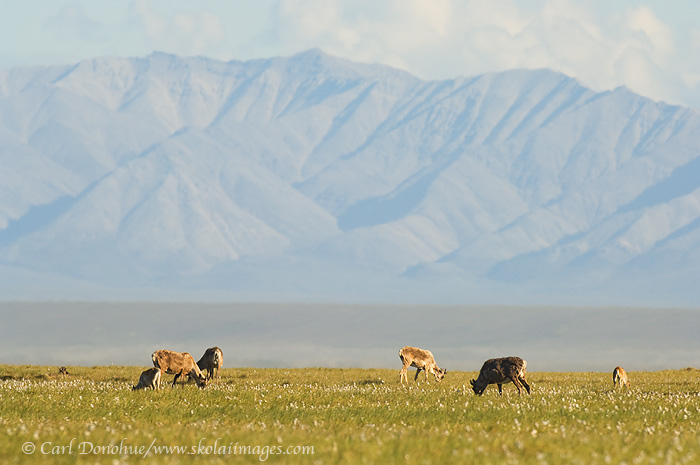
Caribou herd feeding on the coastal plain, the Arctic National Wildlife Refuge, Alaska. Click the thumbnail for a larger, more epic, version.
Hey Folks
Recently I read a photographer ask the following question:
Now I know that blogging gets your profile closer to the top of the heap and web traffic will probably go up. The question is have any of you actually seen a raise in the amount of sales as a result? Is it all worth the amount of time that it takes to do all this stuff?
Now, I hope the photographer doesn’t mind me mentioning his name, but I only do so because this guy is a total BAD-ASS. Readers, meet Mr Adam Gibbs. Adam is an amazing photographer, and I don’t mean ‘amazing’ like ‘oh yeah, cool’ – I mean like his images are simply gorgeous. If this photo doesn’t make you cry, you’re computer is broke. If this photo doesn’t move you, it’s time for you to retire from your position as CEO of Exxon-Mobil, Mr Tillerson.
Anyway, the discussion that ensued revolved, as suspected, around blogging, facebooking, tweeting, etc, etc. Is it “worth it”?
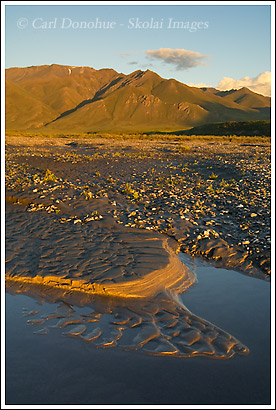
Here’s another image from the summer just gone by. This one was from near our campsite on the Canning River, in the Arctic National Wildlife Refuge (ANWR). We’d had a nice day paddling, enjoying some sunny weather, found a sweet spot to camp, and then I wandered around into the evening looking for a composition that caught my eye. The unnamed mountain across the river is a ridge leading up to Mt. Salisbury. This is one of my favorite areas in the region, right at the edge of the coastal plain and the Brooks Mountains. Typically these kinds of terrains are interesting;
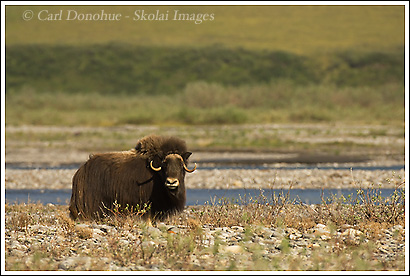
Here’s another Musk Ox photo, from the Canning River, Section 1002 area of the coastal plain of the Arctic National Wildlife Refuge, Alaska.
This trip was the first time I’ve seen MuskOx, and it was great to get some images. They’re almost a prehistoric looking creature, very cool, and reasonably calm, if approached carefully.
We took over an hour just slowly getting closer and closer – but photos were few and far between, as they tended to stay in the willows and thicker brush, making decent photos hard to come by. Patience was rewarded, and I got this and a few other images that I liked.
Muskox photos, Arctic coastal plain, Alaska
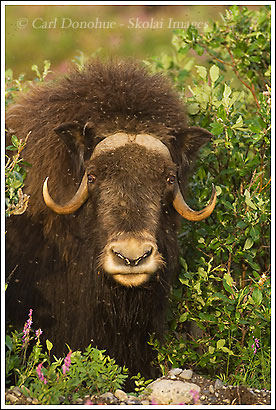
Here’s another image of muskox from our trip to the arctic coastal plain this past summer, and a float trip down the Canning River in the Arctic National Wildlife Refuge. As you can see from the muskox photo, the mosquitoes were out in the droves this summer in the arctic.
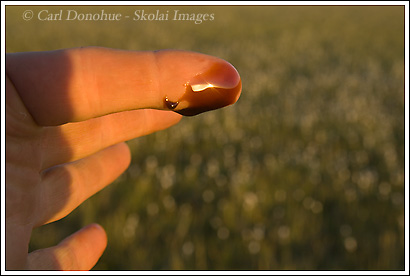
Fortunately the winds we experienced kept them down much of the time – but I had headed out to shoot these guys in shorts, a long-sleeved shirt and a ball cap – not really the gear I needed to keep the bugs at bay. After about 15 minutes of nonsense, I left the muskox, went back and donned some more suitable attire, and returned to the fray.
As I don’t have anything new to post from the Skolai Trip I did last week, I’ll post a few more Muskox.
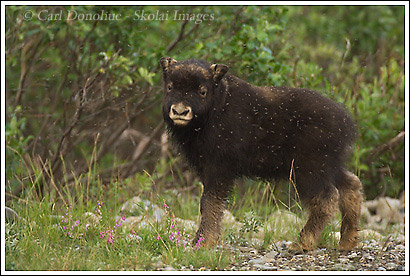
This young calf was hanging around with his mom and the herd one afternoon, and it took quite a while before I got a decent opportunity to shoot a portrait of the calf. Muskox really protect their young well, mostly by hiding the calves behind the adults, and often keeping them in the thicker brush. Finally this calf ran out in the open, stopped and looked back, and I took this photo. You can see the Mosquitoes were plentiful up in the arctic this summer.
What makes a baby muskox so incredibly cute is that they look like a cross between a miniature bison and a very grumpy, overgrown rug. Those tiny, stubby horns haven’t quite formed yet, so they just have these fuzzy little nubs on their heads while they try to figure out how to be intimidating. A baby muskox spends most of its time in a state of high-speed play, darting between the legs of the adults like a hairy little pinball. It is a hilarious contrast to see a frantic, fluffy calf bouncing around a group of adults that are essentially unmoving boulders of muscle and fur.
Despite the cuteness, life for a baby muskox on the coastal plain is serious business. They are born into one of the harshest environments on the planet, often arriving while there is still plenty of snow on the ground. To survive, the baby muskox relies on a specialized layer of underwool called qiviut. It is one of the warmest and finest natural fibers in existence, and even these calves are packed into a dense coat of it from day one. This insulation is what allows them to withstand the brutal arctic winds that would freeze most other newborns solid in minutes.
The social structure of the herd is the ultimate insurance policy for every baby muskox. When a predator like a wolf or a grizzly bear shows up, the adults don’t run. Instead, they form a defensive circle with their massive heads and horns facing outward, tucking each baby muskox safely into the middle of the huddle. Watching a calf peek out from behind a literal wall of thick fur and sharp horns gives you a real appreciation for their survival strategy. They might be the cutest animals in the north, but they are born into a world that is anything but soft.
By now, you’ve all heard the rumors, I’m sure. How the massive oil fields, despoiling the pristine earth lying deep beneath the frozen, barren tundra of the lonely coastal plains of the Arctic National Wildlife Refuge (known by its acronym ANWR), could save our planet. How, if only those whacko enviro-freaks, who are bent on ruining the lives of countless hard-working patriotic Americans, have consistently and ruthlessly undertaken to bully the American Congress and the oil industry into submission, and not allow the oil and natural gas that is currently being wasted underground to be extracted and delivered to gas stations across America.
I’m sure you’ve read the facts, and seen how, if the estimated 10 billion barrels of ANWR oil could be drilled and refined, gasoline prices at the pump would plummet; but not just the gas prices,