If you are looking for where in the US are the Wrangell Mountains, you will find them in the rugged southeastern interior of Alaska.
This range defines the landscape of Wrangell St. Elias National Park, the largest national park in the United States. Many visitors start their journey with a Wrangell Mountains map to navigate the two primary access points: the McCarthy Road to the south and the Nabesna Road to the north.
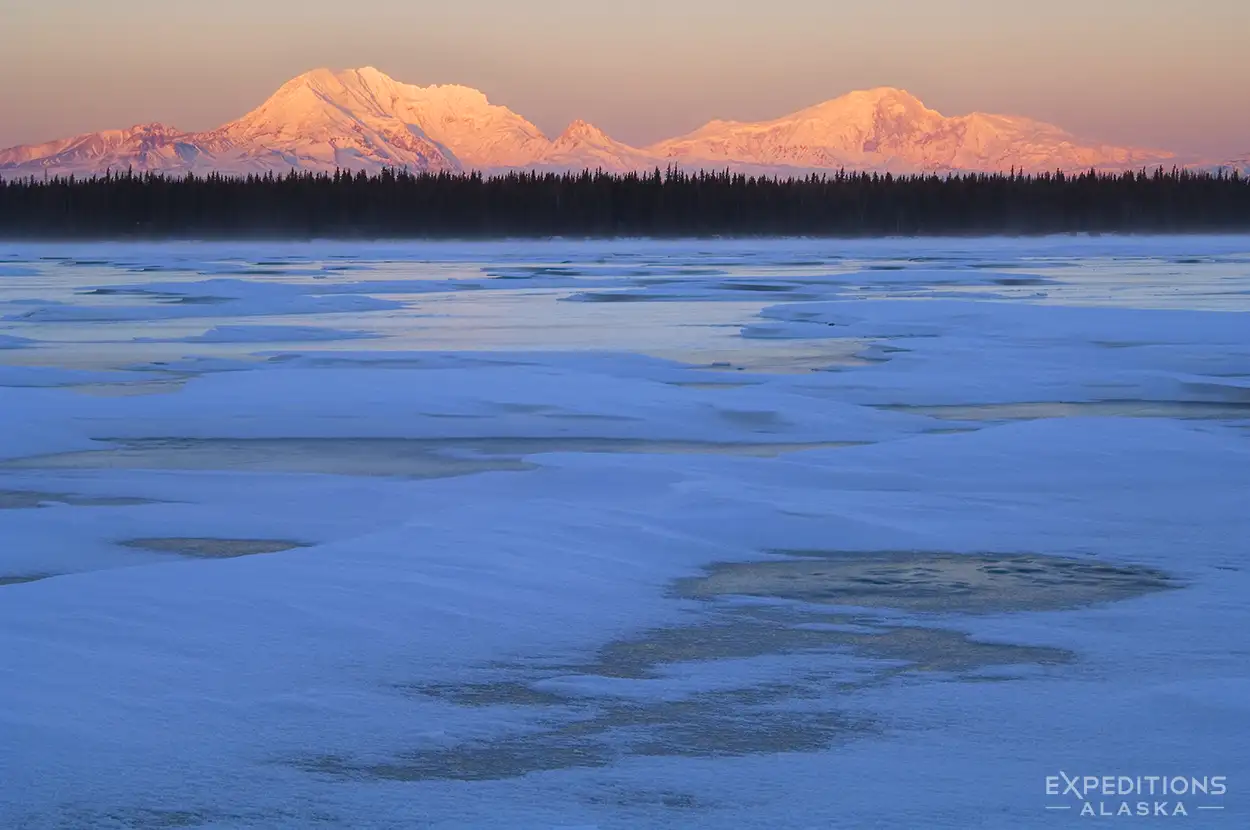
Mt Drum photo, Wrangell St. Elias National Park, Alaska
Scenic Vistas and Winter Light
I truly believe there is no grander vista in all of North America than the Wrangell Mountain Range viewed from Willow Lake. It is one of the few places where you can see a massive line of peaks all exceeding 12,000 feet, including the towering Mt. Blackburn at 16,500 feet.
This photo above was taken a during a brutal cold snap. The alpenglow was incredible, but the temperature was minus 40 and dropped to nearly minus 50 that night. Working a tripod in those conditions is a nightmare. The metal tabs and ballhead lock up, forcing you to remove your gloves to make adjustments. It reminds me of the book “Black Elk Speaks,” where the cold was so intense that metal would freeze to skin and tear it away.
Places to Stay Near Wrangell Mountains
Finding a solid Wrangell Mountains lodge or cabin is essential for exploring this remote country. Depending on which side of the park you are visiting, here are the best options:
- Kennicott River Lodge (McCarthy): A classic choice for those wanting to stay near the historic Kennecott copper mines.
- Blackburn Cabins: For a more private Wrangell Mountains B&B experience in the McCarthy area.
- Sportsman’s Paradise: A great lodge under new ownership (as of 2022) located near Twin Lakes on the Nabesna Road.
- Devil Mountain Lodge (Nabesna): Excellent for those exploring the northern reaches of the range. I love these folks.
- Slana B&Bs: There are several high quality bed and breakfasts in the Slana area for northern park access.
Whether you are looking for a rustic Wrangell Mountains cabin or a guided lodge experience, these spots provide the best access to the high peaks and glaciers.
2 Roads
Here’s another photo of Mt. Sanford from a recent trip to the north side of Wrangell-St. Elias National Park, Alaska.
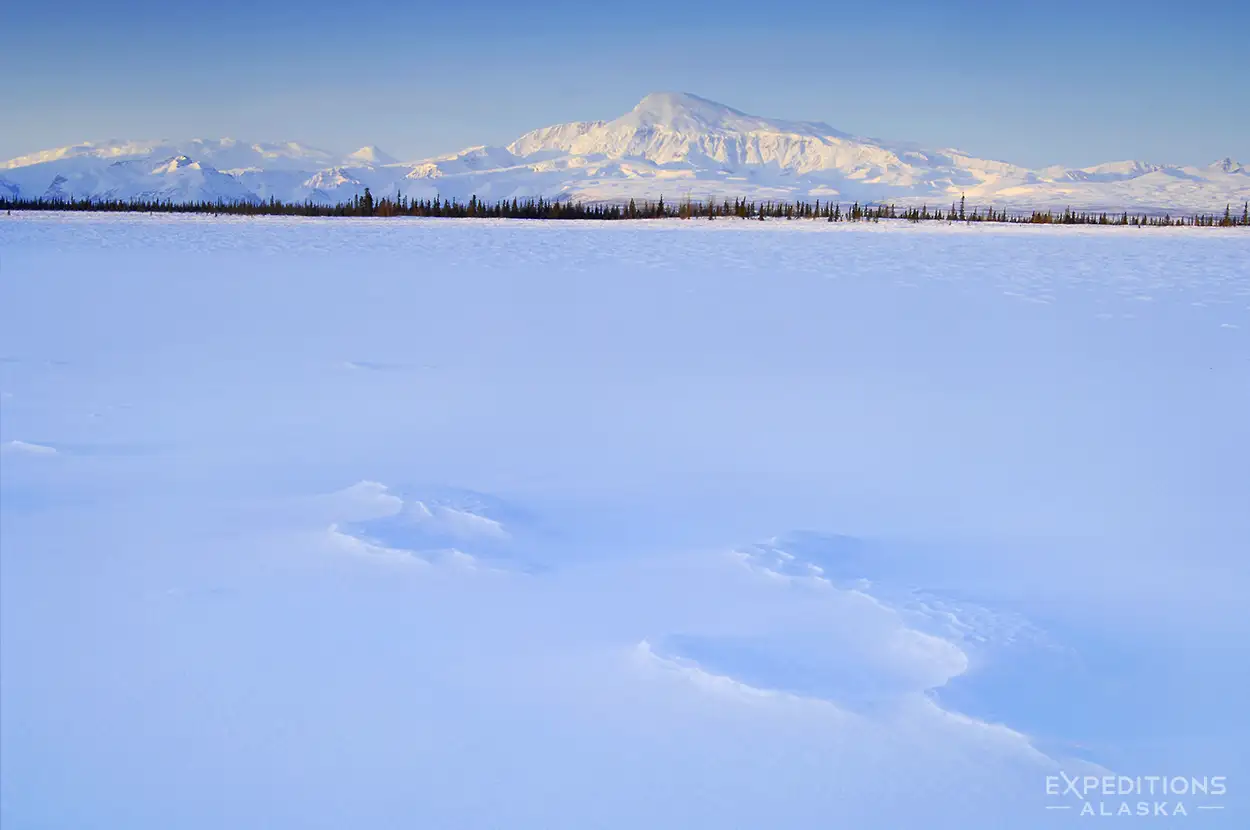
The park is basically accessible via 2 roads, one from the west that runs into McCarthy, and the other from the north, that runs south to Nabesna.
Generally, I’ve always enjoyed the south side area of the park more, but I think the views along the road are often more impressive on the north side. Particularly in the winter.
What’s So Special About the Wrangell Mountains
On a clear day, the Wrangell Mountains lie to the west and dominate the landscape. Mt. Sanford, pictured here, 16 237′ tall, is a great view. Mt. Wrangell, over 14 000′ tall, is also visible, and even a distant Mt. Blackburn can be seen from the entrance of the park.
This small lake is a fairly short hike off the road, and offers, in my opinion, one of the better viewing spots for photographing Mt. Sanford. I’ll be keen to get back to it in early summer and hope for a nice calm morning and reflection of the mountain in soft dawn light. This photo here shows the windblown snow lying on top of the frozen lake – hopefully the lake will be thawed soon enough, the grass along it’s shore greened up, and the clear skies still present. 🙂
Oh, just to be clear, I think the landscape on the southern side of the park is second to none; it’s just that the road rarely offers much view, as it stays low in the thick spruce forest most of its way. Once you get to McCarthy, at the end of the road, the views are amazing.
Here is some trivia for you. These two mountains (top of page), Mt. Drum on the left and Mt. Sanford on the right, are volcanic mountains. Mt. Sanford is a shield volcano. Shield volcanoes are the result of low viscosity lava flows that build up over time. The lava flows and hardens repeatedly, and the mountains gradually grow. They tend to have a lower profile with shallow, sloping sides. They become broader mountains and are sometimes mistaken to be entire mountain ranges.
Shield volcanoes are typically basalt rock, but Mount Sanford is mainly composed of andesite. This is an igneous rock formed along plate margins, and the Wrangell Mountains are on the junction of two major plates along the Pacific rim. The name andesite comes from the Andes Mountain Range in South America, which is also largely a function of tectonic plate movements.
Glacial Erosion and the Sanford Face
The faces of Mt. Sanford and Mt. Drum have been largely eroded away by glacial action, so they no longer have the broad rounded structure of most shield volcanoes. On the southern face, Mt. Sanford rises over 8,000 feet in one mile. I believe this is one of the steepest mountain faces in North America. A plane crashed into Sanford in the late 1940s, and the wreckage was not found until 1999 because it was covered by snow so soon after the crash. Global warming probably uncovered it.
Shooting the Wrangell Mountains at Willow Lake
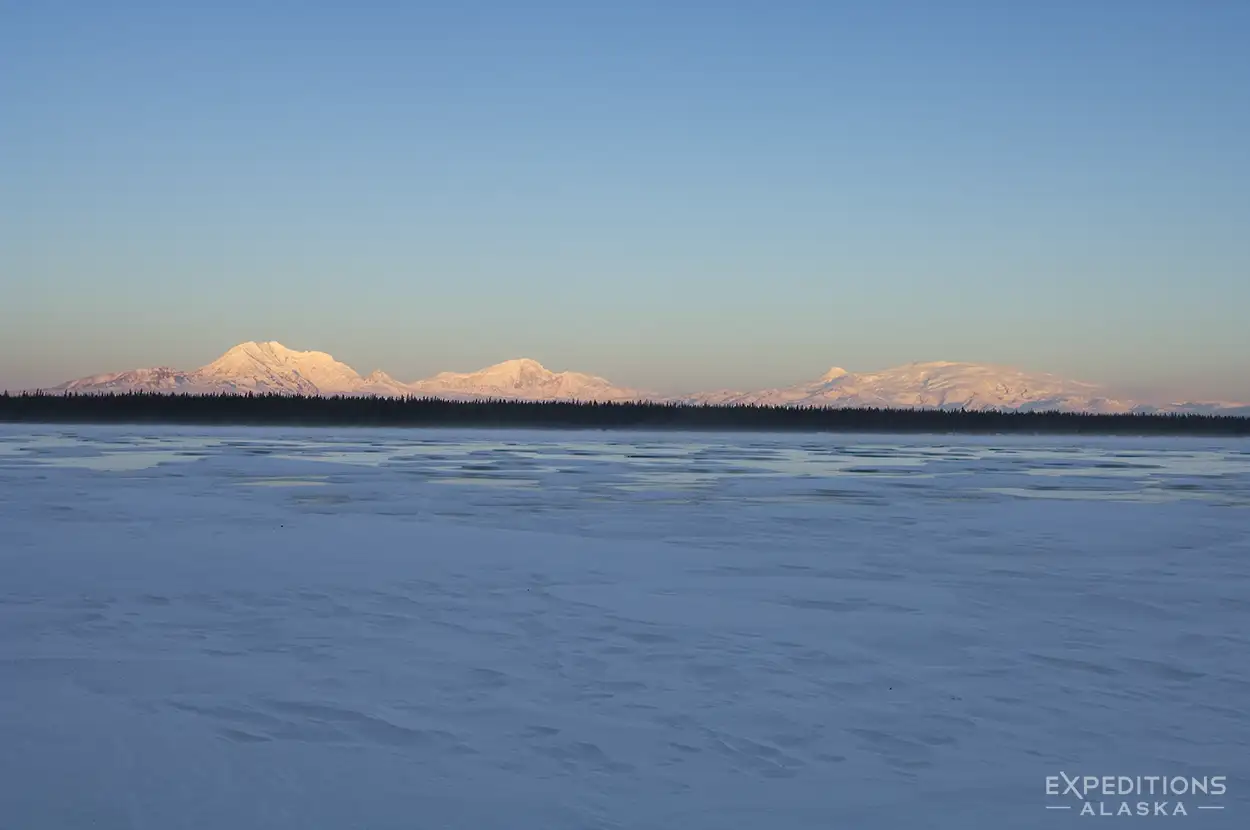
Just got back into town for a brief respite, some catchup work, and I’ll try to post a few photos. This one from the trip home this afternoon. I think there is no grander vista in all of North America than the Wrangell Mountain Range from Willow Lake. For those researching where in the US are the Wrangell Mountains, this vista is one of the most accessible and impressive views in Alaska.
I can’t think of another place where one can see so many really big mountains – all of these are over 12 000′, and haven’t included Mt Blackburn, a little to the south (right) which is 16 500′.
It was REALLY cold here, and is expected to get down to -37? F this evening, hence I took some photos and then jumped in my (heated) van and headed to Anchorage. But I’ll be back, soon.
For now, I’m headed to bed. I’ll write a catch up post tomorrow.
Back to Civilization
I am currently in Anchorage after a long drive from the park. My van has a mystery electrical virus that nobody can diagnose, but through sheer luck and a little grace, it got me and my buddy Charlie back to town. I will be here for a few days to get it into the dealer. I am not eager to head back to a remote Wrangell Mountains cabin with an unreliable vehicle, so I hope for a solid fix before I head back to the subzero temperatures.
Cheers
Carl
Funny – we I lived out there I always asked people the same thing.
Sweet light Carl!
Hey Ron,
Thanks man .. though I figured if you lived out there you’d know the answer, and not have to be asking people. 🙂
Cheers
Carl
Is it Mt. Drum? I’m no geologist , but from what you’ve explained it sounds like it’s Mt. Drum. That’s my educated opinion, which may not be worth scat!! I love the trivia , though. Glad you’re back , Carl.We were beginning to wonder if you were another Bear Grylls!! Hey Ron, did you really live out there?? More trivia! We may learn something! Stay safe.
Hey Beth
Mount Drum is a stratovolcano – volcanoes formed more by the typical eruption of lava blasting out of the ground into the air. But Mt Sanford is WAY higher . it’s over 16 000′ tall, and Mt Drum is a good bit shorter, at 12 000′. 12 010′ to be exact. Mount Sanford is 16 237′ high. What’s REALLY wild is that people have ridden snow machines to the top of these mountains .. and Mount Wrangell, which is 14 163′ high. I can’t imagine riding a snow machine up anything that steep – of course, I don’t have a snow machine either, so that would definitely make it imaginary for me.
Mt Sanford looks much shorter from this angle because it’s so much further away than Mount Drum is.
Cheers
Carl
Hey Carl,
Nice image. Thanks for the trivia, too. It’s all very fitting since I’m taking Geology classes now :). Stop by my blog sometime and say hi … take care, and try not to lose any fingers.
Chris,
hey Chris
Geology stuff is so cool to learn about .. I wish I knew it better.
I’ll try to drop back by your blog and say something, but once I hit the dirt road tomorrow mmorning, I won’t have much internet time at all .. just emails, send some images off, update my blog, and back to my cabin. I won’t even have time to visit Ron’s blog, and he’s already warned me I’m a deadman if I don’t make at least 2 posts a week on his site. 🙂
Cheers
Carl
Two posts a week – hey you called, that is good for a month! 🙂 Great talking to you bud, have a safe trip!
Beth, I did grow up in the area – I used to look at those mountain on my drive back and forth to school – it was pretty sweet!
Ron