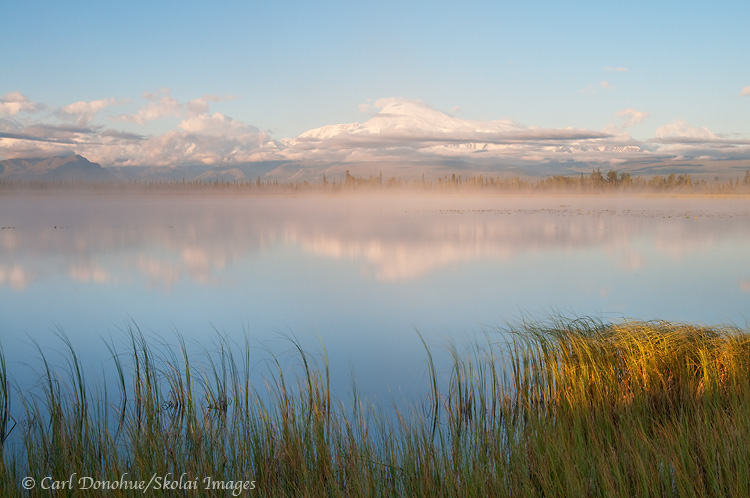
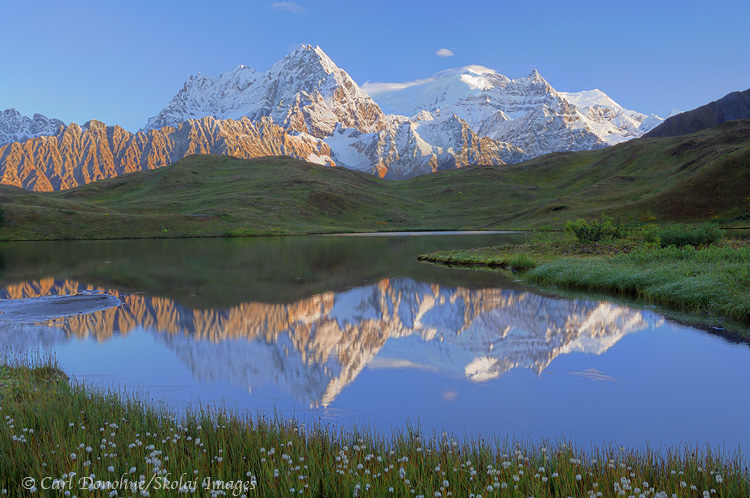
Mount Sanford and reflection, Wrangell St. Elias National Park and Preserve, Alaska.
Here’s a shot from my trip this last week to Wrangell-St. Elias National Park and Preserve. I’m so wanting this shot to come together – as many times as I’ve been here, and waited for the right light, it hasn’t happened yet. This particular morning the air was calm, so the reflection was nice, and the mist added a nice touch, but the alpenglow, earlier in the morning, didn’t happen.
What’s the longest hour of a landscape photographer’s day? That hour between when the light first touches the clouds/mountain tops and when the sun actually rises high enough to light up the valley floor. Standing around, wet and cold, for an hour waiting to see if “Stage II” of the morning light happened, is a tough choice. But, then the light comes up, and it’s all forgotten. What fickle creatures we can be.
I’m pressed for time folks, but I’ll try to schedule another post or 2 for this next week. I just got in this evening and am heading out again sunday morning for 10 days. See ya soon.
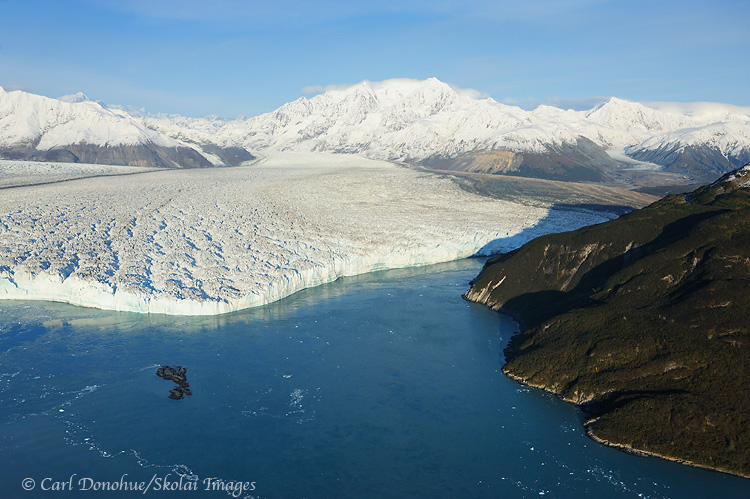
Gilbert Point, the Hubbard Glacier and Mt Seattle, Disenchantment Bay, Wrangell-St. Elias National Park and Preserve, Alaska. Aerial photo.
Hey Folks,
Here’s an image from the first night of my most recent trip, a month long adventure down around the coastline of Wrangell-St. Elias National Park and Preserve. This photo was taken on the air taxi flight out to the coast; we departed a little from the scheduled route and I shot some images of the Hubbard Glacier and surrounding area.
The points of interest here start with the Hubbard Glacier itself, generally regarded as the largest tidewater glacier in the world. At over 70 miles long, it’s quite a chunk of ice (given part of our trip was to look at the Malaspina Glacier and it caving into a tidal lagoon, the Hubbard’s claim to fame may be short-lived; the Malaspina is much bigger, and most definitely reaches the ocean).
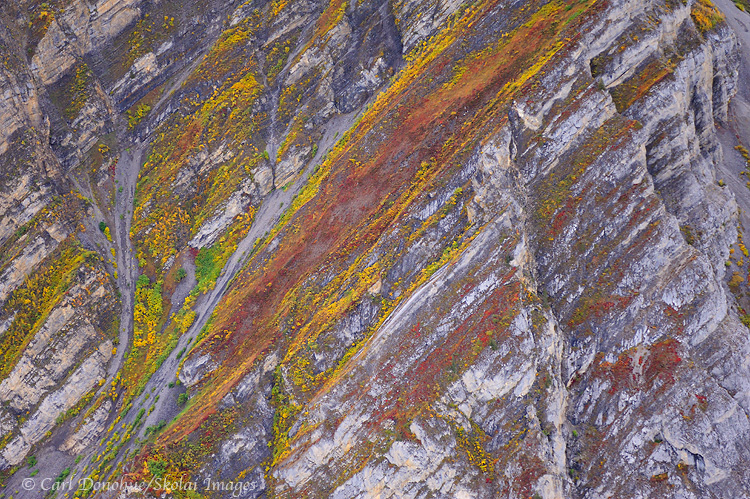
Wrangell mountains, fall colors, sedimentation rock layers ad striations, aerial photo, Wrangell-St. Elias National Park and Preserve, Alaska. Please click on the image above to view a larger version of this photo.
I’d actually asked the pilot to fly us up in this area in the hope to find a particular glacial scene I wanted to reshoot, but the great patterns and colors along the ridges above the glacier were more interesting; in part because we didn’t find what I was looking for anyway.
Aerial photography is an exciting challenge; trying to see compositions that work in camera from such an unusual perspective is harder than one might imagine. The sensory overload of flying through such magnificent scenery,
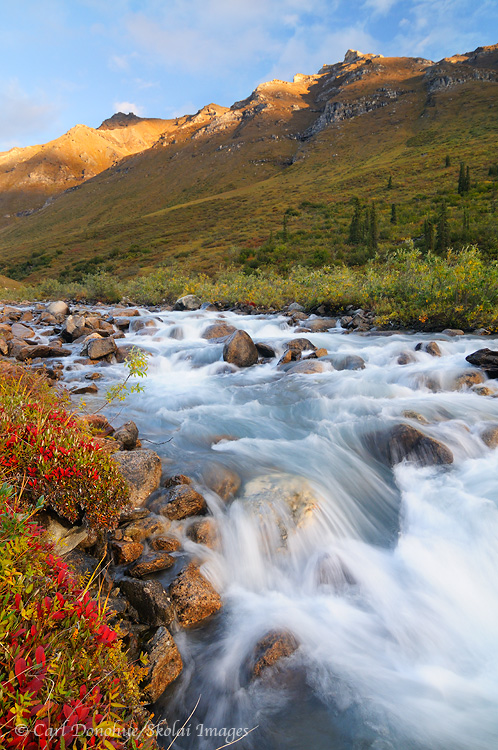
Fall colors along Arrigetch Creek in Gates of the Arctic National Park, Sunrise over the Brooks Mountains, Alaska. Please click on the image above to view a larger version of this photo.
Hey Folks,
Here’s an image I took in August on a trip to the Arrigetch Peaks, in Alaska’s Gates of the Arctic National Park and Preserve. We’d had a great early morning hike up in to and around the Maidens Valley for sunrise, and I shot a few nice images of the peaks catching early light. Afterward we hiked back to camp to catch an hour or so of sleep before breakfast, but I took a few shots along the creek before my nap.
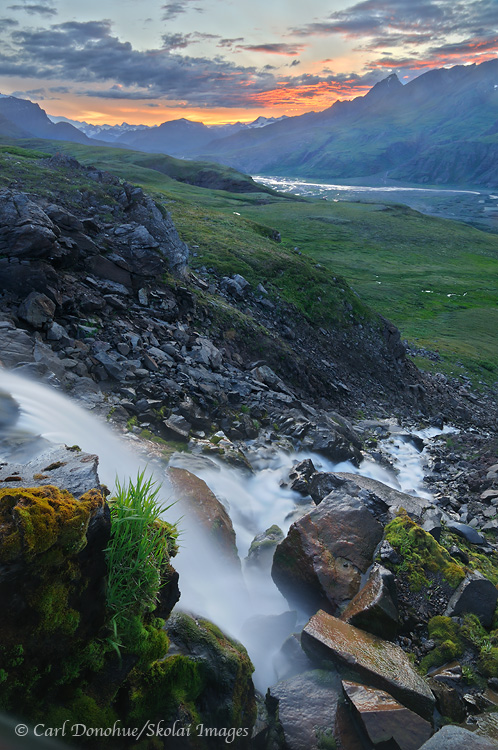
A waterfall, known as Roane Falls, glows in the light of a colorful sunset. Near Chitistone Pass, looking toward Skolai Pass, Wrangell-St. Elias National Park and Preserve, Alaska.
Hey Folks,
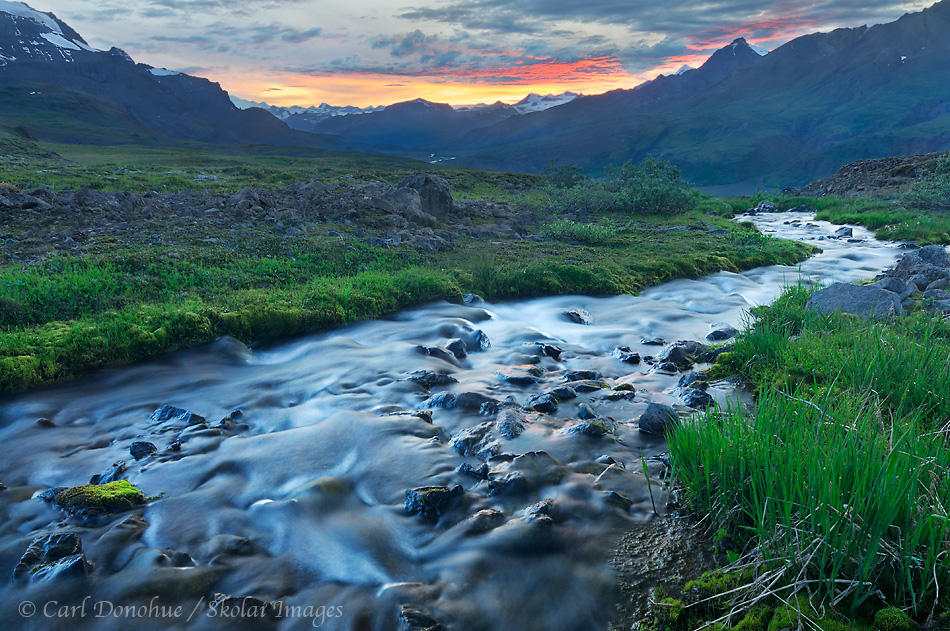
Roane Falls near Chitistone Pass, is a little known, and even less photographed, waterfall in Wrangell-St. Elias National Park and Preserve. I’ll post a horizontal format of this area below
We were on a hiking trip in the area last week, and were treated to some gorgeous weather (along with the obligatory nasty weather as well); The days were well spent walking, talking, eating, and tooling around on the tundra, exploring a glacier, watching wildlife and enjoying this spectacular place. Skolai Pass in the summer is about as grand a place as I know of.
So you won’t find Roane Waterfall on a map, but longtime readers of this blog might remember how it got it’s name. If not, use the search function in the sidebar here and dig around a little. 🙂 This waterfall has appeared on this blog before!
I shot this with multiple exposures, then blended them together in the computer using a combination of the automated HDR tool in Photoshop (CS4) and also manually masking layers of the original frames. I find the HDR program often adds a funky look to the colors, particularly in the foreground, that I can’t seem to properly correct.
I added very little saturation to the sky at all; in fact, I left the waterfalls a little earlier than I should’ve because the sky got even more intense after I moved up the hillside to the location of the previous photo linked above.
Folks often ask whether I bring a tripod on my backpacking trips for photography, due the extra weight and ‘stuff’ factor; I can’t remember the last time I did not bring a tripod on a backpacking trip. Though I don’t always use it for every photo I take, it’s a critical part of my photography; when the light and moments provide the most spectacular opportunities, they almost always require a tripod. There’s be no way I could’ve made an image like this one without the three-legged camera holder.
Sunset over Skolai Pass and the Wrangell Mountains, Wrangell-St. Elias National Park and Preserve, Alaska.
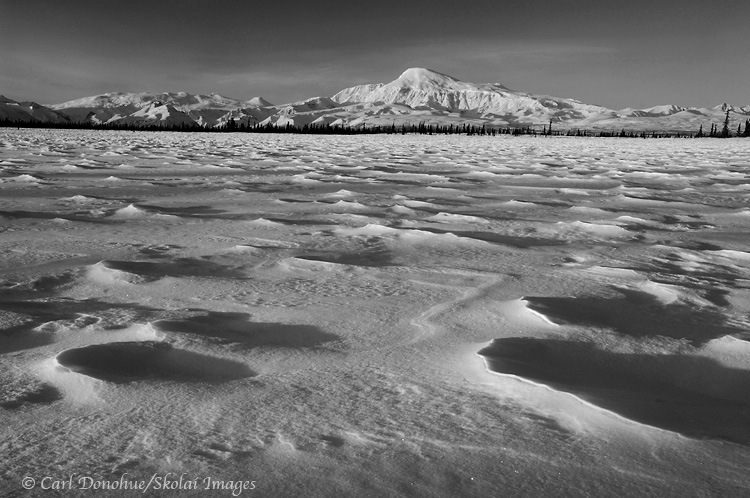
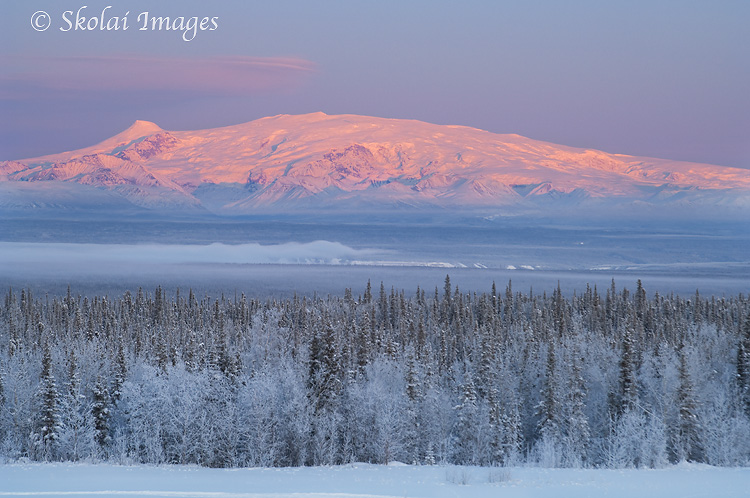
Black and white photo of Mount Sanford, one of the highest peaks in the Wrangell Mountains, at dawn, from a small frozen kettle pond. Winter snow creates patterns on the frozen lake. Mt. Sanford, Wrangell-St. Elias National Park and Preserve, Alaska. Please click on the thumbnail above to view a larger version of this photo.
Hey Folks,
Here’s an image of Mount Sanford, Wrangell-St. Elias National Park and Preserve, I took a while ago, that I converted to black and white in photoshop. I shot this after the alpenglow had faded, and the sun rose high enough in the sky to light up not just Mount Sanford’s massive peak, but the entire floor of the Copper River Basin.
It’s very easy to be tempted to pack up and head off after the alpenglow on a mountain wanes; I often find the light immediately following the alpenglow to be unappealing to me. The sky has a weird yellowish tint to it, and the contrast between the dark, shaded foreground and the brightly lit peak is too great to really photograph well; for me, anyway.
Reflections in the morning, of fresh snow or termination dust on the Wrangell Mountains, near Mount Blackburn, Wrangell-St. Elias National Park and Preserve, Alaska. Please click on the image to view a larger version of the photo.
Hey Folks
Here’s another image, taken earlier, of the scene outside my tent door a few mornings ago. After spending the previous day in the rain, cold, sleet and snow, I went to bed hoping for an improvement in the weather.
All during dinner, I had watched the snowline on the peaks above camp come ever slowly down the mountains – lower and lower. Now, listening to the rain fall on my tent, I didn’t imagine much change happening.
Turning off my headlamp, it was lights out, and I had barely a flicker of hope for the rest of the hike – the continuing patter of rain falling on my tent a sound I was about done with. Eventually that sound faded and then ceased altogether – at first I thought it had simply turned to snow, but a glance outside confirmed that nope, the rain had actually stopped. Woo hoo!
“We had a remarkable sunset one day last November .. It was such a light as we could not have imagined a moment before, and the air also was so warm and serene that nothing was wanting to make a paradise of that meadow. When we reflected that this was not a solitary phenomenon, never to happen again, but that it would happen forever and ever an infinite number of evenings, and cheer and reassure the latest child that walked there, it was more glorious still.
The sun sets on some retired meadow, where no house is visible, with all the glory and splendor that it lavishes on cities, and, perchance, as it has never set before, …. so pure and bright a light, …. so softly and serenely bright, I thought I had never bathed in such a golden flood, without a ripple or murmur to it.” – Henry David Thoreau, “Walking”.
For those of you perhaps unfamiliar with this essay, my advice is to read it carefully; those who’ve read it previously will do well to re-read the piece; it’s a classic.
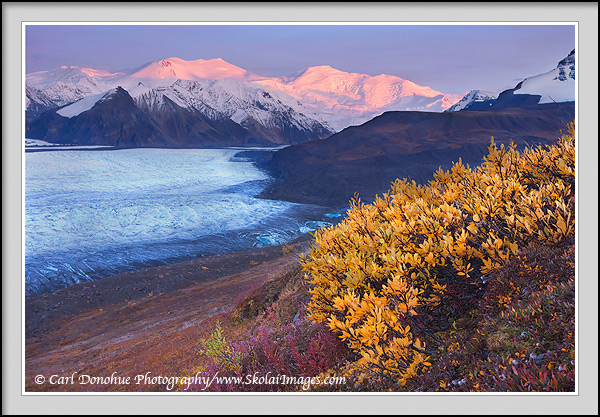
Tallest peaks in the University Range, Mt. Churchill and Mt. Bona rise dramatically from Russell Glacier, catching the last rays of the day, Fall colors in the foreground, Wrangell-St. Elias National Park, Alaska.
Hey Folks,
Here’s an image that I am amazingly lucky to have made. Probably luckier than I deserve to be. Not because of the luck involved in catching this scene like this; this image has been a long, long time in coming. The scene is taken from the south end of Chitistone Pass, near Skolai Pass, Wrangell-St. Elias National Park, Alaska. I’ve spent more time here than I probably should admit to, waiting, hoping and wondering if I’d ever actually happen to catch it in the light that I knew graces these peaks from time to time.
Finally, this September, I was up at Skolai Pass with our phototour and we were really blessed with some great weather. I was giddy with excitement and I’m sure the folks along on the trip were wondering just what they’d got themselves into.
Within 20 minutes of landing we’d already found and photographed a Least Weasel, which I’d never had the opportunity to photograph inside the park previously. Next up we ran into some Woodland caribou, apparently the only woodland caribou herd in Alaska, so that was pretty awesome.