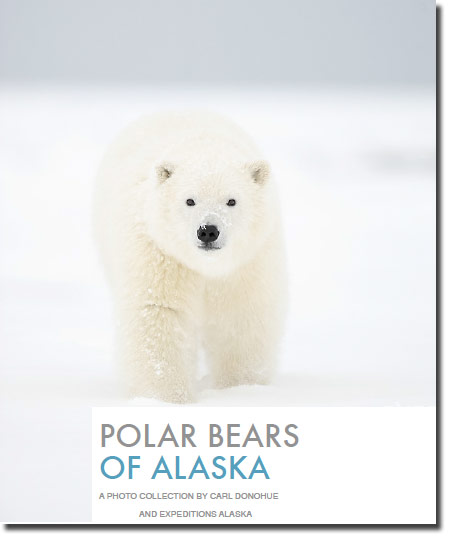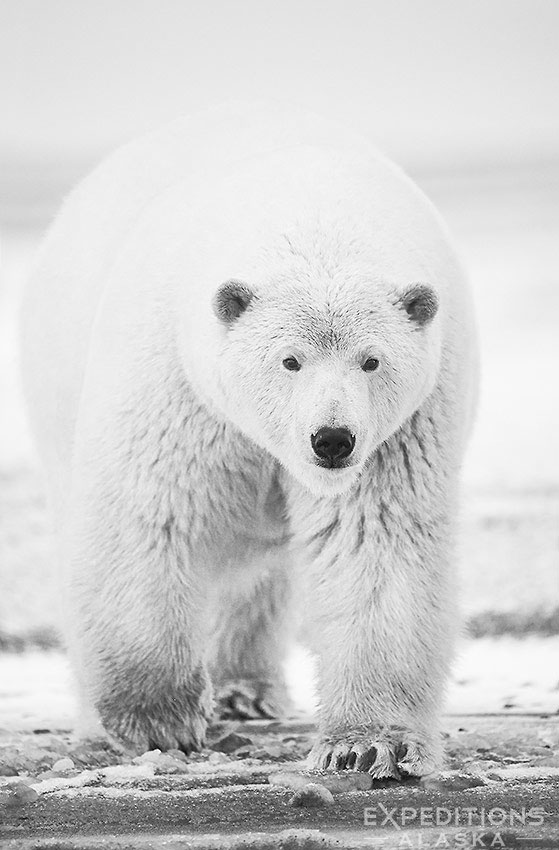
A black and white rendition of this young polar bear approaching the camera. Arctic National Wildlife Refuge, Alaska.
Hey Folks,
Sometimes I wonder if anyone’s still here.
These days, when I do blog, it’s mostly over at Expeditions Alaska. I definitely recommend you check it out over there, if you’re interested, and click on the “Get It By Email” link to stay connected and updated with all the goings on.
I simply found keeping a couple blogs going not worth the time. Maybe I’ll post here from time to time when I get bored, LOL.
Anyway, here’s a polar bear photo from this past fall. We spent a couple weeks in the arctic, again, and had some great photography opportunities with the bears. Never ceases to amaze me how fascinating it is to observe and photograph these incredible creatures. I’ve never really found another animal quite like the polar bear.
I converted this photo to black and whit to see how ti might come out and was pleasantly pleased with the results. What do you think?
Here’s a free ebook, available only to subscribers of my Expeditions Alaska newsletter. And, even better, here a bunch of absurdly great reasons why you want this ebook.
It’s free
It’s a great eBook
Over 80 polar bear photos
My newsletter is awesome
Polar bears are super cool, and
Nobody should need more than 5 reasons for this eBook.
So what is it? It’s a collection of photos of polar bears. Over 80 of them. I’ve written a piece or two about the bears as well. I think it’s a pretty cool little project. Download a copy and let me know what you think. I’d love to hear your review of it.
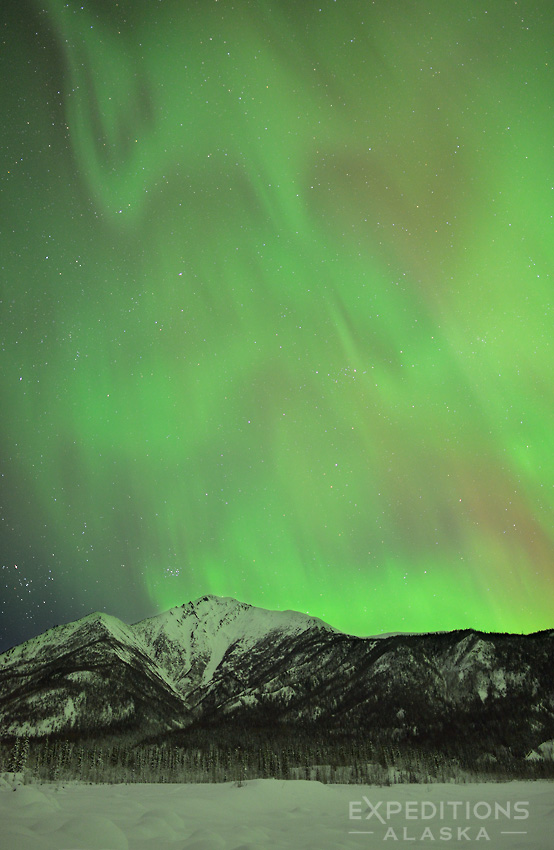
Aurora borealis photo, over Fireweed Mountain, Wrangell-St. Elias National Park and Preserve, Alaska
Hey Folks,
It’s true. This post is the key to your success. This article is THE factor that will drive you to become the most popular, most retweeted, most faved, liked, mentioned and copied Photographer of All Time In The World Ever (and we all know how well those retweets and likes will pay your mortgage).
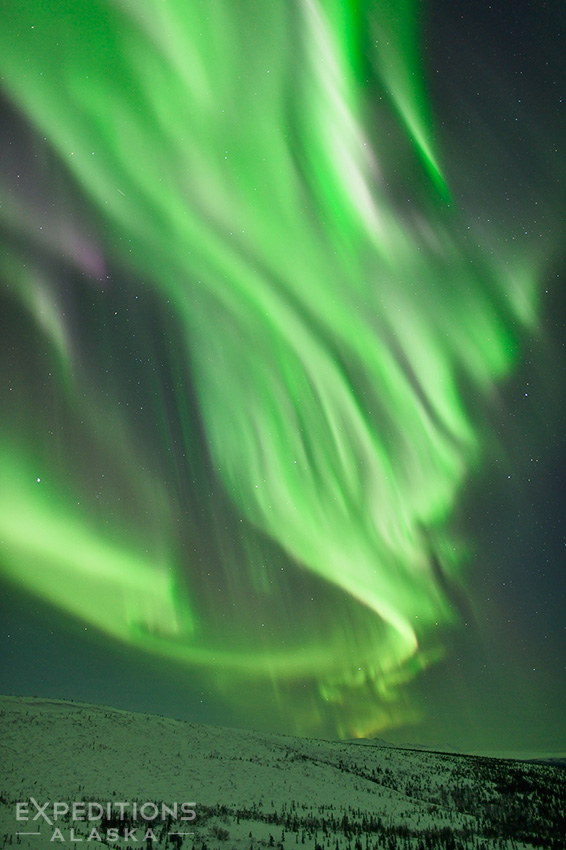
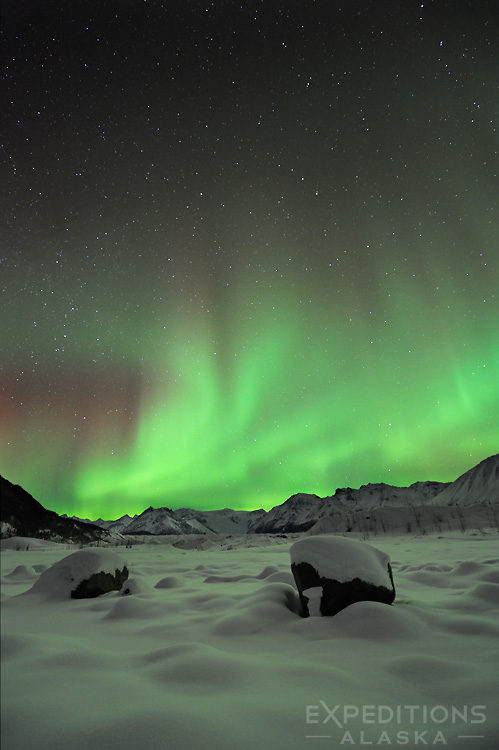
Wrangell-St. Elias National Park and the aurora borealis photo, or northern lights, Alaska. Please click on the image above to view a larger version of this photo.
I was guiding a photo tour into the park, and we were late leaving Anchorage, due to delays with one of the guest’s flight to Alaska.
What Are the Northern Lights?
Wikipedia says this about the northern lights:
“Auroras are now known to be caused by the collision of charged particles (e.g. electrons), found in the magnetosphere, with atoms in the Earth’s upper atmosphere (at altitudes above 80 km). These charged particles are typically energized to levels between 1 thousand and 15 thousand electronvolts and, as they collide with atoms of gases in the atmosphere, the atoms become energized. Shortly afterwards, the atoms emit their gained energy as light. Light emitted by the Aurora tends to be dominated by emissions from atomic oxygen, resulting in a greenish glow (at a wavelength of 557.7 nm) and – especially at lower energy levels and at higher altitudes – the dark-red glow (at 630.0 nm of wavelength). “
Make sense? There you have it folks – the northern lights are tiny little things in the air, like dust, so small we can’t even see them, that glow because they crash into other tiny little things we can’t see. How cool is that?
They’re called the aurora borealis after the Roman Goddess of the dawn, ‘Aurora’, and the Greek god of Wind, “Borealis”. That sounds reasonable, except that the Aurora Borealis isn’t visible in either Greece or Rome.
Seems to me then we should allow people who do see them reguarly to name them. The Scottish called them “the merry dancers” or na fir-chlis.
The Scandinavians name for the northern lights translates as “herring flash”. It was believed that northern lights were the reflections cast by large swarms of herring onto the sky.
The name they gave the northern lights was “norðurljós” — which I have no idea how to pronounce. The Norse folks also called them “the fires that surround the North and South edges of the world”.
In central Asia the belief of the Chuvash peoples is that the lights were the god/goddess Suratan-tura (Birth-giving Heaven).
The Algonquin Indian folklore proclaimed that the northern lights were their ancestors dancing around a ceremonial fire.
The Athabascan people who lived in what is now known as Wrangell St. Elias National Park, saw messages from their dead, the “sky dwellers“.
I love this kind of way of seeing the world. It’s beautiful, much more beautiful than ‘the northern lights’. And as beautiful as they are, it seems fitting we should have a beautiful way to refer to them.
Our Northern Lights Photography
We’ve had some pretty great weather here through the month of February, and that means, a great time to get out and look for northern lights. Working on my own project, rather than photo tours, I was able to hit a few destinations I wanted to shoot that are a little more hit and miss; less reliable than some others, but places I wanted to shoot nonetheless.
One of those places is Wrangell-St. Elias National Park and Preserve. Inevitably I’d be in the wrong place at the wrong time in a place slightly larger than the country of Switzerland; I’d head off in one direction and then have fog and haze cloud up the skies, or I’d head off in another direction, and the lights display would be directly behind me. The mountains in front me being what I want to shoot, and the lights behind me. Not a great mix.
But, such is what happens when you have specific ideas in mind; it’s important to be flexible in nature photography, and particularly so when shooting the northern lights, but part of working on a project involves fulfilling your own ideas. Spontaneity is great, and I’m all for it. But I’m also interested in trying to make a photo of something I envision ahead of time, and working toward that.
I’m sure any of the photographers out there who might chance upon reading this post have themselves what is called a “Facebook Page”. For those non-photography folks who use The Face simply for personal use, a ‘page’ is akin to your profile, but it’s designed for a business, or an artist, etc. Businesses are not allowed to have a profile, but must have created a ‘page’ if they wish to have a Facebook presence. My Facebook pages are here and here, if you’re interested, one for my photography (Skolai Images) and one for my guiding business, Expeditions Alaska.
Pages, over profiles, have the nice benefit of what they call “insights”, where the calculators at Facebook show you how well you’re doing with your Facebook marketing, branding, promotion, engagement, and so on. They have information available like how many visits your page has, how much “engagement” is has had, and even (kinda) where some of that traffic has come from. This data are called Performance Metrics. Continue reading →
I thought I’d share this video on my site here. I wrote the tune, a number of years ago, and recorded it with some friends in Atlanta, GA, when I lived there. Great musicians all of them, and it was a treat to record with them. I played the guitar parts.
The video and stills I shot in 2013 on my Alaska Polar Bear Photo Tour in the Arctic National Wildlife Refuge. One or 2 of the clips were shot by clients on the trip, and thanks go to Sue P and Munir K for their permission to use their clips. See my collection of stock polar bear photos here.
A young polar bear on the prowl, silhouetted against a colorful sunrise, on the frozen ground of the Arctic National Wildlife Refuge (ANWR), Alaska. Polar bear, Ursus maritimus, Alaska. Please click on the image above to view a larger version of this photo.
Hey Folks,
Everyone loves a great sunrise or sunset, right? And everyone loves polar bears; seriously, does anyone NOT love polar bears? So who loves the 2 together?
We set out this morning with high hopes, clear skies and the beginning of color on the horizon. Everyone hoped for a nice sky and some polar bear activity. Hoping, and getting are two different things.
So how does it play out? The sunrise turned out to be, in a word, spectacular. The morning itself, frustrating.
We found some polar bears relatively soon, but they weren’t really in a great location. On top of that, they were asleep. certainly, polar bears are so photogenic that even asleep, they make a great subject. But they were sleeping just below a short embankment, with the colorful sky above and beyond and so we couldn’t find a way to really make it work. One option might have been to shoot multiple exposures, steadily, and then blend the 2 together to properly capture detail in the foreground and the background. I shot a couple of images like this, but even as I was photographing, I knew it wasn’t really happening. OK stuff, but nothing grand.