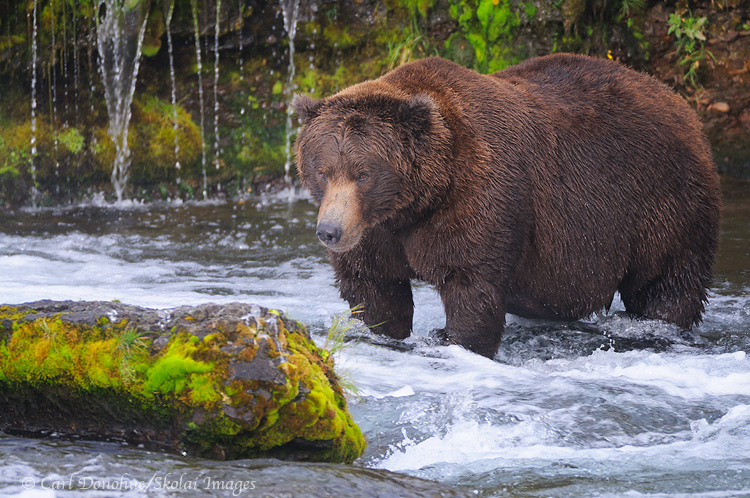
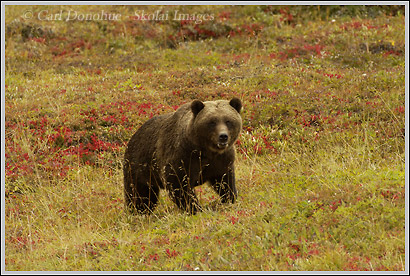
Male grizzly bear, brown bear photo, (Ursus arctos) Katmai National Park, Alaska. Please click on the thumbnail to view a larger version of the photo.
Hey Folks,
Just a quick note here to say if you can, check out this online radio interview (GONE) Tuesday, May 4, 2010, at 9pm EST. I’ll be talking with photographers Greg D and E.J. Peiker, and host Dave Warner. It should be a lot of fun to do, and hopefully interesting and useful as well. I know I’m excited about it, Greg and EJ are great photographers whom I’ve admired for a long time, and it’ll be nice to talk with them.
We’ll be talking about wilderness photography, backpacking and hiking and photographing, as well as some environmental/conservation topics that might be relevant to nature photography.
Greg also had the idea of present a few images online and we can discuss those and present a little more context about the work. I’m not really sure all of what we’ll talk about yet, but the show is open to call in, and it’d be great to hear from you on air. Hopefully the conversation will be interesting.
The broadcast can be heard live here. If you miss the show, it will be edited and available as a podcast soon after – I’ll add a link to this post when that becomes available.
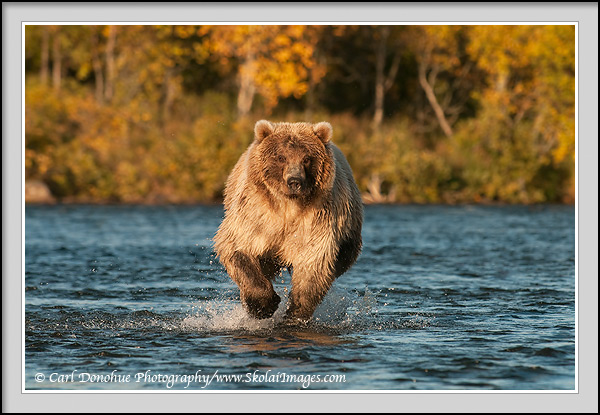
A young brown bear (Ursus arctos) walks through a stream hunting for spawning Sockeye Salmon. Grizzly bear, or coastal brown bear, Katmai National Park and Preserve, Alaska.
Hey folks
Won’t be long until the bears are running around the woods again!!!
I’ll be in the woods for the coming week, but I thought I’d post a brown bear photo, and schedule a couple of other blog posts for while I’m gone.
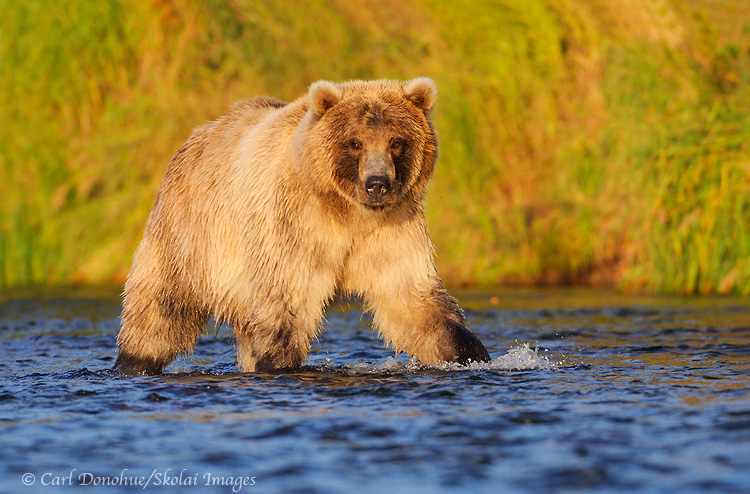
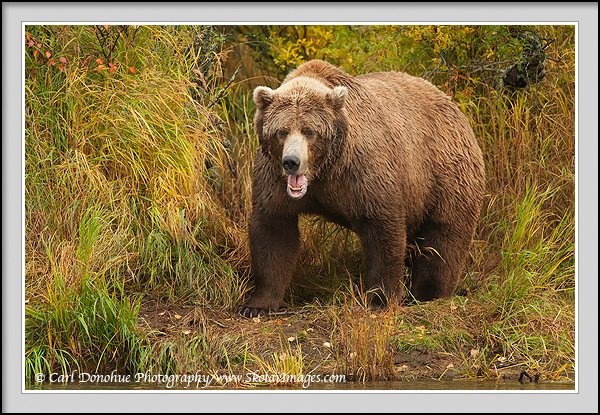
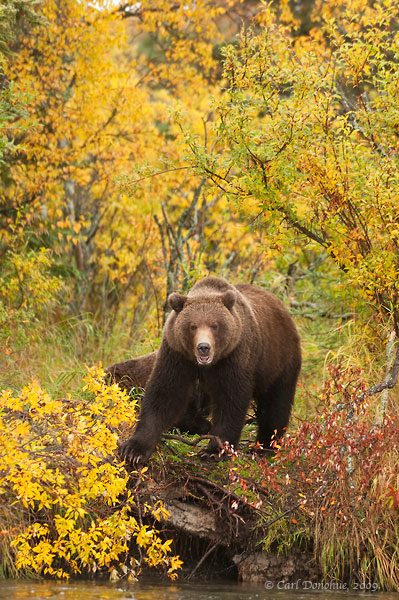
Catching this young blonde colored brown bear in some nice light was quite a treat. That’s the benefit of spending time in the field. Most wildlife photography, it seems, is done in places where the subject is pretty much a given; places like Homer for bald eagles, Yellowstone for elk, Churchill for polar bears, and Katmai National Park and Preserve for grizzly bears, or brown bears.
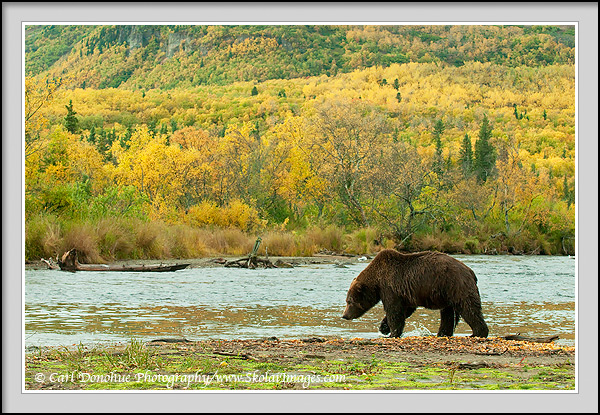
As I said in a recent post, on my recent trip to Katmai National Park and Preserve I really hoped to make some images that featured not only the great grizzly bears, but also the awesome fall colors of the boreal forest .
The Black Cottonwoods of the area provide the perfect background for photographing grizzly bears, but rarely do photographers seem to combine the 2. Most folks come up to Alaska and shoot the bears in the summer, and I think they’re missing out.
The classic shot of a grizzly bear fishing for salmon at Brooks Falls is nice, and only generally possible mid-summer, of course, but there are a lot of other opportunities around in the fall that can be equally exciting.
Great fall colors make stunning backdrops, and can really bring a vibrancy to the image. Stepping back, zooming out, and letting the scene dictate the photos is often the key.
In this photo I enjoy the sense of relationship between subject and environment – the dichotomy is largely only a function of our thought processing. The idea that the “environment” is something other than everything is a little peculiar; the subject IS the environment, as equally as the environment is the subject. There is really no difference between the bear and his habitat.
This Post is About Motion Blurs, Art and Technique
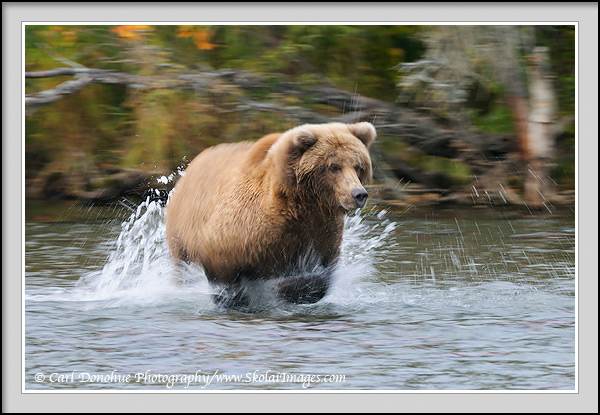
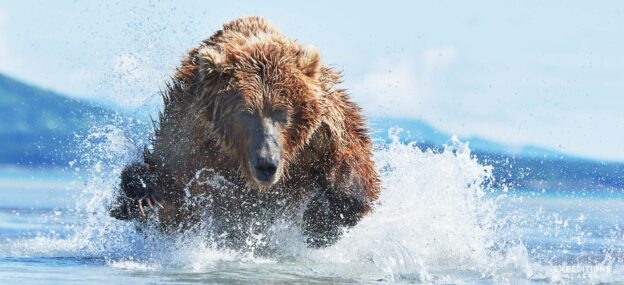
One of the photos I wanted this year was some slower shutter speed blurs of grizzly bears chasing spawning Sockeye Salmon (Oncorhynchus nerka) up the river.
This kind of image is difficult to do with grizzly bears; well, not difficult to do, but difficult to manage a photo that works.
More so, I think, than with most other animals.
The result of this is that it seems to take about 5 times as many attempts to get a decent ‘panblur’ of a grizzly bear than it might, for example, of a caribou or wolf.
What I’m calling a ‘panblur’, for those of you who aren’t certain, is a technique of slowing down the shutter speed when shooting movement, so that the subject becomes blurred, rather than crisp and sharp.
You can see in the image above the spashing water and the legs of the bear are not to sharp at all. By panning the camera along with the bear as it races through the water,
“People usually consider walking on water or in thin air a miracle. But I think the real miracle is not to walk either on water or in thin air, but to walk on earth. Every day we are engaged in a miracle which we don’t even recognize: a blue sky, white clouds, green leaves, the black, curious eyes of a child — our own two eyes. All is a miracle.” – Thich Nhat Hahn.
Hey Folks,
Well, with all the comments about landscapes versus bear photos on the last few pages, I thought I’d try a compromise. I know, I know, compromises end up pleasing no one, right? Well, so be it.
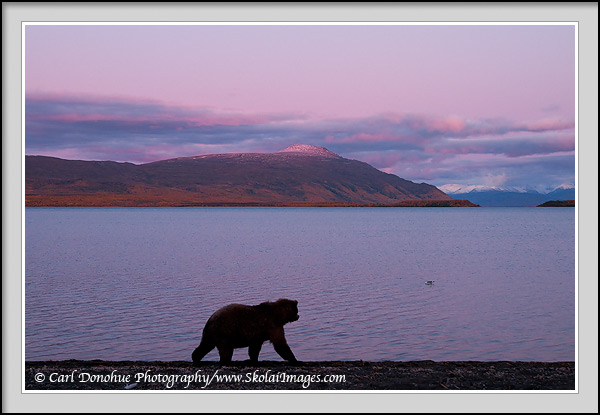
This is possibly the last photo I took on my trip last month, a sunset over Naknek Lake – I was hoping for some nice clear skies the following morning – and actually had a big sunrise – but then it clouded over, very soon afterward, and no good light was had for the morning shooting. Then I had to pack and get ready for the plane to come pick me up. The trip was all over too soon.
The photo is one exposure, so no real photoshop trickery – I even left the gull in the bay (@ Ron 🙂 ).
The real reason I wanted to post this photo was, honestly, a talk I went to listen to tonight, at a local bookstore, by a great Alaskan writer, Bill Sherwonit.
I’ll compile a few older bear photo blogs into a collection here for you. Easier to review if you’re interested
Brown bear (Ursus arctos), at Hallo Bay, Katmai National Park and Preserve, Alaska.
Hey Folks,
Just returned from a week on the Katmai coast photographing brown bears. This was a new trip for me this year; I’d not been over to this specific location, or at this time of year, previously.
It was a grand trip; flying out of Kodiak, and spending a week on a boat along the coast, shooting bears in gorgeous soft summer light. My personal photography priority for the trip was bears in the landscape. I also wanted some cool “behavioral” photos, which included bears clamming at low tide, sparring with one another, and even mating. Cool stuff to shoot.
Shooting mid-summer in Alaska requires a great deal of flexibility; if the weather is clear and sunny, the best light (in this area) is at 9:30pm – 11pm, and 5:00am – 6:00am. So by the time we’d get back from a shoot, it might well be after midnight. Getting back up at 4:30am to shoot again is a rough gig. On the other hand, if the skies are overcast, we’d shift to a more routine schedule, and head out around 8am.
Switching back and forth from one schedule to the next, day to day, is hard and extremely tiresome. I slept pretty well when I got home.
And, speaking of getting home, a good tip is to make sure your luggage doesn’t get left on the boat when you fly back to Kodiak – especially if the specific piece of luggage holds your wallet and ID.
OK – all the whining about ‘no bears’ brings us back to the grizzly. This adult male was kind of enough to give me a few cool poses, of which I think this is one of my favorites. There’s little more to be said other than ‘bears rock’.
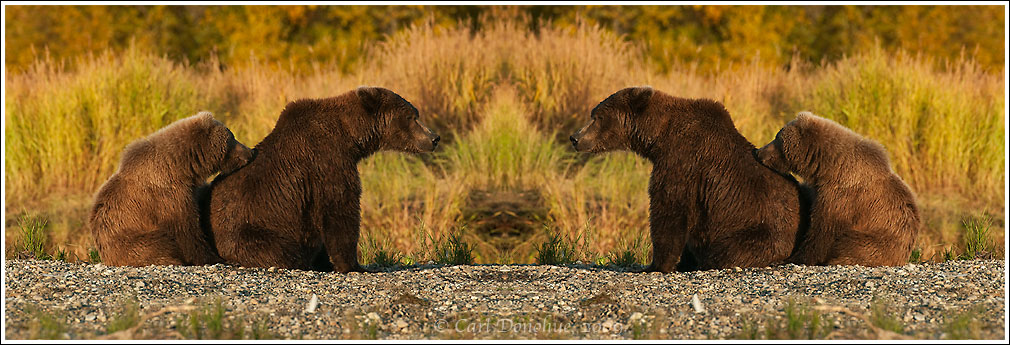
4 Grizzly Bears
While I’m going through my recent images, I processed this one and thought I’d post it for kicks. It’s a simple computer trick, which even a cursory look unveils. All I did here was copy the image, flip it horizontally, and paste it alongside the original. I got a split second to shoot this scene, as the bears didn’t hold the position very long – another bear came by and the cub backed away from his nonchalant mum. I was thinking about the composite when I took the frame, remembering the shot I made a number of years back (on this page).
I don’t do a lot of this kind of photoshop trickery, but sometimes it’s fun. I’m interested to hear if folks like this image or not.
Brown bears Playing
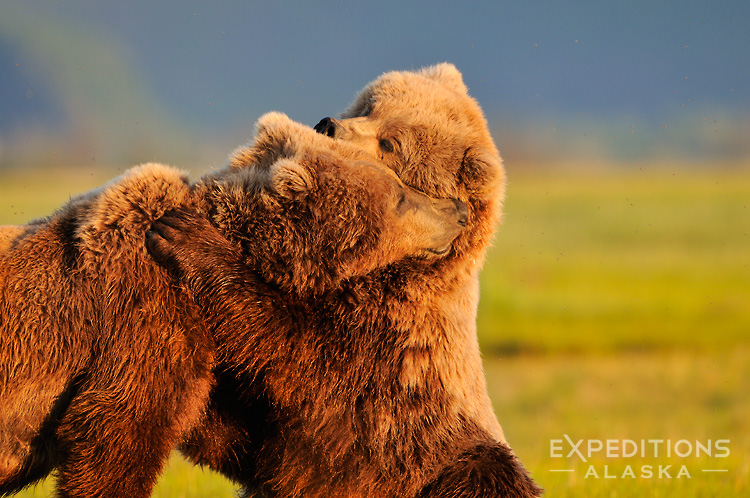
2 adult brown bears playing (Ursus arctos) together in an embrace. Hallo Bay in June/July is a great time to see and photograph bear behavior like this.
Another photo from this past summer when I led a photo tour to Hallo Bay and the coast of Katmai National Park and Preserve here in Alaska. I’ve been photographing brown bears for many years now, and return to the Alaskan Peninsula every summer to watch and photograph these creatures. They’re simply an awesome animal to see, whether its up close and personal like this, or from a distant ridge on a mountain hike somewhere.
I intentionally picked late June for this particular tour with the hope of catching some interaction between the bears, and especially mating behavior. Brown bear breeding season is anywhere from late May through mid-July, with some exceptions even being later. Generally, early summer is the time for brown bears’ breeding season.
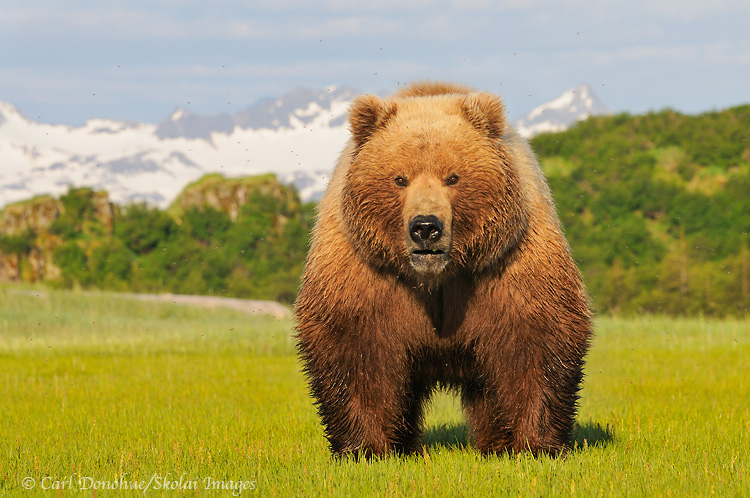
They say 3 is a lucky number – so here’s my third grizzly bear photo in a row. This was one of the prettiest grizzly bears I’ve seen, a really light blond color, with darker bands around the lower legs and face – simply a beautiful animal. I spent a lot of time shooting this bear, and got a number of runs like this, the bear coming directly at me, great light, nice background – what’s there to not like?
That 2010 photo tour idea I mentioned below? It happened. And it’s been happening every fall since.
This last year’s trip wrapped up a few weeks ago and it was one of the better ones. The group was solid, the weather cooperated more than it usually does, and the bears delivered. We had consistent action throughout the week, with bears fishing, sparring, and doing all the things that make these trips worth the long days.
Everyone came home with keepers. A few people nailed shots that’ll anchor their portfolios for years. That’s the goal, and it doesn’t always come together this cleanly, so you appreciate it when it does.
The format has evolved over the years but the core remains the same. Small group, remote camp, long hours on the water and along the banks. No crowds, no viewing platforms, no competing for position with forty other photographers. Just bears and fall color and the kind of quiet that only exists when you’re a float plane ride from the nearest road. I’m already booking for next fall. If this kind of trip interests you, reach out sooner than later. These fill up.
Sorry for the delay (again) in posting here. I’ve been busy the last 2 weeks, trying to photograph grizzly bears. I just returned, 24 hours ago, from a trip to Katmai National Park, where I focused on trying to get some grizzly bear photos that were different to what I’d shot in the past. Here’s the first of what hopefully won’t be too many that you get bored with them.
Yes, it’s true – I took some time out to detour away from Wrangell-St. Elias National Park, when I promised myself not to – but the change did me great! One of the things I really wanted to focus on
Young male grizzly bear on the tundra in Wrangell-St. Elias National Park
Bear Attack in Wyoming
I’ve been reading a little about a recent case of a bear attack, this time in Yellowstone National Park, Wyoming. Fortunately, the fellow who was mauled is alive. Here’s one version of the story.
A lot of discussion has focused on this incident on various nature photography forums. I’m always particularly interested in the subject because I spend so much time photographing bears. I’ve had a few encounters that caught my attention. Much of that discussion revolves around the potential for this kind of thing to be a vehicle for new, tighter regulations brought into place by the National Parks’ Service, placing ever tighter restrictions on photographers and the activities they engage.
My Experience
I’ve been photographing bears in the wild a long time. Probably longer than most folks. I don’t know all there is about grizzly bears, but I do know more than most. I spend weeks on end every year photographing grizzly bears, hiking and backpacking in bear country, and talking to researchers and other naturalists who know bears.
So I’ve got my bear bones.
Points of Discussion About Bear Attacks
1. We Hope the Victim/s are OK
While I think that’s a worthy discussion, hopefully it’s not the be sole focus of our concern. Firstly, I hope the guy’s OK. I’ve been close enough to many grizzly bears that I can barely (now there’s a great pun) imagine how terrible it must be to be mauled by one.