Osprey, Wrangell St. Elias National Park, Alaska

osprey soaring, Wrangell St. Elias national Park, Alaska.

Hey Folks,

It’s been a fun week so far .. the birds are back in the north country. Specifically, Wrangell-St. Elias National Park, Alaska. That means lots of time wondering how I can sneak my way close enough for a photo of one of them.

Ever try to sneak up on a bird?

It’s a tough gig. They have ‘eyes like eagles’ funnily enough, and always know exactly where you are – and how close they let you approach seems to correlate precisely with how well they fit in the frame of your camera – as they get more than half the viewfinder, they fly away – regardless if you’re shooting an enormous bald eagle or a sneaky little robin.

But it’s fun, and it’s so great to have them back in the north.

The woods literally come alive every morning with the various songs and calls of the migratory birds, all getting their groove on and nesting and breeding before summer. I hadn’t realized how much I dig their many sounds until they returned.

Here’s an osprey photo. I was set up in my blind trying to get some duck photos – with no luck. This osprey appeared and I tried to get some images of him/her. It was ridiculously hard, as I was sitting on the ground, kneeling in fact, with my tripod about 1 foot off the ground.

I had the 500mm and a teleconverter mounted on it, and this osprey appears, flying around looking for something to eat. So I’m literally flopping about on the ground, on my back shooting up at this osprey, swinging my camera and lens around like a militiaman and his gattling gun.

I didn’t get much in the way of sharp images, but it was pretty cool – especially what happened about 10 seconds later.

osprey and Goshawk, Wrangell St. Elias national Park, Alaska.

I was sitting on my blind waiting on some ducks to approach (they never did – ducks are among the sneakiest of all birds) and this osprey started flying overhead.

All of a sudden out of the woods comes this Goshawk on the attack .. it was all over pretty quickly. The osprey, far larger, had it’s butt kicked all too soon, and took off from where it came. The Goshawk disappeared back into the woods once the osprey was gone. They must have a nest I there somewhere, but I never saw it.

More of my raptor photos can be found here.

Cheers

Carl

Bald eagle, feeding on snowshoe hare, Alaska

Bald eagle, feeding on snowshoe hare, Alaska.
Alaska bald eagle photo.

Hey Folks,

Who said bald eagles only eat fish. This one has a snowshoe hare and seems to be more than happy with it.

So far, I’ve seen my first grizzly of the year, my first black bear of the year, bull moose, cow moose, beaver and some other white thing that raced across a road in front of me, that I have no idea what it was .. larger than a housecat, with a tail, snow white, and running for it’s life.

A mystery.

That’s the mammals. None of which I photographed. I do have, however, some bird images. You’ll be seeing a number of birds on this blog over the next week.

Continue reading

Red fox kit, Arctic National Wildlife Refuge, Alaska

A young red fox kit on the coastal plain, Arctic National Wildlife Refuge, Alaska.

Hey Folks,

I’ll be visiting the Arctic National Wildlife Refuge (ANWR) 6 weeks from now, spending 2 weeks floating the Canning River, from the Upper Marsh Fork near the Continental Divide in the Brooks Range, 120 miles northward, out of the mountains and across the coastal plain to the Beaufort Sea and the Arctic Ocean. I can’t wait.

I just saw this article on CNN’s website. From the first paragraph, ‘President Bush said Saturday that the Saudis’ modest increase in oil production “doesn’t solve our problem,” ‘

The whole tone of the article is an acknowledgement that such a relatively small increase in oil supply, for the US, is meaningless. This increase could bring gas online to the American market almost immediately. At the same time, the current US administration is arguing for the opening of the Arctic National Wildlife Refuge (ANWR) to oil and gas extraction.

The US Govt’s own studies yield a mean peak in oil supply from the Refuge of under 900 000 barrels a day. That peak would arrive about 10-12 years AFTER the oil supply came online – and the oil is expected to take 10-15 years to come online after any legislation allowing drilling their might be passed.

Continue reading

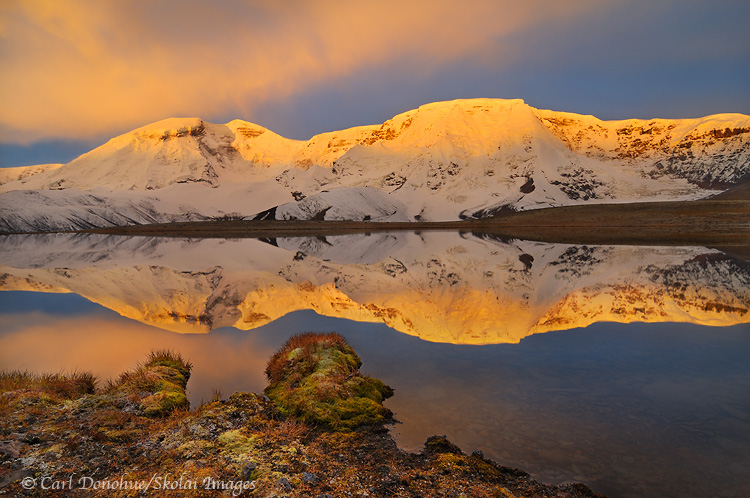
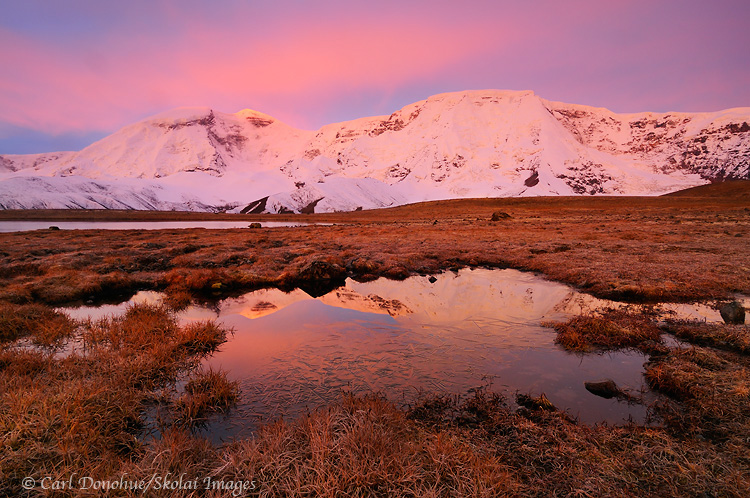
Hole in the Wall, Skolai Pass, Wrangell St. Elias National Park

Ice and snow form a glacier on one of the peaks at Hole in the Wall, Skolai Pass, Wrangell-St. Elias National Park, Alaska.

Hey Folks,

Here’s an image from last September – I was basecamped in Skolai Pass, part of the Goat Trail backpacking route. This morning I had some nice light to shoot a variety of images.

Skolai is an amazing place with a variety of photographic subjects that is seemingly without end.

Wildflowers can be amazing there, landscapes as grand as the immense Russell Glacier and Mt Bona and Mt Churchill, 16 550′ high Mt Bona, and 15 638′ high Mt Churchill towering in the background, ice patterns and crevasses in the glacier, lakes, waterfalls, streams and cascades, shorebirds, raptors, songbirds, and mammals ranging in size from tiny voles and arctic ground squirrels to foxes, marmots, Dall sheep, caribou and grizzlies.

I’ve even see wolf tracks along the air strip up there.

Yellow Paintbrush Photo, Skolai Pass

Yellow Paintbrush or Coastal Paintbrush photo, wildflower, Wrangell-St. Elias National Park, Alaska.

Here’s a photo of a Yellow or Coastal Paintbrush (Castilleja unalaschensis).

Taken in Wrangell St. Elias National Park, Alaska. I’m eagerly waiting spring this year here to really get some more photos of the flowers in the area. The flowers don’t really hit the high country until July, but hopefully I’ll get some opportunities in the lower country, in the forest, in the spring.


Hole in the Wall is a massive escarpment of peaks similar to Moraine Lake, only bigger and Hole in the Wall feels more primordial, with no trees, the moraine and glacier are still intact, rather than the revegetated montane alpine country and the deep blue lake of Wenkchemna. Hole in the Wall has 7 peaks, rather than 10, and they stand almost sentinel like over Skolai Pass.

Continue reading

Casa de Piedra, Futaleufu River, Patagonia, Chile

Casa de Piedra, House of Rock, Class V rapid, Futaleufu River, Patagonia, Chile

Hey Folks,

Here’s another image from Chile, the Futaleufu River.

This rapid is called ‘Casa de Piedra’, which translates in English as ‘House of Rock’. See that big huge boulder smack in the middle of the river? The one with 4 small trees growing on top of it.

THAT’S the rock.

It’s huge – I’ll try to dig up an image that might give a sense of scale here – the rock is easily bigger than a regular house – a huge boulder that crashed down to the valley floor centuries ago, and now resides in the Futaleufu River.

Casa de Piedra is a Class V rapid, and a really technical run.

Guides would often not let some guests run the river, if they weren’t strong enough paddlers – once you enter the rapid, from just upstream and to the left of the rock (which would be ‘river right’, facing downstream), it’s a non-stop run for over 200 yards of holes and waves and pour-overs.

Usually we’d stop a few miles upstream, and decide who wanted to go on, and if they were up to it. If we cold round up a boat full of people, they’d consolidate into one or 2 rafts, and head off downstream. The last few miles were pretty sweet whitewater, with Más o Menos (‘More or Less), a huge wave train of Class IV and V water, some smaller rapids, and then Casa – the wickedest rapid on the lower

Continue reading

Volcano Eruption, Chaiten, Chile

Three Nuns, Futaleufu, Andes Mountains, Patagonia, Chile.

Hey Folks,

I’m sure you’ve heard of the volcano eruption in Chile this last week – down at Chaiten, a massive eruption has devastated the towns of Chaiten and nearby Futaleufu – ash up to 12 inches deep covers much of Futaleufu. Geologists say the volcano hasn’t erupted in nearly 10 000 years.

The volcano is still erupting, a week after the initial explosion, and wind is carrying the ash and dust east and over the town of Futaleufu. The poor little coastal town of Chaiten has been totally rocked, and Futaleufu is hurting – so far all but a few people have left town. A National Geographic vulcanologist has said this particular type or eruption is the worst kind, and could easily continue for months.

Continue reading

Wild Wolf photo, Denali National Park, Alaska

Wild black wolf, alpha male, howling, Denali National Park, Alaska.

Hey Folks,

Well, it seems those pesky wolves are in the news up here yet again.

This time it’s not the F&WS and their infinite wisdom declaring a population to be ‘experimental’, or a bunch of anti-wolf people shooting wolves from airplanes.

This time, the news is about the National Park Service tracking down a wolf in Denali National Park, anesthetizing the animal, and removing a snare from its neck. You can read more about the story (the pictures are pretty gross, don’t visit these links if you might be upset by some nasty wounds on a wolf) here and the update here.

Basically, 2 wolves had been trapped this past winter, and escaped, but with the snares on their necks. The snares dug in deep, and caused some ugly wounds. The park service, getting ready for the opening of the park and influx on countless visitors, has no interest in having a bunch of tourists see wolves in this condition, so they’ve been hunting high and low for these 2 wolves, to try to remove the snares.

Continue reading

Caribou Herd, Wrangell St. Elias National Park, Alaska

caribou herd crossing frozen lake, wrangell st. elias national park, alaska.

Hey Folks,

Here’s a photo of part of a small herd of caribou I ran across in Wrangell-St. Elias National Park a few days ago. I visited the north side of the park briefly, before having to head to Anchorage for a week. The north side of the park is so different to the middle and southern side I’ve spent most of the winter on so far (I say ‘winter so far’ because we’re currently in the middle of a predicted 2′ dumping of snow – which, in my book, means winter isn’t over).

My trip up to the northside, coming to the park from Nabesna Rd, has me all fired up already to spend some more time there both this summer and the fall and winter .. I think wildlife are more prevalent on the northside – I saw moose and caribou on one afternoon .. lots of caribou, probably over 300 in a few hours, scattered along the way in bands of between 20 and 50.

They’re super skittish though, and difficult to photograph.

I spent the better part of an afternoon trying to get close enough for some decent photos, with little luck. This band I found out on a still ice-covered lake, and with a little patience (on my part) and a lot of luck (on my part) and much tolerance (on their part) I managed a few photos. The light was awesome.

Continue reading

Northern Lights, Alaska

Aurora Borealis, Northern Lights, over Wrangell St. Elias national park, Alaska.

Hey folks,

Here’s a quick one from the road. Taken last night. The aurora borealis, or northern lights, as it’s commonly called, is absolutely the most mystical, magical, unbelievable thing I’ve ever witnessed, and dare say ever will. I’ll write more on the lights later, but here’s a quick recount of my experience last night (or 2 nights).

I was headed to the north side of the park, during the evening, after finally get my van out from a mudhole I’d stupidly driven into. So I was late heading north.

Continue reading

Trumpeter Swans on Ice, Wrangell St. Elias National Park, Alaska

Trumpeter swans stand on ice, waiting for it to melt, on a frozen lake in Wrangell St. Elias National Park, Alaska.

From my birds of Wrangell-St. Elias National Park feature.

So spring’s finally here, and summer’s just around the corner. Well, so thought the trumpeter swans, anyway. They headed north, arrived, and trumpeted the standard ‘What The Heck?” when they saw ice everywhere.

This family of 4 trumpeter swans were amongst the first to arrive – good flyers, I expect, as I doubt they took a shortcut. I’m sure they’re about as keen as I am for the ice and snow to melt and some warmer weather. I was surprised to see a couple of youngsters with them – what a way to start your life, a crazy migration thousands of miles north

to the land of ice and snow. The youngsters are last year’s chicks, I didn’t realize they stayed with their parents more than a year.

Continue reading