Gilbert Point, Hubbard Glacier photos, Alaska

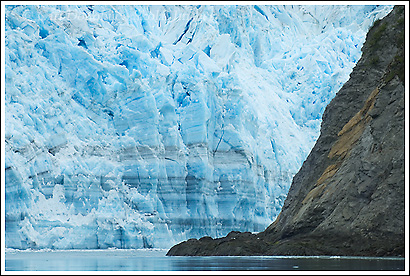
Gilbert Point, Hubbard Glacier and Disenchantment Bay, Wrangell St. Elias National Park, Alaska.

hey Folks,

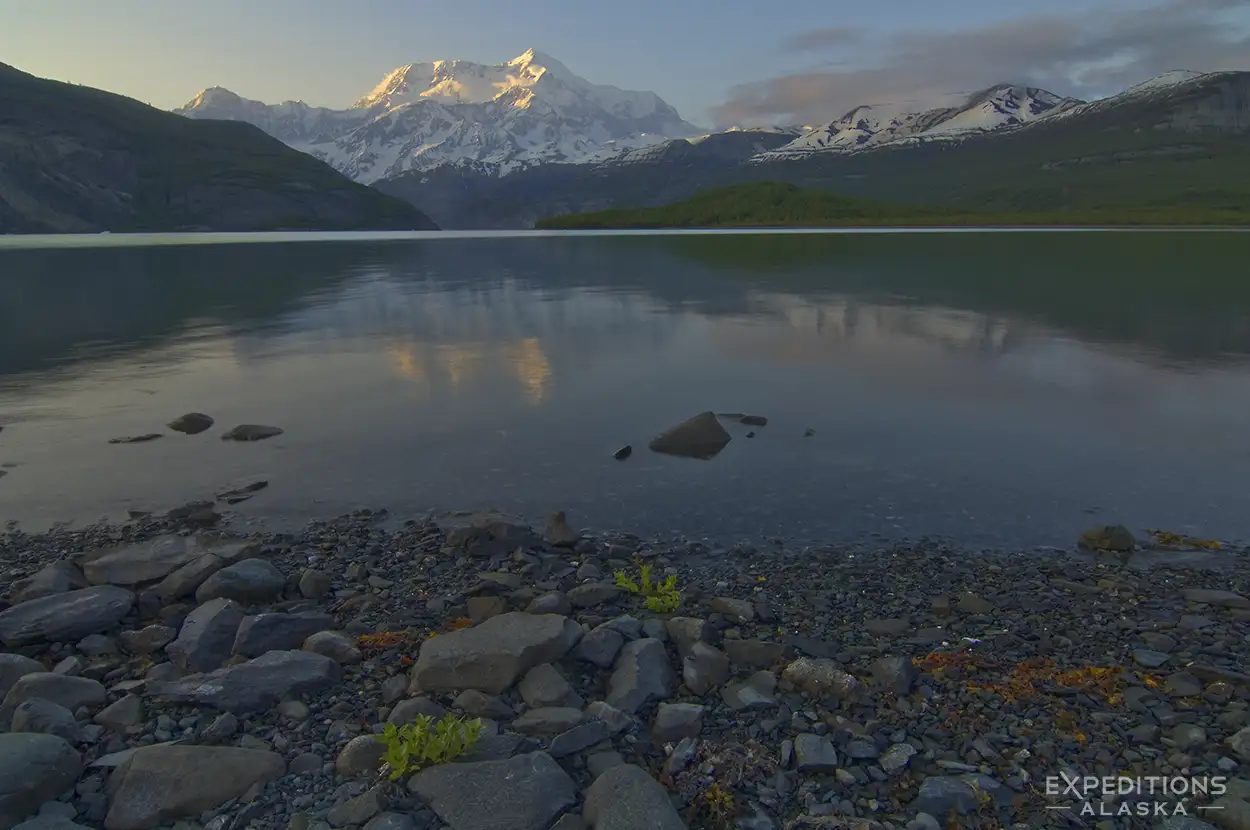
As I said, Mark got us closer. And Closer. This photo is of Gilbert Point, famous because the glacier has advanced enough at times past that it closed the gap, and dammed up Russell Fjord, which sits behind the gap – around to the right in this photo, behind the cliff face.

The Hubbard Glacier has been advancing pretty rapidly recently, and in 2002 it closed off Gilbert Point. This had occurred previously in 1986. It essentially turns Russell Fjord into a giant dam, stranding wildlife in the area, including whales, sea lions, fish, etc.

Eventually, the pressure builds up enough that the dam bursts, and water flows out of the strait at some insane volumes –

Continue reading

Hubbard Glacier photo and Disenchantment Bay, Alaska

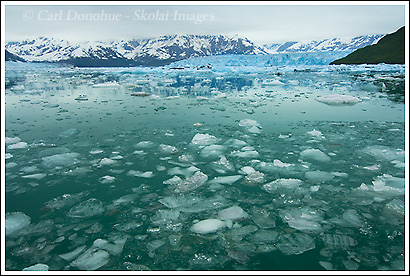
Disenchantment Bay and the Hubbard Glacier, near Yakutat, Alaska.

Hey Folks,

So ya can’t go to Yakutat without a trip up to get some Hubbard Glacier photos.

I wanted to do a flight-seeing trip to shoot this glacier, but the light wasn’t that great. And when the light was great, I was out at the beach. I need to get back down there and shoot some stuff of this glacier from the air to complement the images I got from lower down.

The Hubbard is one of the most visited glaciers in Wrangell-St. Elias – you can’t really do a book on Wrangell-St. Elias National Park without at least some photos from the Hubbard Glacier.

Continue reading

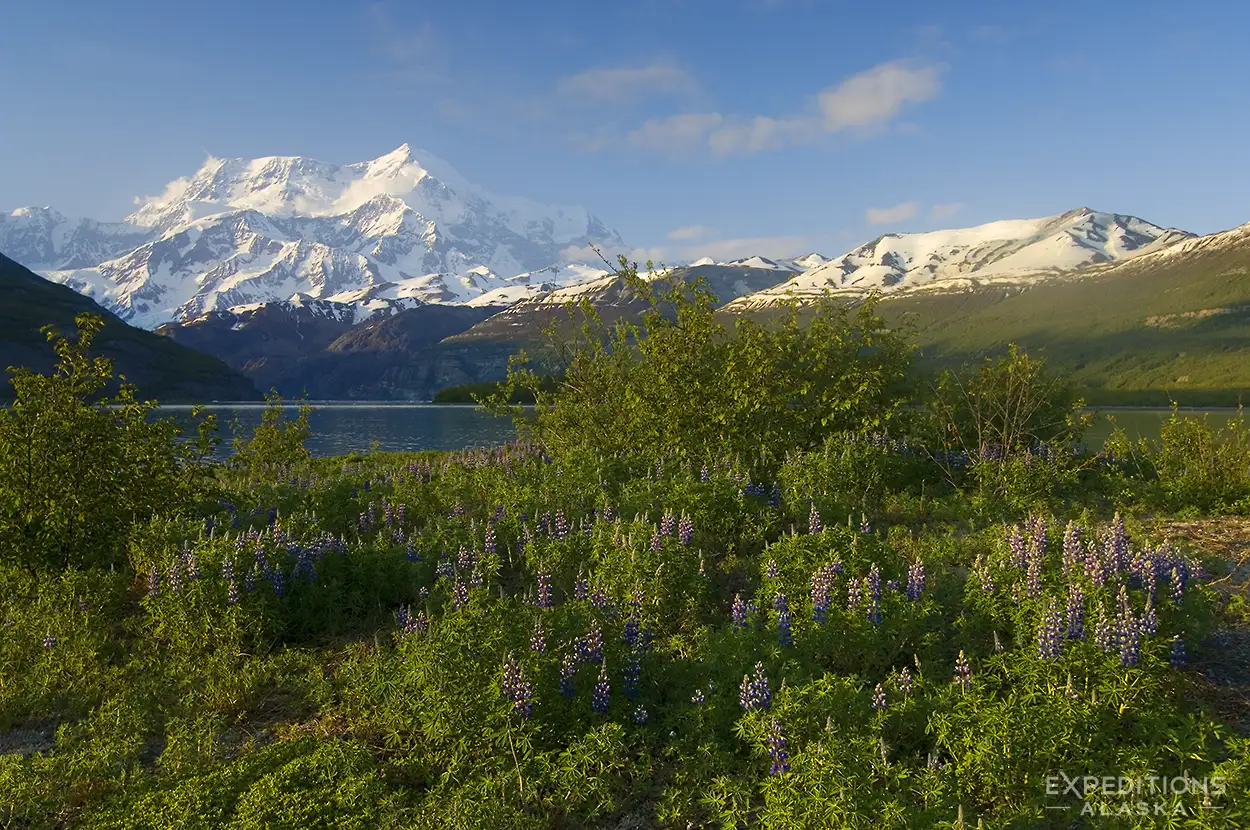
Mount Saint Elias from Icy Bay, Wrangell St. Elias National Park, Alaska

Mount Saint Elias from Icy Bay, Wrangell St. Elias National Park, Alaska.

Hey Folks,

After paddling back from the island I wrote about the other day, the light got warmer. The lupine weren’t as impressive back in this area, but still pretty cool. My tent wasn’t quite as close as this photo implies, but this was pretty much the view out my tent door for the night. Suh-weet!

Continue reading

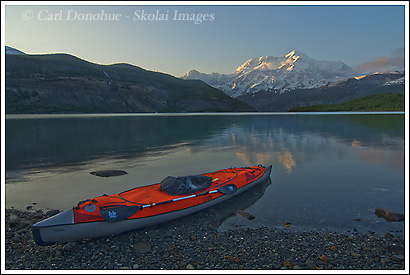
Sea kayak, Taan Fjord, Icy Bay, Wrangell St. Elias National Park, Alaska

Sea kayak on the shore of Taan Fjord, Icy Bay, at sunset, with Mt. St. Elias, Wrangell St. Elias National Park, Alaska.
Sea Kayaking trip to Icy Bay, Wrangell-St. Elias National Park, Alaska.

Hey Folks,

So here’s the beginning of where this trip gets fun.

This is one of the last photos I took this particular evening. The day had turned into a gorgeous afternoon, and I had a blast. A nice supper round the corner from this point, with this view of Mt. St. Elias over the Taan Fjord of Icy Bay is pretty hard to beat.

As the light got nicer and nicer, I was puttering around trying to make some photos. It makes for a long day here in the Alaska summer – this one here was close to midnight. My last 3 shots of the day were this one, a vertical composition of the same scene, and then a landscape image of this area without the boat.

Then I went to bed.

Continue reading

Mount Saint Elias photo, Icy Bay, Wrangell-St. Elias National Park, Alaska

Nootka lupine cover an island in the Taan Fjord, Icy Bay. Mt. St. Elias rises in the background. Icy Bay, Wrangell-St. Elias National Park, Alaska.

Hey Folks,

As impressive a mountain as there is, in my opinion, Mount Saint Elias, as seen from Icy Bay, Wrangell-St. Elias National Park.

The mountain is actually on the border of Alaska and the Yukon Territory, Canada, so it’s not only the 2nd highest mountain in the US, it’s also the 2nd highest mountain in Canada. Mt Logan, 25 miles to the north, is the highest mountain in Canada. The peak of Mount Saint Elias is a mere 10 miles from the shores of the Taan Fjord in Icy Bay, which means the vertical relief, which I spoke about yesterday, is huge.

Continue reading

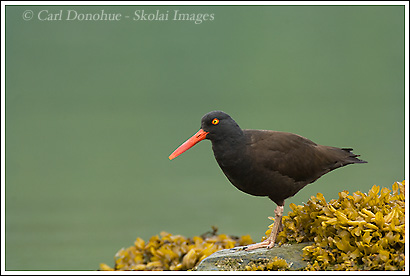
Oystercatcher, Icy bay, Wrangell-St. Elias National Park, Alaska

Oystercatcher, Icy bay, Wrangell-St. Elias National Park, Alaska.

Hey Folks,

So why go to Icy Bay?

Well, firstly because it’s such an amazing place. The scenery is superb – National Geographic list Icy Bay as one of the world’s top 10 treasures.

Secondly, I’m working on a book on Wrangell-St. Elias National Park and Icy Bay is in the park.

Thirdly, I hadn’t been there before. 4th, the natural history of the place is so unique. Icy Bay is a relatively new place, with the recent retreat of 3 glaciers, the Guyot, the Tindall and the Yahtse, there are now 4 fjords, filled with the cool waters of the northern Pacific Ocean.

When the area was first explored by European ships 150-200 years ago, Icy Bay didn’t even exist. John Muir, the great naturalist and founder of the Sierra Club, visited the area a little over 100 years ago, and Icy Bay didn’t exist.

Continue reading

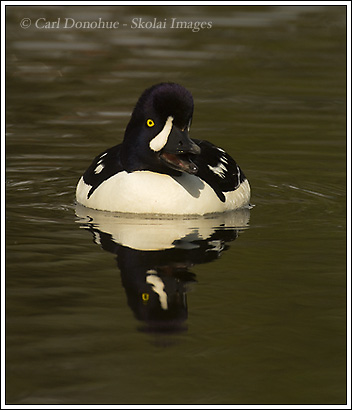
Male Barrow’s Goldeneye, Wrangell-St. Elias National Park, Alaska

Male Barrow’s Goldeneye, calling, Wrangell-St. Elias National Park, Alaska.

Hey Folks,

Guess who should be back tomorrow? Here’s a hint: you might get to see something besides birds on here real soon. Of course I’m writing this post 2 weeks in advance, so there’s a chance you might not, too. But by the time this goes online, I should be just about back from 2 weeks in ……?

I ain’t telling.

So here’s the male of the Barrow’s Goldeneye again. I liked this image because his bill is wide open and he’s looking at me. I had just moved slightly, where I was more visible to him, and it was as if the bird was saying ‘dude, I so TOTALLY see you’. This was one of the last images I made of this duck. What a cool bird.

Male Barrow’s Goldeneye, Wrangell-St. Elias National Park, Alaska.


Female Barrow’s Goldeneye, Wrangell-St. Elias National Park, Alaska

Female Barrows Goldeneye, Wrangell-St. Elias National Park, Alaska.

Here’s the female of the 2 Barrow’s Goldeneye ducks I photographed recently. I couldn’t have asked for a more co-operative pair. They were surprisingly tolerant. I didn’t have a blind setup or anything, just slowly and gingerly made my way around the pond, through the woods, hid behind a small bush, and waited for a few hours, and they gradually started coming over my way from time to time, where I could get some images.

It’s wild to see the different between the male and the female of the species. The male of the species, in breeding plumage, is way sharper looking than the drab female. This is pretty common in numerous species, but particularly birds.

Female Barrow’s Goldeneye, Wrangell-St. Elias National Park, Alaska.


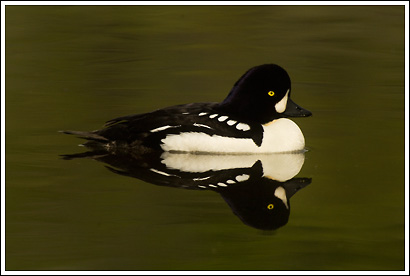
Male Barrow’s Goldeneye, Wrangell St. Elias National Park, Alaska

Male Barrow’s Goldeneye, Wrangell St. Elias National Park, Alaska.

Here’s the best of the duck opportunities I had. The Barrow’s goldeneye.

A male and a female were hanging out at this small pond, and I spent a number of hours there trying to get some images. ducks spend a lot of time floating around on ponds with their head tucked under the wings sleeping. ‘Dabbler’s” they’re called – well these ducks did more sleeping than dabbling.
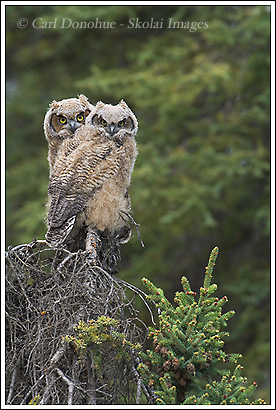
Great Horned Owlets, Wrangell-St. Elias National Park, Alaska

Great Horned Owl chicks, perched on a spruce tree, Wrangell-St. Elias National Park, Alaska.

Hey Folks,

Yep, birds again.

Here are 2 of the 3 Great Horned Owl chicks I got to photograph recently.

I could never manage to find all 3 perched together. I did a a few images of some of them individually. I also never managed to find them in any kind of decent light, so had to shoot at the higher end of the ISO range on my camera – which is a total disaster. The D2x is terrible at higher ISOs (anything over 250, IMO), which makes life miserable late in the day for shooting wildlife – the best time, of course, to find wildlife.

So, these little guys are probably flying around the park now, racing each other through the boreal forest as they swoop, silently, down on the snowshoe hares that are really abundant right now.

Great Horned Owl chicks, Wrangell-St. Elias National Park, Alaska.
Cheers

Carl

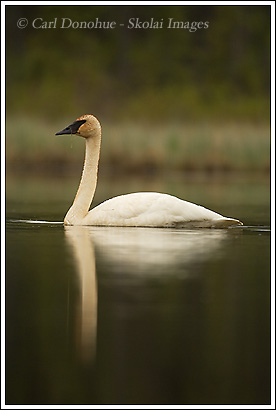
Trumpeter swan, Wrangell-St. Elias National Park, Alaska

Trumpeter swan on pond, and reflection, Wrangell-St. Elias National Park, Alaska.

Hey Folks,

Continuing with the bird theme again, here’s a trumpeter swan I found on my recent travels. The trumpeters were the first birds I saw back in the park as spring began, 2 of them actually swimming on the Kennecott River as it first opened up.

Once the river is ice free, it becomes a silty chocolate brown color, and quite a raging river, the last place a swan might frolic.

But early on, as the first ice melts back, the water is a deep aqua blue, clear and cold, and not as torrential as it becomes in the summertime, once the glacial melt increases. So I was kinda surprised to see trumpeter swans there early on. Then I saw them on the ice, from where I posted a photo or 2 a month back.

Now the ponds are all open and the swans grace their way along the surface (I know, ‘grace’ isn’t a verb, but it sounds nice). They’re definitely an awesome bird.

Trumpeter swan, Wrangell-St. Elias National Park, Alaska. You can see more bird photos from the park here.


Juvenile trumpeter, Wrangell-St. Elias National Park, Alaska

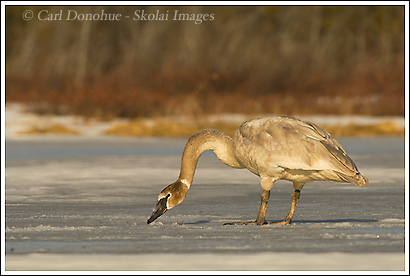
Juvenile trumpeter swan on ice, Wrangell St. Elias National Park, Alaska.

Here’s one of the young trumpeter swans I shot the other day on the ice in Wrangell-St. Elias National Park.

There were 2 adults and 2 youngsters in tow, last years young, I imagine. As the waters open up the adults will nest and hopefully raise some more cygnets this year.

This yearling was trying to get a drink of water from the meltwater of top of the ice.


Arctic Loon, Wrangell-St. Elias National Park, Alaska

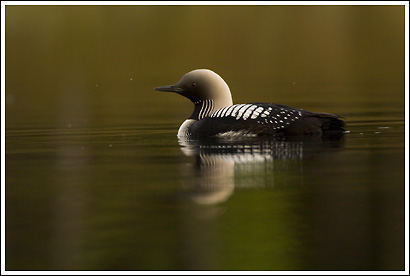
Arctic Loon, Wrangell St. Elias national Park, Alaska.

Hey Folks,

I think of all the birds in the world, the loon has to be the most beautiful. I think the saying should be ‘beautiful as a loon’, not ‘crazy as a loon’. I’ve spent a bit of time watching loons lately, and have yet to seen them do anything crazy. But oh my, their beauty is immeasurable.

Absolutely amazing.

This pair are, according to my bird guide, ‘Arctic loons’, or Gavia arctica, as the Latin name would have it. I thought they were Pacific loons, or Gavia pacifica, but some other photos clearly show the front of the neck to be green more than purple – so I’m gunna call them Arctic loons.

Of course, the same guidebook says the crown and nape are ‘pale gray’ – I saw a blend of creamy tones none of which could be described as ‘gray’, by even the most bland scientific measurement. So much for guidebooks and trying to be objective.

So here’s a ‘thank you’ to my new friends, the Arctic loons, the most beautiful birds in the world.

We have more birds from Wrangell-St. Elias National Park on this page.

Cheers

Carl