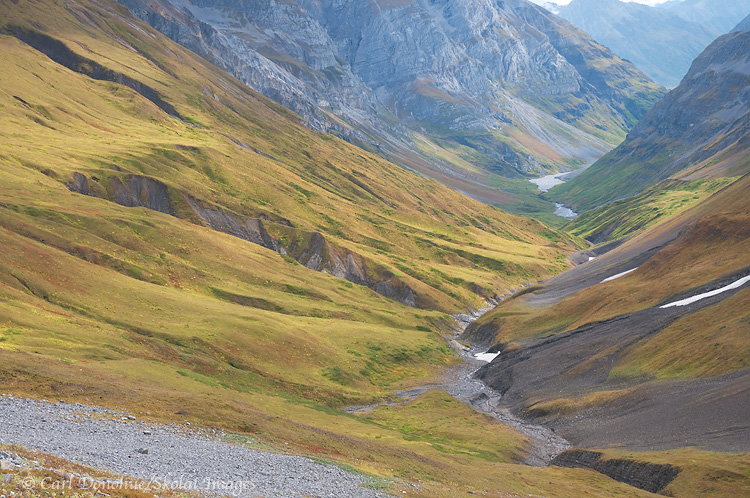
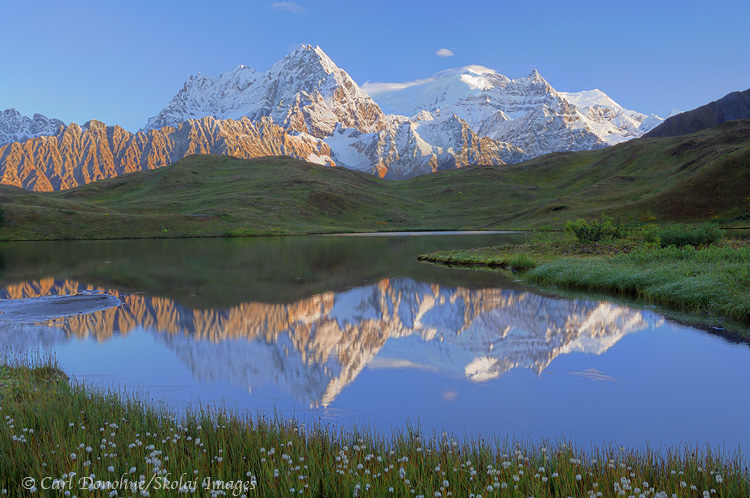
Hidden Creek valley, in the Wrangell mountains. A popular backpacking route, Hidden Creek in the Wrangell Mountains over to the Lakina River is a wonderful hike. Wrangell-St. Elias National Park and Preserve, Alaska.
Hey Folks,
I’ve headed out again for the next trip, but will schedule this post in advance. This is from close to the pass above Hidden Creek, looking back down the valley we’d just hiked. We walked up the south side of the valley (right side in the frame), then crossed and climbed up to a bench on the north side of the pass. Camping up there was simply awesome. 2 bands of Dall sheep were wandering the mountains above us, and we saw mountain goats higher still.
Hidden Creek is simply stunning. This particular afternoon, we crested the pass and camped on the other side of the saddle, which is where the previous post’s photo (“Reflections”) was taken. Suffice it to say that the back half of the trek is just as rocking as the front half.
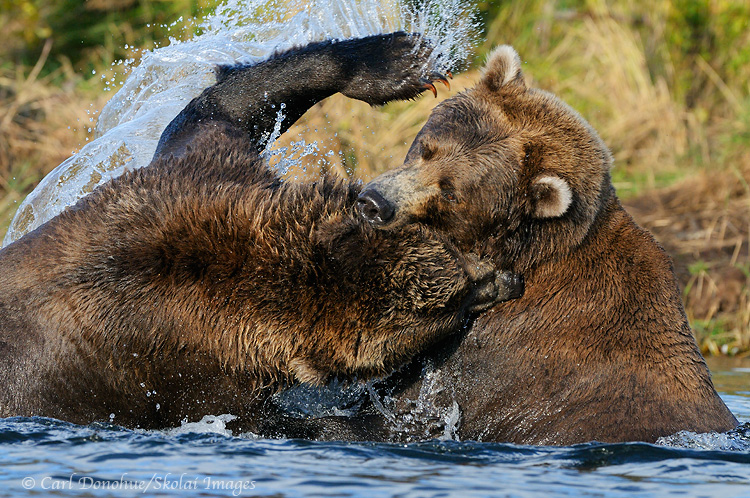
How ’bout that for a left hook! 2 young grizzly bears fighting in a salmon stream. Rarely do real vicious fights break out, but when they, these well-armed opponents can do some serious damage to one another. Grizzy bears, or coastal brown bears (Ursus arctos), playfight in Katmai National Park and Preserve, Alaska.
Hey Folks,
I’ve finally added some new grizzly bear images to my website – after way too much time. I’ve just added nearly 250 new grizzly bear images from my trips to Katmai in 2009 and 2010. Check them out; some of the images have appeared on the blog in the past, but many of them have not; those photos are from this most recent trip.
So, how about this particular photo?
We were shooting 2 other bears when I saw this scuffle start to erupt behind us. Time to move and move fast, these little eruptions (usually) don’t last too long. So we shouldered the tripods and heavy gear, and moved quickly through the long marshy grass to be in position to shoot this ‘fight’.
Knowing what might happen is a big help when you’re photographing wild animals. It can make all the difference between being ready for something awesome, and completely missing it. (See my recent blog post on Expeditions Alaska about how often we miss).
We saw these 2 young bears playfight several times during the 2 weeks I was down there.
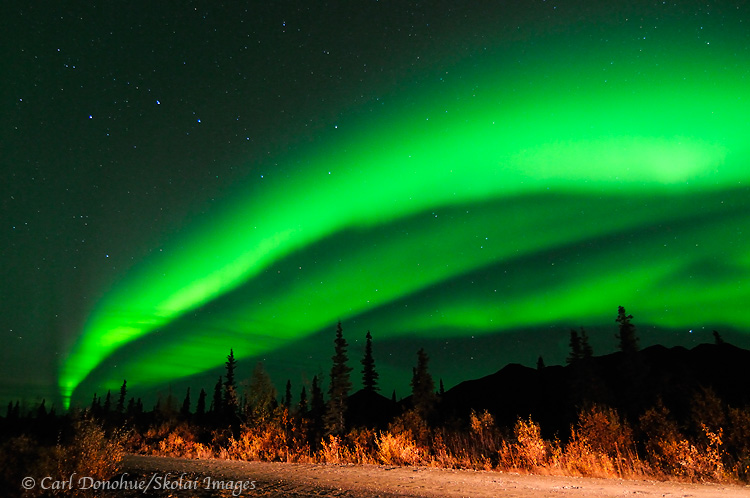
Aurora borealis photo. Using my vehicle headlights to light up the foreground a little bit. Northern lights, Wrangell-St. Elias National Park and Preserve, Alaska.
Hey Folks,
An aurora borealis photo taken a few weeks ago.
I’ve never had the good fortune to shoot the aurora borealis on a well lit night; a clear night when the moon is full, or close to it, would be ideal. My luck always seem to run into a dark night, which makes for a great, great experience, but the photographs could benefit from some ambient light on the foreground.
So, in this particular instance, I turned on the lights of my van for a split second during the exposure. It took me a couple of tries to get the balance right, and it’s far from ideal, but I kind of like this shot; taken along the Nabesna Road in mid-September.
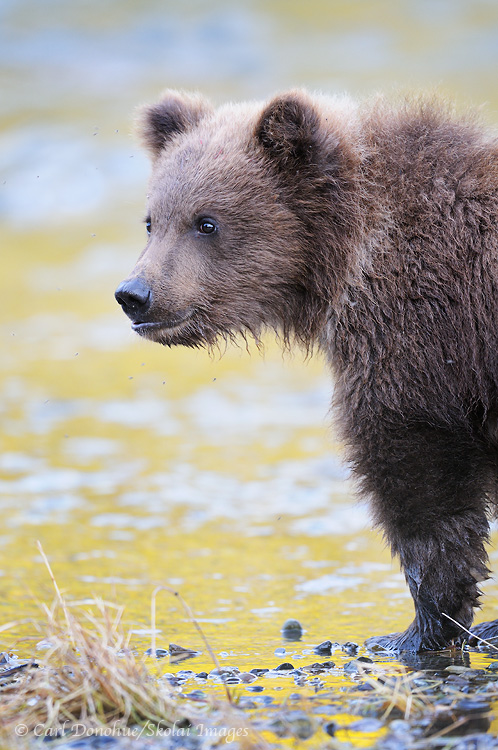
Brown bear cub photo. A young brown bear (Grizzly bear, Ursus arctos) cub. Brown bear cubs will stay with their mother for 2-3 years before venturing out alone. Brown bear cub, Katmai National Park and Preserve, Alaska.
Hey Folks,
Here’s a young spring bear cub photo from the recent photo trip I led to Katmai National Park and Preserve. This youngster had 3 siblings, and it was a real treat to get to see them play and tumble together.
Catching a photo of one by himself, without the others in the frame, was more difficult than one might guess it would be. There were almost always other bears in the frame.
Last year, for some reason, there were not too many spring cubs in the area at all, but this year the area was home to quite a few. They’re such a blast to photograph, and oh-so charismatic. Each has his/her own character, and some of them are unbelievably plucky little critters. We watched one take quite a dunking from his mother, after he tried to steal a salmon from her. She grabbed him in her mouth, shook him back and forth like a rag doll, and literally buried him in the river. I thought ‘well, that’ll teach the little guy a lesson’ – Hardly! He came up growling louder than before, grabbed the fish in his mouth, and took off with it before his mother could even snap at him. They’re just way too cute!
These little baby bears are born in the dark of winter, tiny and defenseless. Their mothers-to-be enter a den in late fall, usually anywhere from late October through November. Brown bears almost always enter their den during a snow storm, or immediately before a snow storm. The theory most folks ascribe to is the snow storm will cover both the entrance and the tracks leading to the den, hiding both the bear and the den’s location.
Late January or early February, though sometimes as late as March, the cubs are born, blind and virtually helpless.
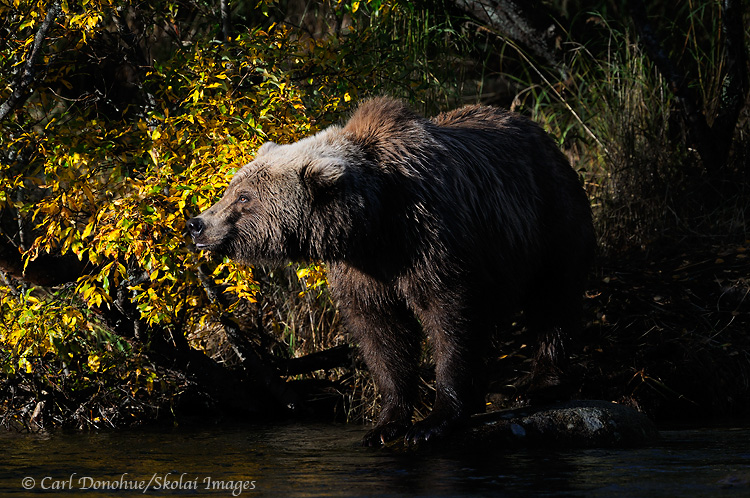
Grizzly bear and fall color, standing in warm afternoon light on the edge of a salmon stream. Ursus arctos, brown bear, Katmai National Park and Preserve, Alaska.
Hey Folks,
As I mentioned in a post a few days back, I am pretty excited about some of the grizzly bear photos I took on this most recent trip to Katmai National Park. Over the years I’ve spent so many weeks there, shooting and re-shooting photos of grizzly bears, that it can be difficult to really bring home some new images. This photo is one I was super happy with.
I took, of course, countless images of bears eating salmon, chasing salmon, catching salmon, standing around, sitting down, sleeping, fighting, playing, etc. But what I really wanted to capture was some dramatic images in dynamic weather or dynamic lighting situations.
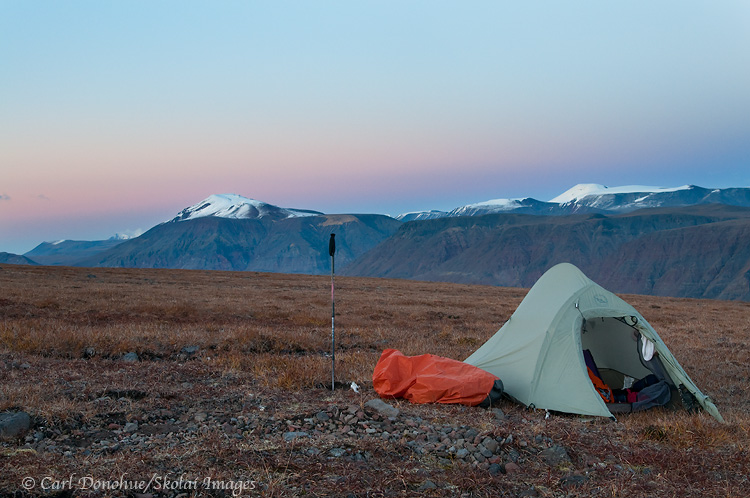
A backcountry campsite (Big Agnes Seedhouse SL1) high on the tundra in the Wrangell Mountains. The high alpine ridges near Mt Jarvis, Wrangell-St. Elias National Park and Preserve provide a great place for hiking and backpacking.
The Trip: Backpacking Near Mt Jarvis in Wrangell-St. Elias National Park
Just to stave off the impending deluge of grizzly bear photos, I thought I’d drop this one in here. This is from the last backpacking trip of the season for me, the recent Mt Jarvis excursion. Here’s a campsite I picked out all by myself, high on the tundra.
With a night so wonderfully clear, the temperatures dropped down a bit during the evening, and it was plenty cold in the am when I awoke before dawn, and sauntered across the tundra to ‘reflection pond’, where I shot some of the recent images posted of Mt. Jarvis.
Weight and Packability
For this trip, I carried the Big Agnes Seedhouse SL1 tent that you see here. It’s a nice little 1 person tent, pretty roomy actually, and relatively light. Weighing under 3lbs,
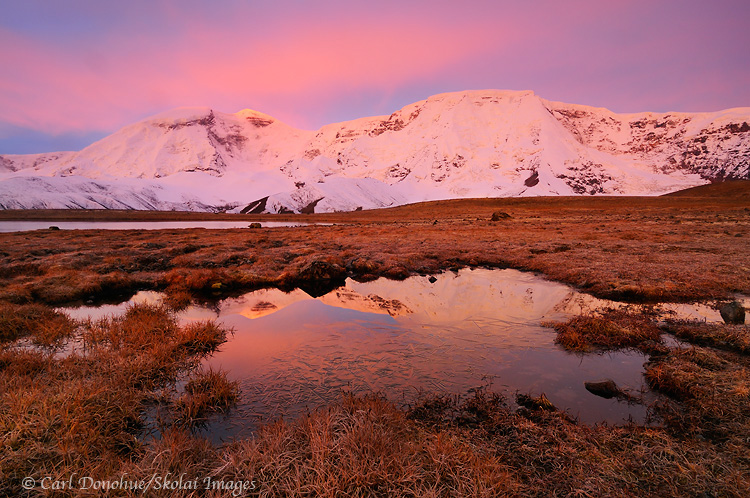
Dawn rises over Mount Jarvis, alpenglow lighting the mountain and it’s reflection. Fall, Mt. Jarvis, Wrangell-St. Elias National Park and Preserve, Alaska.
Mt Jarvis, in all it’s 13 421′ glory.
A recent trek up around the Mt Jarvis area yielded some amazing scenery and fantastic views. I hadn’t been to the area before, and will definitely be heading back next year. To camp within a few hundred yards of this mountain face is a treat indeed. We were pretty lucky, for sure, considering we were camped at about 7200′ in the Wrangell Mountains in September!
We had a real mix of weather, from snow storms and rain to gorgeous sunny days; which I’ll take gladly. The trek was a lot of fun, with a great couple from Chicago, Brad and Tracey. I appreciated their flexibility and easy going nature, which allowed me to sneak out a morning or 2 and grab some photos. Tracey joined me once or twice, and both Brad and Tracey got up early on our final morning to make a a mad dash out the Nabesna Rd in the hopes of snaring some nice alpenglow on Mt Sanford. Much appreciated, Tracey and Brad. What a gorgeous morning that turned out to be.
Reflections in the morning, of fresh snow or termination dust on the Wrangell Mountains, near Mount Blackburn, Wrangell-St. Elias National Park and Preserve, Alaska. Please click on the image to view a larger version of the photo.
Hey Folks
Here’s another image, taken earlier, of the scene outside my tent door a few mornings ago. After spending the previous day in the rain, cold, sleet and snow, I went to bed hoping for an improvement in the weather.
All during dinner, I had watched the snowline on the peaks above camp come ever slowly down the mountains – lower and lower. Now, listening to the rain fall on my tent, I didn’t imagine much change happening.
Turning off my headlamp, it was lights out, and I had barely a flicker of hope for the rest of the hike – the continuing patter of rain falling on my tent a sound I was about done with. Eventually that sound faded and then ceased altogether – at first I thought it had simply turned to snow, but a glance outside confirmed that nope, the rain had actually stopped. Woo hoo!
The Copper river and Mt Drum, from Simpson Hill Overlook. View of the Copper River basin and Wrangell Mountains, Wrangell-St. Elias National Park and Preserve, Alaska. Please click on the image thumbnail to view a larger version of this photo.
Hey Folks,
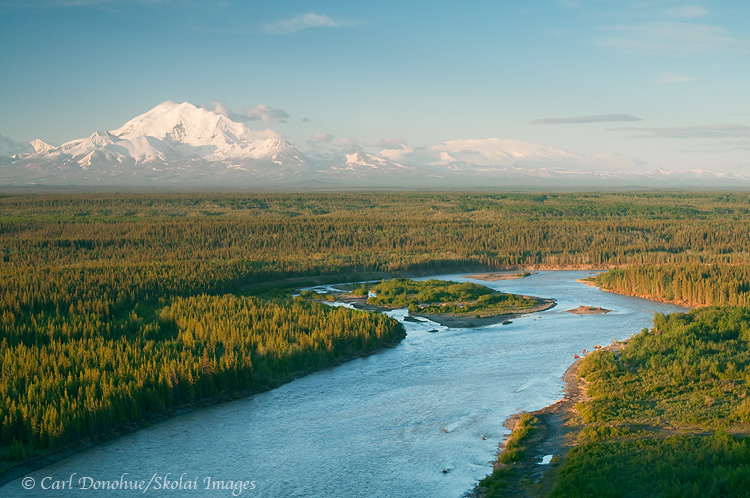
OK, enough with the waterfalls already! Here’s another image from my spring trip earlier this year, from Simpson Hill Overlook, off the Richardson Highway, near Glennallen, Alaska. This is a scene I’ll never tire of; looking down the Copper River, with the Wrangell Mountains in glorious sunshine. The mountains you can see in this image are Mt. Drum on the left and Mt. Wrangell the broader, dome-shaped mountain on the right in the background.
Just out of sight to the left of the frame is Mt. Sanford, and Mt. Blackburn to the right. How many vantage points do you know of in North America where you might choose to exclude from your photo two mountains both of which stand over 16 000′ high? That speaks volumes, in my opinion, about how amazing this viewpoint is. The 5th (Blackburn) and 6th tallest peaks (Sanford) in the US and they don’t make the photo? Craziness!
The Copper River is pretty grand too. Not to get bogged down by meaningless numbers and superlatives, but the Copper River is 300 miles long, and the 10th largest river, by volume, in the US. The Copper River is also the north and western boundaries of Wrangell-St. Elias National Park and Preserve, coolest park in all the world! It’s perhaps best known, however, for its nearly infamous Red Salmon run, usually over 2 million spawning salmon, loaded with fatty Omega-3 oils that make for some delicious supper.
I was really hoping for some sweet delicious alpenglow on this particular evening …. but ….. alas, such wasn’t to be my fortune. The light faded soon after I shot this – the boreal forest in the foreground grew dark, and the mountain light ebbed and dwindled; distant dim clouds low on the northwestern horizon thwarted my efforts at capturing some rich color on the snow-capped peaks, as seems to be the case all too often.
This scene is one of the very few ‘roadside‘ vantage points from which to photograph some of the big mountains in Wrangell-St. Elias National Park and Preserve. Willow Lake is another. The views on a clear day from these places rival anything I’ve seen anywhere else. The problem, I guess, for photographers is that the clear days are few and far between. Enjoy ’em when ya can! 🙂
Copper River and Mt. Drum, Wrangell St. Elias National Park, Alaska
Copper River and Mt. Drum, Wrangell St. Elias National Park, Alaska.
Hey Folks,
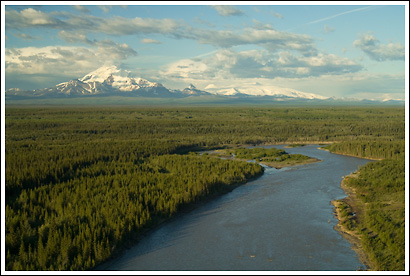
Here’s another image taken from Wrangell St. Elias National Park. This scene looks towards the park from the national Park boundary, the Copper River. Mt Drum and the Wrangell mountains oversee the immense Copper River Basin providing an incredible backdrop to this vastness. The Copper River is one of the largest rivers in Alaska, and also, like all large rivers, critical to the life and cultures of the ecosystems existing around it. The Copper River actually starts out on the east side of these mountains, on the Copper Glacier, which runs off Mt Wrangell.
Mt Wrangell is visible in this photo as the broad almost flat snow-covered peak rising directly above the island in the river. As this scene is taken from the north west corner of the park, it’s clear the river wraps around the mountain, starting on the east side, running north then west, then eventually running south, forming the western border of Wrangell-St. Elias National Park, all the way down through the Chugach Mountains, the Chugach National forest, forming the huge Copper River delta, and emptying into the Gulf of Alaska. The Copper River runs about 300 miles, or nearly 500 kilometers, from its beginnings in the Wrangell Mountains until it reaches the coast.
The Copper River has been important to people in the area for many years, for many reasons, but is primarily known today for the red salmon that run up it every summer to spawn. Copper River Reds, as they’re known, are widely regarded as some of the tastiest salmon in the world. They’re also known as Sockeye Salmon.And they sure are tasty!
The views towards the park from the Richardson Highway are as fine as they salmon that swim up the river are tasty. From various overlooks, it’s possible to see 4 mountains all standing over 12 000′ high, including 2 peaks over 16 000′ (Mt Sanford and Mt Wrangell). The Wrangell mountains are as impressive as any I’ve seen. Great photo opportunities can be found right off the highways (Richardson and also the Glen Highway), weather permitting, of course. These are all volcanic mountains, and have some dramatic features, Mt Drum, from the south side, is simply stunning.
Copper River in Winter
Simpson Hill Overlook
View of Wrangell-St. Elias National Park and the Copper River.
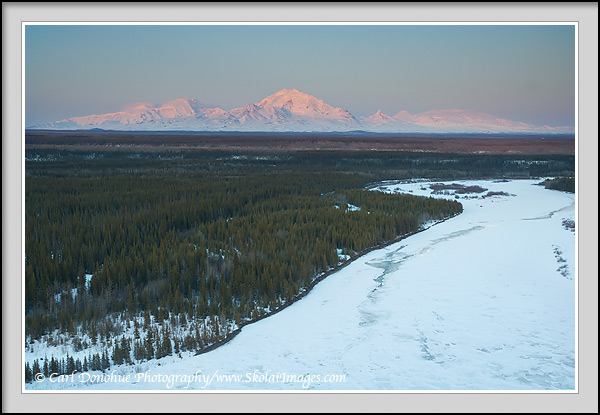
Here’s a photo I took last spring, just at start of the season Alaskans call “breakup”. This photo is taken from the roadside overlook just south of Glennallen, at Simpson Hill. Simpson Hill is rapidly disappearing, as the Copper River (in the foreground) erodes and cuts away at its base. Soon enough the spot may be known as “Simpson Mound”.
This is probably one of the very few (maybe 2) iconic view spots for the Wrangell Mountains and Wrangell-St. Elias National Park, the largest (and way coolest) National Park in the US. There are certainly many other grand views to be had, and amazing sites, but few that are so frequently photographed from.
The mountains, viewed from this spot, are simply awesome. From left to right, the mountains are Mt. Sanford, Mt. Drum, Mt Zanetti and Mt. Wrangell. Mt. Sanford is the highest of the 4, at 16 237′ tall. Next up is Mt. Wrangell, the broad round massif on the far right, at 14 136. Mt. Zanetti, the little “ski jump” looking cone that springs off Mt Wrangell, is 13 009′ tall, and Mt. Drum, front and center, is just over 12 thousand feet, at 12 010′ high. Those are some grand mountains. Most of the boreal forest in the foreground is white spruce, though there’s a cool band of aspen or poplar in the middle of the frame that can add a vibrant yellow to this scene in the fall. The mighty Copper River, defines the border of the National Park, running south to delta where it runs into Prince William Sound near Cordova. It’s fascinating to see how the river changes throughout the year, raging a turbulent, roaring silt-laden brown in early and mid-summer, clearing up through late fall as it’s volume decreases to a crystalline turquoise, to a frozen, ice-covered mystery in the winter.
It’s a magnificent viewpoint, and it’ll be interesting to see how it changes in the coming years, with the Copper River eating away so readily every summer. I was there last weekend, again, and noticed it’s even eroded further back than it was in the spring.
Note to visitors: If you DO perchance go to Simpson Hill to get this perspective on Wrangell St. Elias National Park and the Wrangell Mountains, I’d recommend parking in the paved parking lot, and walking the 100 yards or so back over to the edge .. driving over the little gravel road/trail to the edge can easily get you bogged and stuck, as the soil there is way muddy, and your tires can readily sink into it’s greasy depths. Not that this ever happened to me, of course .. 🙂 … but it can happen . so be careful up there. And hope you get some nice light. It’s a great vantage point in the evening.
Exploring Keystone Canyon: Bridal Veil Falls and Horsetail Falls
If you are visiting Alaska and looking for a great drive, the trip south from Glennallen to Valdez is tough to beat. The route climbs south parallel to Copper River. Eventually it ascends up and over Thompson Pass in the Chugach Mountains and passes the Worthington Glacier before descending into the spectacular Keystone Canyon. This canyon was first used as a route for a train line to the interior gold mines, and you can still see the old tunnel built nearly a century ago.
The Lowe River runs through the bottom of the canyon, creating a dramatic backdrop for two of the most famous waterfalls in the region. While many people search for these names in California, the Alaskan versions in Keystone Canyon offer a much more rugged experience.
This route parallels the nearby Copper River.
Finding Stillness, Horsetail Falls
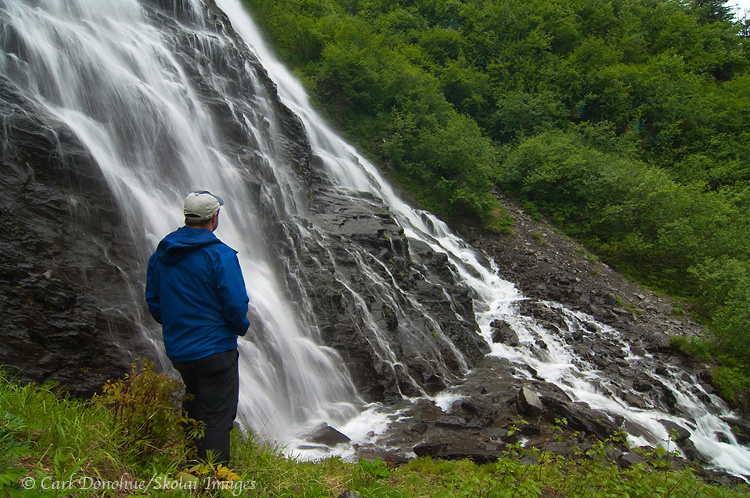
Standing alongside Horsetail Falls, near Valdez, on the Richardson Highway, Alaska.
Here’s a photo from my trip down the Richardson Highway – Memory Lane.
This one is Horsetail Falls, another waterfall in Keystone Canyon and the Lowe River, just south of Bridal Veil Falls, (that image is posted below).
Waterfalls are so cool; I can sit and stare at a waterfall for hours, it seems, never tiring of the flow. The energy of the falls is often spellbinding.
I first visited this particular area, along the Lowe River in Keystone Canyon, on a trip to Valdez in 2000. That trip seems like several lifetimes ago now. It rained most of the time, and I left soon after, heading north to Wrangell-St. Elias National Park for a backpacking trip. I wish I hadn’t taken so long to return.