Hey Folks,
Here’s the last of my series on the Arctic National Wildlife Refuge, for now.
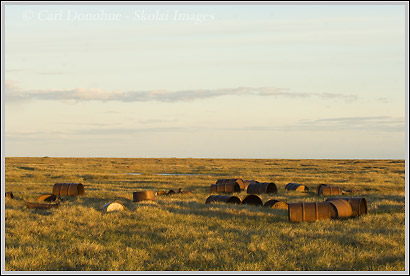
I’d like to write some more about the place, but will do that later. I wanted to post this because I read somewhere the other day that because the Arctic National Wildlife Refuge is not a pristine wilderness, we may as well go ahead and drill there. What so often is forgotten or neglected is that much of the disturbances to the pristine nature of the land here are a function os previous oil exploration. Out on the coastline, the tundra is littered with signs and debris of oil exploration. Whilst I was hiking one afternoon, I counted over 300 empty oil barrels lying on the tundra in one very small section of coastal plain.
That didn’t include the bits and pieces of machinery and buildings and whatnot I found as well. It is amazing that anyone could leave behind such trash and debris here. It’s even more amazing that people who want to open the Refuge to drilling then make the argument that (a) they’ll do so with environmental sensitivity, and (b) the Refuge isn’t a pristine wilderness so they ought be allowed to drill there. Essentially, they’re arguing that because they’ve already disturbed the area, they may as well go full speed ahead and finish the job.
I guess to some people nothing matters beyond financial concerns. I do appreciate the import of money in our culture, and I do respect those who work hard to create it. But I find it hard to respect those who place its value above all else. To do so is, quite simply foolish.
“Only when the last tree has died and the last river has been poisoned and the last fish been caught will we realize we cannot eat money.” — Cree proverb.
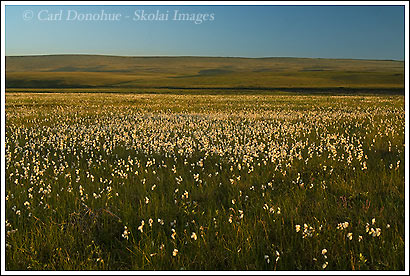
We all hear about how barren and ugly the coastal plain of the Arctic National Wildlife Refuge is. The coastal plain is a desolate wasteland, we’re told. Well, I don’t agree with that. I think it’s a beautiful place, and well worth our respect. Here is a field of Alaska Cotton Grass in full bloom along the coastal plain, east of the Canning River, in Section 1002, the section proposed to be opened for oil drilling. Trust me – the photos you see posted across websites and emails doing the rounds that suggest the place is ‘ugly’ are simply bad photos.
But the issue shouldn’t simply come down to aesthetic beauty – that’s in the eye of the beholder, as we all know, and also somewhat irrelevant. What is relevant is learning to once again respect the earth we live upon – and setting aside areas like the Refuge, protected from the ravages of oil and gas development and other extractive processes is, IMO, a good idea. In fact, I’d say it’s a critical one.
I’m heading out for a trip to Wrangell-St. Elias National Park, and won’t be back for a week, but will pre-post a few entries scheduled to appear over the coming week.
So we may as well go ahead & trash it , huh?? How far from th coastline was this? Just curious.