Hey Folks,
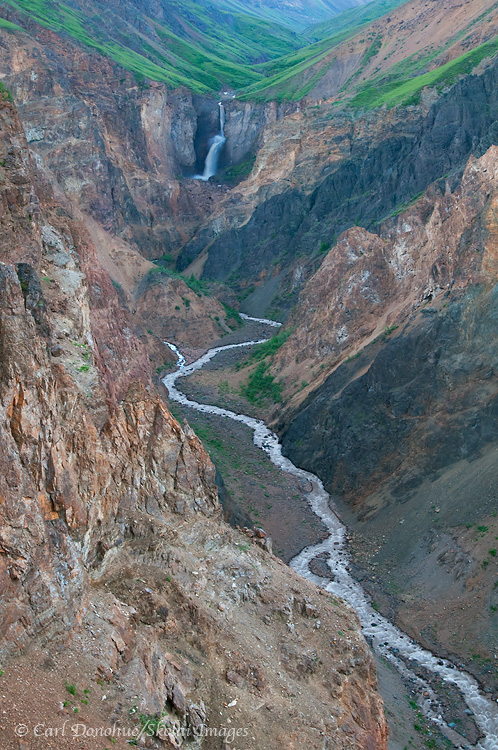
Chitistone falls are one of my favorite waterfalls in the entire park yet I rarely get to see them.
How do you get to Chitistone Falls?
I usually backpack down the Goat Trail from Skolai Pass. It’s possible to approach from the west if you’re coming up Chitistone River, or even from the north if you can up Doubtful Creek from Nizina Lake.
When I do the Goat Trail now, I head north after crossing the scree slopes, and go away from the Chitistone river, rather than down lower toward the river, which is the only way to view the falls.
However, this particular evening was so nice that after dinner I headed out for some photos, and knew right away I’d be spending some time watching and photographing the falls. It’s a tough slog to walk another 4 miles after backpacking all day, but can be SOOOOO worth it.
The trek down from where we’d camped was nice; it’s great to walk unencumbered after carrying a heavy backpack all day. I set out with my camera bag over my shoulder and my small backpacking tripod in one hand. For trekking I carry the carbon fiber Gitzo G1058 tripod and the ultra light Really Right Stuff BH-25 ballhead. It’s a great little combo for backpacking and hiking, weighing under 2lbs. Gitzo have since replaced this model with a newer version, the GT-0540 and GT-0530. I’m not sure how they’re different to my older one, but if you’re looking for a really great little hiking rig, this setup works well for me.
So I moseyed my way down from the high shoulder we were camped on, watching the light get sweeter and sweeter on the nearby high peaks of the University Range. When the weather is nice, few things are quite like walking alone in the Alaska mountains late in the evening. What a beautiful hike this is!
I got down to the plateau I was aiming for, and, before even pulling out my camera, simply soaked up the atmosphere. The American Tree Sparrows were still singing their summer call, those 3 vibrato-laden little notes that proclaim the alpine summer. Hardly a breath of air moved and yet the sounds of the mountains carried down the valley; a moving experience in the Chitistone Canyon.
The word ‘Chitistone‘ is derived from a native Ahtna (Athapaskan) word, ‘chiti‘, that translates as ‘copper‘ in English; so ‘chitistone‘ is ‘copper stone‘. The bulk of the rock around the Chitistone canyon is Nikolai greenstone and limestone. The entire region is famous for copper production, with Kennicott Copper Mine being perhaps the most famous of all. Fortunately, the mining has largely ended in the region now, and the canyons and mountains are left alone for the bears and Dall sheep and hikers, and the mountains themselves. It’s a grand landscape.
On a warm summer day, when the glacial melt is high, the river is fairly broiling, and the falls can be thunderous. Quite a spectacle.
This particular viewpoint has always reminded me of Artist Point, in the more famous Yellowstone National Park. This one receives far fewer visitors.
Chitistone Canyon rocks.
More from Chitistone River
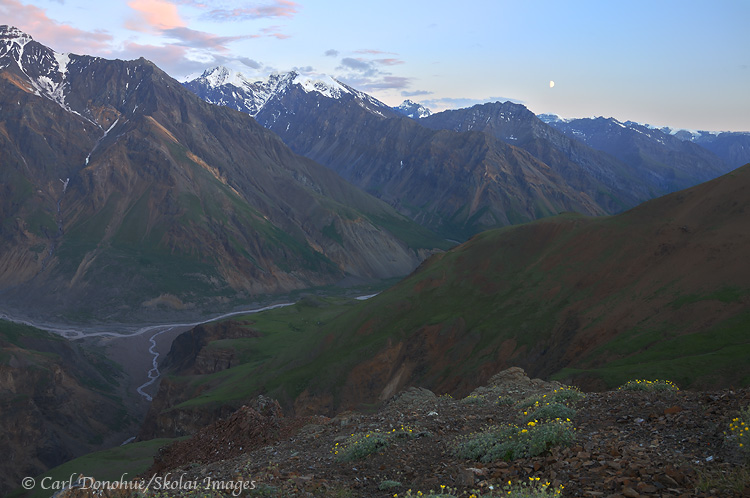
Another frame from the evening after crossing the Goat Trail, this one looking west down the Chitistone River, as it pours toward the Nizina River a few miles down from here.
This hike is the first trip I ever made in Wrangell-St. Elias National Park, and one of the first I ever did in Alaska. It’s always a real treat to return to the area and walk this valley again. The Chitistone Canyon is absolutely spectacular, and a fantastic backpacking trip.
Views like this don’t happen everyday, which made this particular trip even more fun. We had pretty good weather most of the trip, no bugs, and lots of laughs. Just what a trip to the mountains should be.
Sunset over the University Range
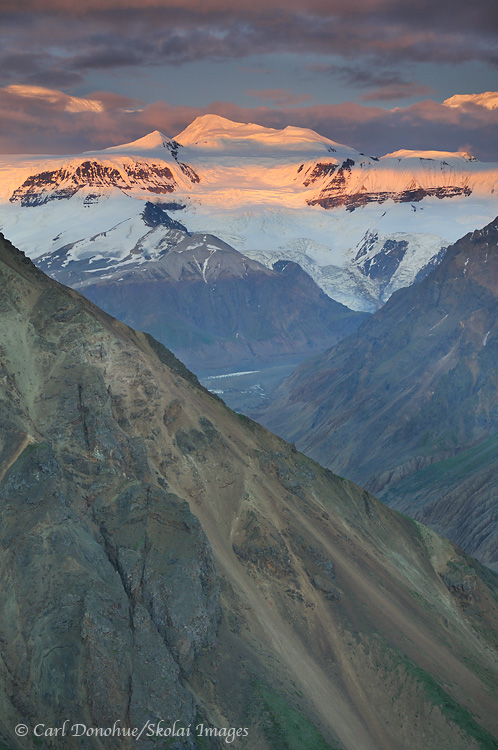
This shot looks across the Chitistone Canyon, south toward the University Mountain Range and the Chitistone Glacier. We’d hiked across the Goat Trail, a series of steep scree slopes that require a little attention, and made camp on a nice little plateau high above the Chitistone River. Dinner on the hillside and an evening with a spectacular view made a great end to a great day’s hiking.
The trip was a blast. We had good weather for the bulk of it, which cleared the way for great big views. We saw all the major mountains in the area, including the massive Mt. Bona and Mt Churchill, the Grand Parapet and the Twaharpies. We also saw a gaggle of grizzly bears (7 total, including a sow with 3 spring cubs), a fox, ground squirrels, golden eagles, ravens, ptarmigans, Dall sheep, mountain goats, and myriad ground nesting migratory birds.
Flowers were in full bloom and we had a good time with the guide book reviewing images and identifying as many as we could. Verna Pratts’s great guidebook on Alaska wildflowers is a great reference. For the most part we figured all of them, but a couple of mystery flowers had us all scratching our heads.
Mostly though, we hiked, napped, looked around, joked and chattered our way through a truly wonderful landscape; mountains and glaciers piled on top of mountains and glaciers. Good times indeed. And I’m heading back to the area this week for more of the same.
That is great Carl – enjoy your next trip!
Pingback: Tweets that mention Chitistone Falls, Chitistone Canyon, the Goat Trail, Wrangell-St. Elias National Park, Alaska. | Skolai Images Stock Photo Blog -- Topsy.com
Hey Ron,
Thanks. The ‘next trip’ was a blast too. More about that one in upcoming posts.
Cheers
Carl