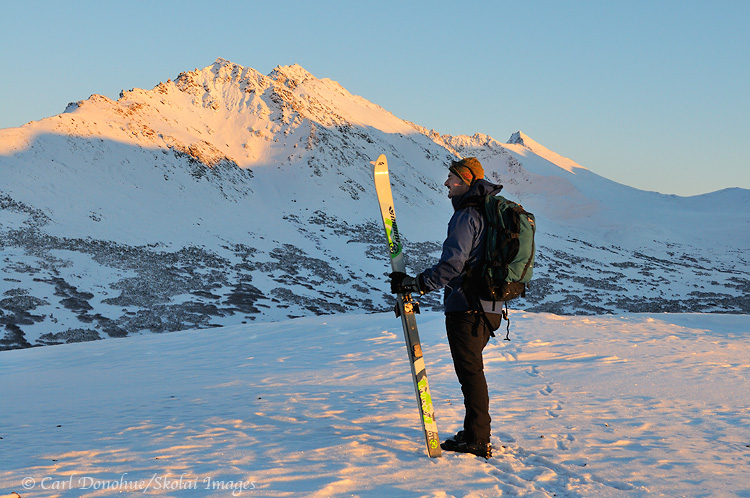
Backcountry skiing on a ridge on Flat Top Mountain, Glen Alps, near Anchorage. Chugach State Park, winter, Alaska. Please click on the image above to view a larger version of the photo.
Hey Folks,
I recall a conversation or 2 on the subject of art and science; essentially, what differentiates and what connects the science and art. Art is exploration. Science is similar process with maybe more strictly defined boundaries. Certainly they’re both forms of creative expression.
I think the critical illustration of their differences is very simple; artists are so often WAY cool, and scientists way nerdy. 🙂
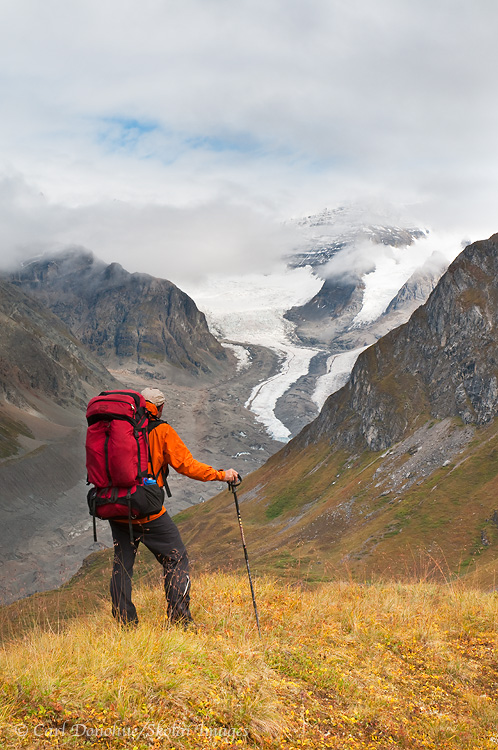
A backpacker/hiker stands and looks up the Lakina River drainage to the Lakina Glacier, on the side of Mount Blackburn. Wrangell mountains, Wrangell-St. Elias National Park and Preserve, Alaska. Please click on the image above to view a larger version of this photo.
Hey Folks,
If art is exploration, then perhaps one of the best modes of “practice” we might undertake is the challenge of the new; stepping outside our comfort realms and engaging something new. Stepping toward the unknown.
The process of learning is stimulating in itself, but I think it’s more than that, too. It’s stepping back and revisiting how to learn. Going through the process of picking up at the beginning, and working toward building a comfort level with some kind of form.
Art involves, essentially, that process. With that in mind, I find it great practice to pick up something I’ve not done before, something I know nothing about, and step into it. This winter, for example, my goal is to learn to telemark ski. I’d fooled with it briefly last year, but didn’t really understand or know the process. Also, as I found out this fall, had all the wrong gear for learning on. So, I’ve set myself up this winter with a nice rig, and taken some lessons.
The good news; what started out as essentially a “Special Ed” class is gradually molding into something resembling telemark skiing. It’s great fun, and quite a workout. On top of that, it’s stimulating! Continue reading →
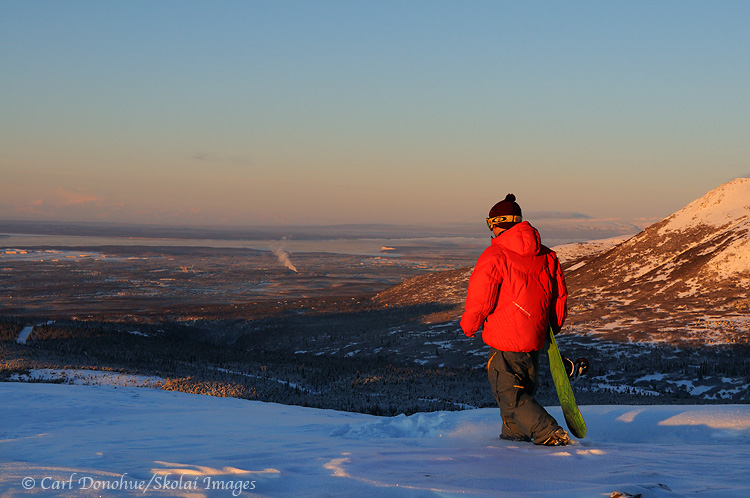
I was photographing toward the mountains when 2 snowboarders came on by. I snapped this photo of one of them before he took off down the mountain. A snowboarder walks across the ridge near Flatop Mountain, Glen Alps, near Anchorage, in winter, Alaska. Mt. McKinley, known as “Denali” in the distance. Please click on the image above to view a larger version of this photo.
Hey folks,
A quick word of advice. If you think it looks like a nice afternoon to go out and shoot some photos (i.e., the light is rockin’, fresh snow on the mountaintops, etc, etc, etc), the very best of advice I might offer you is this: Head out on your own.
I know better than to think I might do some photography when I head out with non-photographers. Well, I like to THINK I know better, but I today did it yet again. Sometimes I’m a just a flatout non-learner, I guess.
So, as the setting sun turned the sky and nearby mountains a glorious pink, instead of photographing the grandeur, I was packed up and skiing my way back to the parking lot, my camera and tripod safely tucked away inside my daypack.
Photography and non-photographers just don’t mix well. The first time I was given this lesson was years ago, in a discussion with the late Bill Silliker, Jr (a great photographer and a good man); we were talking about being a photographer versus being a musician. Bill had been a drummer in his younger days. His words were “Carl, one of the best things, for me, about photography as a gig is that I don’t need a bass player”. Continue reading →
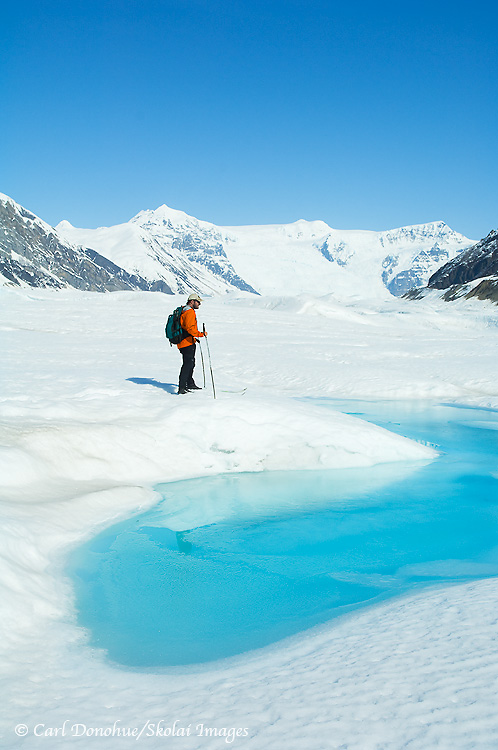
Backcountry skiing, exploring the Root Glacier, with Stairway Icefall in the background. Springtime brings melt, opening a small pool of water on the glacier’s surface. Cross country skiing, Wrangell-St. Elias National Park and Preserve, Alaska. Please click on the image above to view a larger version of this photo.
Hey Folks,
I think art involves exploration, the process of stepping into the unknown, and taking a journey of sorts. In this way, I think we might relate the idea of art to the idea of “icon photography” discussed earlier. Seeking out the new is a vital fragment of making art, in my opinion.
At some point, we delineate art from craft. Art, to me, involves a greater element of the unknown, while craft is more a process of refinement and control. One hones one’s craft, but I don’t think that’s necessarily the case with art. Art might simply involve turning a new direction with each step (though maybe it doesn’t have to do so). We don’t have to refine anything.
On a trek through the mountains, I enjoy the exploration, the wander itself. Though I guide hikes in places I’m obviously familiar with, I make an effort to reserve at least a trip or 2 each season as an exploratory hike. This summer, for example, we’re heading out on a Arrigetch Peaks backpacking trip in Gates of the Arctic National Park. A park I’ve visited once, my very first remote hike in Alaska (wow, what a great memory that is). Venturing into the unknown is an artful process; a game of chance. I don’t know what we’ll find on the trip, and that itself is motivation for the undertaking; to simply experience that gift of the hidden.
Jazz musicians understand this, every time they step to the mic to improvise a solo they do exactly this. That’s the beauty of jazz. That’s also the beauty of art. The other is artifact.
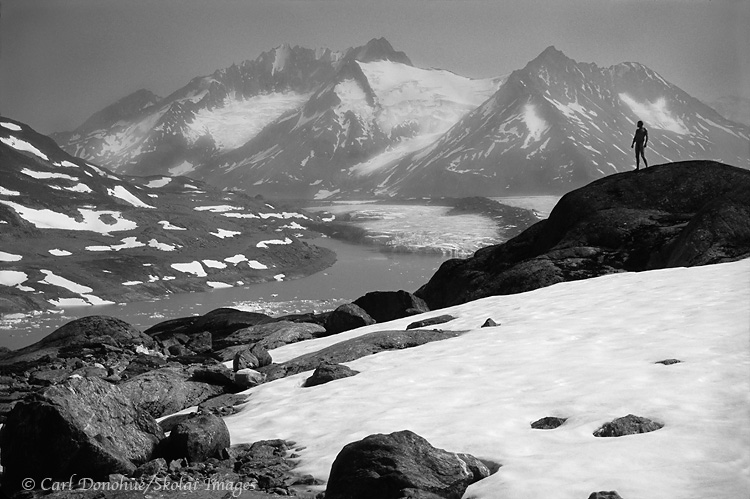
A backpacker stands, naked, in the Chugach Mountains, Wrangell-St. Elias National Park and Preserve, Alaska. Click the image to see a larger version.
Hey Folks,
“It can be a difficult journey to live a creative life, if you live within an environment which does not understand or value creativity. Seek-out and surround yourself with positive soulmates”.
I read this note on a Status Update on facebook a while back, posted by a great photographer from Australia, Steve Coleman. Steve posts consistently valuable stuff on his facebook page, and I try to read every one of his insights. It’s nice to see someone so giving of their talent. I’ve never met Steve, but looking over his website I can tell you I already know I like the guy; click on ‘Workshops‘. That page tells me all I need to know; what a wonderful perspective!
The strength of the quote is in the paradox that it holds; creative work comes from within, yet what rises up from within is a function of the external. The input we open ourselves to form the outputs our work brings. But it’s more than that; I think a collective energy exists that is very real, very tangible, and we tap into that if we surround ourselves with a vibrant, creative community. Our neighbors, our friends, our peers, our families; these are all critical sources of creative energy that we draw upon, whether it be consciously or unconsciously.
To create and bring to life an idea, your idea, is a terribly frightening process; it opens us to vulnerabilities few of us wish to expose. A ‘support group‘ is critical.
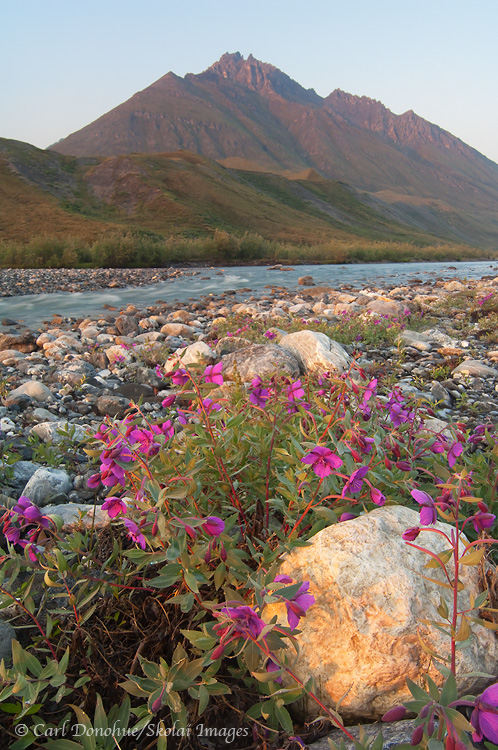
Dwarf fireweed (Epilobium latifolium) and the Upper Marsh Fork River of the Brooks mountain range, in the Arctic National Wildlife Refuge (ANWR), Alaska. Mid summer, this photo was taken about 2:00am. First light of the day. 🙂 Please click on the image above to view a larger version of the photo.
Hey Folks,
Recently I’ve read a few articles and posts abwout photography and and photographers, and particularly landscape photographers; the question of ‘shooting icons’ almost invariably comes up. For those readers here who aren’t quite sure what that is a reference to, it simply points to the regularity with which so many famous landscapes are photographed. Scenes such as Grand Teton from the Snake River Overlook, Yellowstone National Park’s Lower Falls are almost ubiquitous with landscape photography.
It’s an interesting discussion. Those kinds of locations are frequently photographed because not only are they spectacular scenes, but they’re also great to photograph; overlooks and viewpoints seemingly designed with the landscape photographer in mind. This is not true of all spectacular scenes, for a variety of reasons.
The primary reason a scene like this one, of Mount Edith Cavell and Cavell Lake in Canada’s Jasper National Park has been photographed so many more times than, say, the scene at left, is that Edith Cavell is road accessible. All the other discourse about happiness and contentment and art versus stock and following one’s creative muse and shooting your passion is simply talk; it all comes down to the pavement. If it’s off the road, it’s probably not an icon.
The question then concerns itself with the value of our pursuit; and that, like so many such questions, is entirely contextual. For some people, shooting photos that sell well is all that matters. For others, shooting photos that express some personal vision is more important.
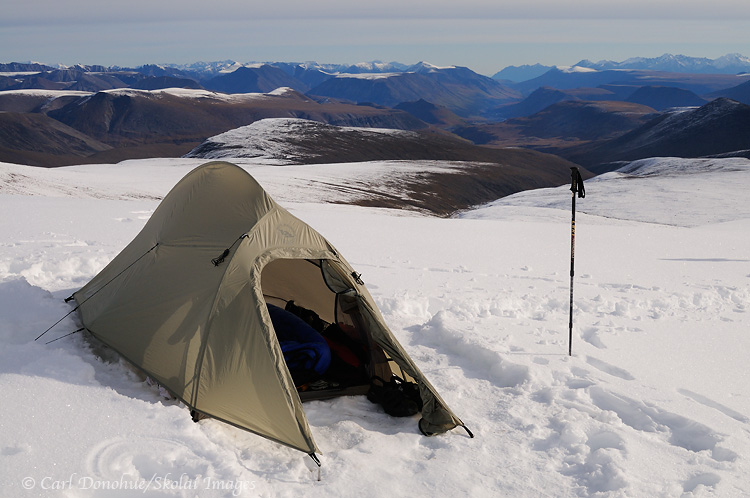
Big Agnes Seedhouse SL1 backpacking campsite on snow, near Mt Jarvis, alpine tundra, Wrangell-St. Elias National Park and Preserve, Alaska. Please click on the image to view a larger version of the photo.
Hey Folks
Just a quick snapshot. Here’s a photo from the campsite a day previous to the recent posting of my backcountry campsite. Camped at about 7 200′ ASL in September, in Alaska, snow can be expected.
There was a pretty good cover of fresh snow when we arrived at this spot, but we got another good dumping in the few days we were there, So, plenty of snow to go around! For the record, the Big Agnes Seedhouse SL1 handled the snowfall just fine.
Here’s a funky story to go with this campsite. Somehow I contracted Strep throat on this trip. I’m not sure where I got it, and who’s to blame for passing on this nasty little bug to me, but on day 3 of our trip, I didn’t feel so good. Continue reading →
Grizzly bear and fall color, standing in warm afternoon light on the edge of a salmon stream. Ursus arctos, brown bear, Katmai National Park and Preserve, Alaska. Please click the image to view a larger version of the photo.
Hey Folks,
As I mentioned in a post a few days back, I am pretty excited about some of the grizzly bear photos I took on this most recent trip to Katmai National Park. Over the years I’ve spent so many weeks there, shooting and re-shooting photos of grizzly bears, that it can be difficult to really bring home some new images. This photo is one I was super happy with.
I took, of course, countless images of bears eating salmon, chasing salmon, catching salmon, standing around, sitting down, sleeping, fighting, playing, etc. But what I really wanted to capture was some dramatic images in dynamic weather or dynamic lighting situations. We were fortunate to have an abundance of both, Continue reading →
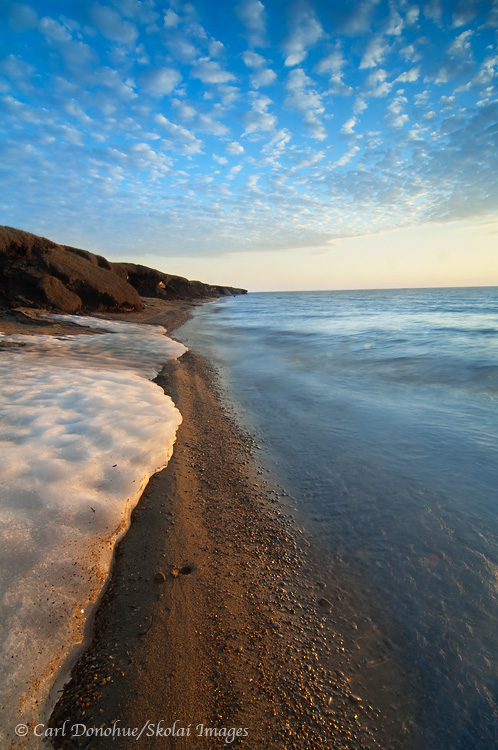
The Beaufort Sea along the coastal plain of the Arctic National Wildlife Refuge (ANWR). The Arctic Ocean sea ocean, after spring breakup, rests on the beach. Melting permafrost in the bluffs signals warming temperatures. Arctic Ocean, Coastal Plain, ANWR, Alaska. Click for a larger photo.
Hey Folks,
Another photo from our recent trip to the Arctic National Wildlife Refuge and the Beaufort Sea. I hiked from our final camp across the coastal plain (well, across part of the plain, not the whole thing) with Steve Weaver hoping to photograph some of the icebergs we’d seen the previous day along the shoreline. Unfortunately, strong southerly winds had blown almost all the ice out to sea, and we were largely thwarted. This patch of ice, however, had been resting on shore, stranded when the tide rolled out, and we made a few images.
Coastlines are such dynamic landscapes, and in the Arctic particularly so. They can change drastically in a day or less, and do so frequently.
This photo was taken around 1:15am .. maybe later. I think Steve and I arrived back at camp around 4:00am, and I went to bed at nearly 5:00am. up at 10:00am-ish to break camp, roll the raft, and wait for a bush plane. We arrived, finally, in Coldfoot, around 5:30pm,(the temp was 90deg F, a start contrast from the Arctic Ocean we’d just left) unpacked the gear from the plane, sorted it and loaded the van, ate dinner, and hit the road, rolling into the Yukon River area stop late at night. Then up early the next morning to drive from there to Anchorage. 36 hours later it was out the door to pick up folks for the next trip to Wrangell-St. Elias National Park and Preserve. Summertime can be like that in Alaska.
I’ve been out to the Beaufort Sea here a number of times, now every time I’ve been so fortunate as to have an absolutely glorious final evening. The wind wasn’t bad at all, the bugs had quieted down, and the expansive vastness of the place really moves me. It’s a fantastic experience, to see such a harsh and rugged environment also be so sensitively fragile; the quiet tundra, the shorebirds, a whisper of air and the glowing rays of the sun, low on the horizon. After the trek back to camp I simply couldn’t go to bed, but sat for nearly 45 minutes by my tent, just watching, listening and enjoying the grace of the Arctic coastal plain. It’s a phenomenal place.
The bluffs on the left of the frame, like Castles Made of Sand, slowly slip into the sea – eventually.
Playing a Native American Indian flute on the arctic coastal plain, Arctic National Wildlife Refuge (ANWR), Alaska. Please click on the image to view a larger version of the photo.
Hey Folks,
I’ve been wanting to write for the last week about the current Gulf Oil disaster, but haven’t really been quite sure what to say. There are simply so many tangents to this mess that I’ve not known where to start. The deaths of 11 people seem, unfortunately, to fade into the melée of concern about big oil, political ineptness, poisoned ecosystems, fathomless litigations, ad infinitum. The web we weave seems larger than the spread of oil.
It makes sense, to me, to start at home. The reality is that this catastrophe stares us right in the eyeball. The mirror reflects our own lives – I drive a car, I love my gore-tex and silnylon tents, my synthetic-fill jacket, my polycarbonate cameras. I eat fresh bananas and whole grain breads shipped here from afar. My computer was flown directly from Shanghai, China. The world I live in is a fossil fuel world. That world includes crude oil belching from the ocean floor into the Gulf of Mexico, and on to Gaia knows where.
So I bear responsibility in this mess; I want cheap gasoline, cheap oil. I complained about the soaring gasoline prices just 2 years ago. I failed to demand that the federal government not exempt BP from an environmental impact study. I failed to demand that Minerals Management Services mandate a remote-control shut-off switch on all drilling operations. I failed to demand that the oil industry follow the strictest, safest procedures possible. Continue reading →